
On AI in the Music Industry
I have been writing and talking about the use of AI in the music industry since I developed and taught the course “Music Tech Innovation: Launching New Ventures” at UCLA Herb Alpert School of Music in 2016 when I was an Innovation Fellow at the UCLA Center for Music Innovation.
At the time, there were dozens of startups in accelerators and incubators across the US and around the world building AI tools and ML projects to address various aspects of music creation and data analytics.
I had been running my consultancy agency, Rights Department, where I helped founders navigate the intellectual property implications of their startups as well as develop go-to-market strategies. I was also a mentor to startups through a few accelerator programs and an advisor to a roster of music tech and digital media startups through my ENT Ventures, LLC advisory brand. Later, I would feature some of these companies, including those involved in cryptocurrency, augmented reality, NFTs, and blockchain in my lecture that I gave at universities and the Music Biz Conference titled “Music 2020: The Next Era of Innovation in the Music Industry” (https://daeboganmusic.com/2018/10/12/music-2020-the-next-era-of-innovation-in-the-music-industry/)
In early 2019, I wrote a note titled “Are Founders Of AI Music Services Being Disingenuous When They Tell Human Music Creators Not To Worry Or Are They Just Clueless?” where I asked:
“Recently, we’ve seen AVIA become the first AI to be recognized as a composer represented by the French performing rights society SACEM (I have bigger concern over the implication of recognizing AI as a composer and what that could mean to the legal definition of an author under copyright law) and Endel recently became the first AI to land a major label record deal with Warner Music Group.
If AVIA is a composer and Endel is a recording artist, and they can produce massive volumes of content (WMG is releasing 20 albums by Endel this year alone), what does this mean for the quality and pace of human-created music?” (https://daeboganmusic.com/2019/03/22/are-founders-of-ai-music-services-being-disingenuous-when-they-tell-human-music-creators-not-to-worry-or-are-they-just-clueless/)
This past week, ASCAP, BMI, and SOCAN — the largest public performance organizations in North America that represent millions of music creators — put out a joint statement announcing the acceptance of registrations of partially AI-generated songs and thus clarifying that partially AI-generated songs are eligible to receive public performance royalty payments. (https://www.musicbusinessworldwide.com/ascap-bmi-and-socan-will-now-accept-registrations-of-partially-ai-generated-musical-works/)
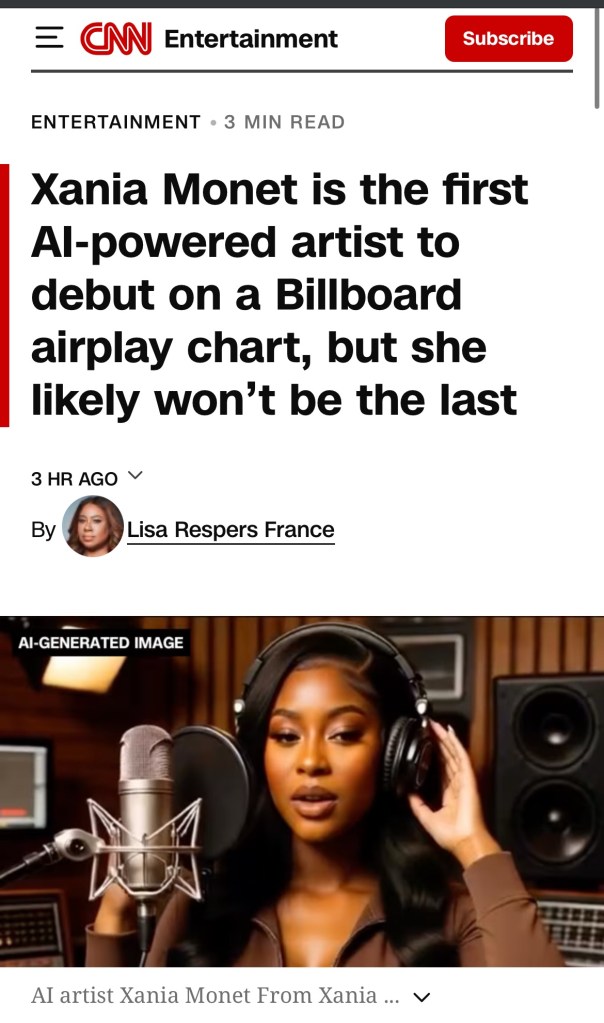
So, the news that AI singer Xania Monet being charted for radio airplay on Billboard means that the songwriter will be able to receive public performance royalties for those plays, in addition to the royalties for the streams on digital music services. (https://www.cnn.com/2025/11/01/entertainment/xania-monet-billboard-ai)
So, that brings me back to the question I asked in 2018: “Are Founders Of AI Music Services Being Disingenuous When They Tell Human Music Creators Not To Worry Or Are They Just Clueless?”
In September this year, I spoke on a panel about AI in the music industry at the Bogotá Music Market in Bogotá, Colombia. I argued that music creators and consumers will have to reconcile our tolerance for creativity and authenticity in the AI-music era and promoted the responsible use of AI as a tool, an innovation in the evolution of the arts no different, fundamentally, from innovations of decades past (enter the printing press, the electronic guitar and synthesizers). (https://www.instagram.com/p/DOgkjVUDT1A)
Some artists will leverage AI as a tool (there are many use cases other than generative AI vocals). Some will resist and possibly fall short. But what is clear to me is that the evolution, which begun as scrappy projects by founders and small teams in the 2010s is now being accelerated by multi-billion dollar investments, regulatory overhauls, and innovative creators who enjoy and do not fear new tools.
And what about consumers? How do consumers feel?
Free DIY eBook
CONNECT WITH ME


 Dae Bogan Music