
5 Ways The Music Modernization Act Could Be Fairer To ALL Music Creators

Today, the Music Modernization Act has passed the U.S. House of Representatives with a unanimous 415 – 0 vote (16 reps abstained from voting at all).
The mega bill — which consists of a bundle of Titles that were previously independently proposed bills — will change the way in which musical works are licensed by digital service providers and provide a safe harbor for infringement under a blanket licensing mechanism (Title One – Musical Works Modernization Act); it will bring recordings made before 1972 under federal copyright protection (Title Two – Compensating Legacy Artists for their Songs, Service, and Important Contributions to Society Act or CLASSICS Act); and it will codify an allocation of digital radio royalties to music producers and sound engineers (Title Three – Allocation for Music Producers Act or AMP Act).
On its surface the MMA sounds amazing, when summarized this way.
Accordingly, the passing of the MMA in the House was widely praised by executives from the most recognizable U.S. music rights organizations and trade associations (e.g. NMPA, RIAA, DiMA).
However, there remains many uncertainties in the language of the bill presenting an opportunity for the Senate to course correct before the bill becomes a law that would take over 20 years to improve, again (the Digital Millennium Copyright Act was the last piece of legislation impacting the music business — it was enacted in 1998).
So, what could the Senate do to make the bill more fair to the tens of thousands of music creators who are not represented (or underrepresented) by the industry sponsors of this bill? Well, there’s at least five issues that can be addressed immediately:
- Ban the practice of distributing by market share unclaimed royalties that rightfully belong to DIY musicians and songwriters.
- Mandate that record companies provide complete and accurate (at the time of release) publishing information for each track within the metadata delivered to distributors/aggregators, and that the latter provides that information to DSPs.
- Do not expunge all past copyright infringement claims, only future claims upon the date of the enactment of the law.
- Maintain a representative MLC board of 50% publishers and 50% songwriters (with at least 1 unsigned songwriter on the board (e.g. Chance the Rapper)) as opposed to the BS 10 publishers, 4 songwriters (who’ll likely come from the major publishers anyway) that has been written in the bill.
- Respect the Berne Convention by not disregarding the musical works of non-US songwriters who have not (and will not) register each of their songs with the USCO or MLC.
How else could the MMA be improved? Or do you feel that it is fair enough? Let’s discuss in the comments.
I Was Interviewed By The Congressional Budget Office Regarding The Music Modernization Act, And Now I’m Even More Concerned For DIY Musicians
I just spent the last hour giving a copyright law and music publishing crash course to a Principal Analyst at the Congressional Budget Office who’s tasked with determining the economic impact of the revised Music Modernization Act (which, by the way, now includes the Musical Works Modernization Act (which is an update to the originally proposed MMA, affecting songwriters and publishers), AMP Act (affecting producers and engineers) and CLASSICS Act (affecting recording artists of Pre-1972 records)) on states, DSPs and music creators.
He emailed me yesterday and asked to speak with me about the magnitude of the unclaimed royalties market, although we ended up discussing much more than that. Apparently he had discovered a presentation that I gave at the Music Industry Research Association’s MIRA Conference last year titled “The State of Unclaimed Royalties and Music Licenses in the United States.”

Email from a Principal Analyst at the Congressional Budget Office
At the top of the one hour call he began by stating that he’s had to learn copyright and music publishing in 2 days (2 days!!!). The guy who’s going to contribute to a recommendation to Congress that will impact whether or not 3 different bills will be enacted and change our copyright law has spent only 2 days learning about the complex web of regulations and customs that govern an entire industry and its millions of constituents. I guess this is how legislation is vetted; economically.
The good news is he had a lot of great questions and had did a significant amount of research prior to our call. To be fair, I meet plenty of music industry professionals who have (or at least demonstrate) less knowledge of what’s going on in the world of music rights administration and music publishing than this gentleman; and they’ve spent years in the industry! It is refreshing to know that the government does inquiry with non-lobbyist from time to time when considering the impact of proposed legislation.
At any rate, he was open to hearing my advocacy on behalf of music creators (specifically songwriters, music producers, and recording artists of Pre-1972 records) as well as my substantiated opposition to some features of the revised MMA (generally those features that would disproportionately benefit music licensees (primarily, DSPs) and major publishers while leaving DIY music creators to fend for themselves).
[This paragraph was omitted on 4/20/2018 as a result of a clarification that I received for Title 3 of the MMA]
Another issue I have is with the ownership of the unclaimed mechanical royalties fund(s). The Musical Works Modernization Act (Title 1 of the MMA) would, for the first time, codify the existence of a mechanical royalties black box in the United States. The current US Copyright Act does not give copyright owners a right to earn or collect mechanical royalties if their musical works are not registered with the US Copyright Office.
After the NOI has been filed, it is then the copyright owner’s responsibility to become aware of and locate the NOI, and then take action in order to receive mechanical royalties. The law states, “To be entitled to receive royalties under a compulsory license, the copyright owner must be identified in the registration or other public records of the Copyright Office.” (17 USC 115(c)(1))The law also makes it clear that the licensee is not required to pay mechanical royalties until after the copyright owner has been identified. “The owner is entitled to royalties for phonorecords made and distributed after being so identified…” (17 USC 115(c)(1)) What’s worse, the law does not require the licensee to pay retroactively for mechanical royalties earned before the copyright owner is identified. “…but is not entitled to recover for any phonorecords previously made and distributed.” (17 USC 115(c)(1))
However, intermediaries (e.g. Harry Fox Agency, Music Reports, Loudr) that process NOIs (Notice of Intent to Obtain a Compulsory Mechanical License) on behalf of their DSP clients do encourage their clients to set aside unattributed mechanical royalties into an escrow account (the so-called “black box”). The royalties sit there until the copyright owner raises his/her/their hand to collect the earnings or until the entity decides to disburse or absorb the uncollected funds.
Generally, this is a “good faith” policy.
Now, since the MMA will codify the black box as a matter of law, this private sector matter will become a government matter. The question, then, is will federal government or state governments have the right to maintain the unclaimed royalties black box?
Currently, unclaimed property laws enable states to receive and hold unclaimed property (such as money) when the property owner can not be reached. For example, California’s Unclaimed Property Law requires corporations, businesses, associations, financial institutions, and insurance companies (referred to as “Holders”) to annually report and deliver property to the California State Controller’s Office after there has been no activity on the account or contact with the owner for a period of time specified in the law – generally (3) three years or more. I’ve had a few refunds from services that I used and cancelled when I moved from one place to another. I did not provide the service with a forwarding address, so my refund became unclaimed property and ended up with the California State Controller. By searching the CSC’s database, I was able to find and then claim the property (pictured below).


If your property goes unclaimed too long (each state has their own statute of limitations), the state has the right to liquidate the property (e.g. sale an unclaimed vehicle) and absorb proceeds as miscellaneous revenue to the state’s budget [lawyers, correct me in the comments if I’m wrong].
Because states unintentionally (benefit of the doubt) benefits from unclaimed property, I could see states with significant music industries (e.g. California (Los Angeles), New York (Greater New York City), Tennessee (Nashville), Georgia (Atlanta)) suing the federal government or the Mechanical Licensing Collective (the entity that would be granted under the MMA to administer a new blanket licensing system along with a centralized database of musical and sound recording copyrights to match works with usage reports submitted by digital services) over the right to collect unclaimed royalties, especially if the black box is hundreds of millions of dollars (which I believe it is).
There are many other issues that I have with the MMA such as the proposed formation, structure (especially the imbalance of representation on its board where there would be 10 publishers and only 4 songwriters (why not 7/7?)), and governance of the MLC and similar unclaimed royalties issues related to the CLASSICS Act; among other issues. I’d be happy to discuss, but this post is already yuge!
In a word, I am all here for improving royalty rates, ensuring the fair treatment of music copyrights and moving towards a more equitable representation of music creators. However, the MMA is not quite there yet and passing it as-is, with all of its ambiguity, would be a shame. I don’t know if the music industry will have another shot to make this kind of update to the Copyright Act in the next 20 plus years (the Digital Millennium Copyright Act of 1998 was the last significant update).
We should probably get it right — now.
Spotify, Google, Amazon, Microsoft And Others Filed Over 12 Million New Address Unknown Section 115 NOIs In The Second Half of 2017…And We Have Them All.

Music Business Association To Host Webinar On Black Box Royalties Presented By Dae Bogan

Music Business Association will host Dae Bogan’s webinar on black box royalties on Thursday, October 26th at 11am PDT / 2pm EST. Open to all.
Description: The global music licensing ecosystem is ripe with inefficiencies, complexities and legal mumbo-jumbo that affects the livelihood of music creators and copyright owners when royalties become trapped. The idea of not being paid when your music earns royalties is frustrating. Some would even call it highway robbery! But there are some practical solutions that every interested party in music royalties can put to use immediately to ensure that your music industry administration operations get you paid. This webinar will demystify so-called “Black Box” royalties and demonstrate how rights-holders can leverage technology to combat this global issue.
Register at https://register.gotowebinar.com/register/5742451649783265539
Dae Bogan Joins Los Angeles County Bar Association’s Panel Event On Unpaid Royalties
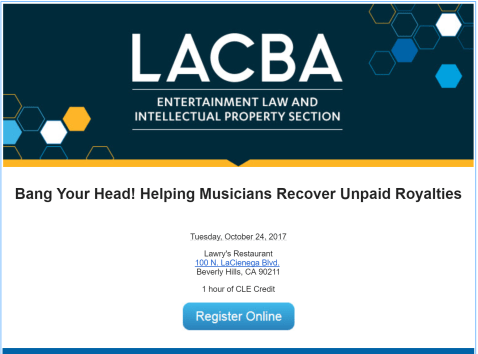
PROGRAM DESCRIPTION
In an era of ever-changing revenue streams, how can musicians make sure they receive the royalties they are entitled to? One of the most commonly litigated issues in lawsuits filed on behalf of musicians concerns artists not being compensated for their work. Join us for a lively discussion featuring advice for musicians (and those representing them) from top legal minds Bill Colitre and Eric Bjorgum, and cautionary tales from songwriter/recording artist Tommy Victor, of the rock bands Prong and Danzig. Speakers:
A. Eric Bjorgum, Karish & Bjorgum, PC
William B. Colitre, Esq., Music Reports
Tommy Victor, Prong and Danzig
Dae Bogan, TuneRegistry and Royalty ClaimModerator:
Meghan Moroney, Meghan M. Moroney, Esq.Location:
Lawry’s Restaurant
100 N. LaCienega Blvd
Los Angeles, CA 90211Time:
Registration: 11:45 a.m. – 12:30 p.m.
Program: 12:30 – 1:30 p.m.CLE Credit:
1 Hour of General CLE CreditParking:
Parking is complimentary.Prices:
CLE+ Cardholders with Meal Free ELIP Section Members $55.00 LACBA Members $70.00 All Others $105.00 Law Students $35.00 *CLE+ Members can purchase the meal below for an additional $45.00.
REGISTRATION CODE – 102417ELI
The (Not Quite) Definitive Guide To The Exploitation Of Music Royalties

There’s been a lot of talk lately about music royalties; those pesky micro-pennies that add up to something worth fighting over after millions and billions of streams.
With the music industry seeing revenue growth powered by streaming, coupled with shrinking per-stream royalty rates caused by a combination of horrible statutory royalties, unsustainable subscription models, and more content than ever before splitting up the pie, music royalties have never been more scrutinized in modern music history, IMO.
In the United States alone, there are several legislative measures being proposed that directly address music royalties — Fair Play Fair Pay Act (artist royalties), Songwriter Equity Act (songwriter royalties), AMP Act (music producer royalties), CLASSICS Act (legacy artist royalties) — with powerful proponents (music rights organizations, music creators’ rights advocacy groups, and music industry trade associations) and even more power opponents (digital media and Internet company coalitions, broadcaster lobbying organizations, and in some cases, DSPs themselves) on both sides.
Nevertheless, this is an interesting time for music royalties.
Technologists and music licensing experts have come together to create a variety of offerings to music creators and rightsholders to help them exploit their music royalties. Whether you want to find unpaid royalties, get a loan against future royalties, sell your royalties or allow music fans to invest in your music royalties, there’s a platform for that.
Here’s a (not quite) definitive guide of music royalties tools and services (A-Z):
FIND & CLAIM UNPAID MUSIC ROYALTIES
- Paperchain (Revenue Share) – Enriching the music supply chain. Paperchain solves the problem of unpaid royalties in the music industry. Paperchain empowers music copyright owners with products and services to solve the problem of unpaid royalties.
- Royalty Claim (Free/Subscription) – Search, Find, and Claim Millions of Unclaimed Royalties and Music Licenses. The Royalty Claim Platform is powered by data made available through the ongoing research of the Royalty Claim Initiative, its researchers and data scientists, and valued music industry partners.
GET ADVANCES & LOANS AGAINST FUTURE MUSIC ROYALTIES
- Sound Royalties (Flexible Repayments Terms) – Next-generation royalty financing. Retain your music rights. Keep your royalties.
- Lyric Financial (Flexible Repayment Terms) – Advances, Loans, and Financial Solutions for the Music Industry
- Royalty Advance Funding (Interest Loan) – Royalty Advance Funding has funded hundreds of established music royalty earners including songwriters, composers, publishers, producers, and their successors.
SELL, BUY OR INVEST IN MUSIC ROYALTIES
- Royalty Exchange (Ownership & Dividends) – Your online marketplace for buying and selling royalties.
- SongVest (Dividends) – The Stock Market of Music. For the first time ever, both investors and fans can own and get paid by the music that they love.
- Perdiem (Dividends) – Investment platform for creatives. Start your own record label and build your brand in music.
Featured Photo by Fabian Blank on Unsplash
Microsoft Is Shutting Down Groove Music – Here’s Everything You Need To Know About Claiming Mechanical Royalties Before It’s Too Late!

Microsoft is shutting down Groove Music. Here’s everything you need to know about claiming mechanical royalties before it’s too late!
Have You Searched The Royalty Claim Database? What Are You Waiting For?
Royalty Claim Announces Unclaimed Neighboring Rights Database – Launches With Nearly 1 Million Records
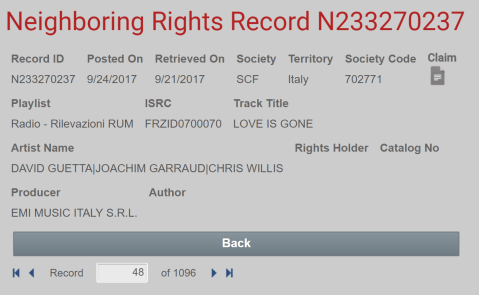
Neighboring rights is becoming a hot ticket music rights issue as download decline (and thus, mechanical royalties) and Internet streaming soars. However, the fact that US music creators and rights owners get the short end of the stick in terms of the global view of neighboring rights protections and financial reward, it is more important than ever of US stakeholders to see where and how their music is performing around the world. Neighboring Rights Agencies have boomed over the last several years to address this issue, but they’re still highly selective and most work with a few dozen performers, if any at all.

If You’ve Never Received Mechanical Royalties From Google Play Music, This Might Be Why
Is Google Willfully Refusing To Use Its Own Assets To Identify Copyright Owners?
In recent weeks Google and YouTube has come under fire by high-profile music industry professionals in regards to Lyor Cohen’s statements on the royalties it pays to artists. This piece is NOT about that.
At Royalty Claim, we periodically randomly select and investigate records that our researchers and data scientists ingest. Random investigations — sometimes against pre-determined hypotheses and sometimes just to follow down the rabbit hole — has helped us uncover nuances in the music licensing ecosystem that manifest into trends that suggest major systemic issues.
Earlier this month we reported that Google has filed nearly 7 Million Section 115 NOIs on the US Copyright Office for musical works in which it claims to be unable to identify the copyright owner. Then, Lyor Cohen boasted about YouTube’s royalty payouts and its growing ability to match music to videos (Google it, it’s everywhere). And then we remembered that this is only possible due to YouTube Content ID, which is arguably the largest database of copyright information with music codes, audio samples, etc.
So, if the largest submitter of “copyright owner unknown” NOIs is also the owner of the largest private database of copyright owner information, it makes no sense that Google cannot seem to identify copyright owners to pay mechanical royalties for the use of the copyright owner’s songs on Google Play Music.
So, we investigated this.
Free DIY eBook
CONNECT WITH ME


