
ETLA, The Research Institute Of The Finnish Economy, Publishes Report On State Of Digital Music Infrastructure – Calls For Transparency And Addresses “Black Box” Issues
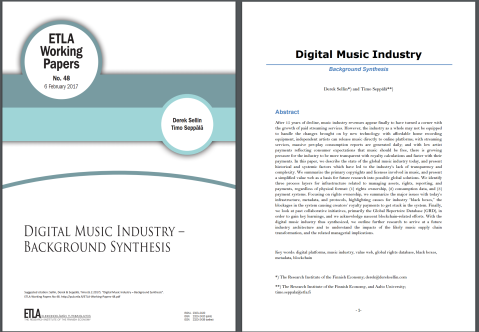
I had the honor of being interviewed by researcher and author, Derek Sellin, for his industry report “Digital Music Industry – Background Synthesis” for ETLA Working Papers No. 48, published by Elinkeinoelaman Tutkimuslaitos – The Research Institute of the Finnish Economy.
Black boxes materialize for many reasons, including but not limited to: the inability to identify rights holders despite payments made for the use of their compositions; the lengthy time required for filing domestic and ultimately international copyrights, often begun only when a recording is actually released; multiple claims for the same rights exceeding 100% of ownership, resulting in indefinite disputes; international collaborations with less than all creators asserting their rights; international legal inconsistencies regarding what type of performances result in payments (most visible in the fact that radio play does not generate royalties for recording artists in the United States); and the slow and often manual processes to report usage and clear payments under international reciprocal agreements. – Dae Bogan
You can download the report at https://www.etla.fi/en/publications/digital-music-industry-background-synthesis/.
About ETLA
The Research Institute of the Finnish Economy (Etla) is engaged in applied economic research with emphasis on topics that are important from the Finnish point of view. The main focus is on issues that relate to productivity and drivers of its growth, to the functioning of the labour market, as well as to challenges in maintaining a balanced macro economy including sound public finances. Etla monitors economic development, compiles forecasts as well as assesses economic policy and comments on it.
Etla is a private non-profit organisation. Its operations are backed by the supporting association, the members of which comprise the Confederation of Finnish Industries and the Confederation of Finnish Industry and Employers (TT) Fund. The funding from the background organisations covers more than a third of the institute’s budget and forms a solid base for its operations. Read more.
The Elephant In The Room: Unclaimed / Undistributed Royalties
In the United States, there are several “unclaimed / undistributed royalties” funds held by music rights organizations. These funds collectively consist of tens of millions of dollars in undistributed earnings generated by the use of music within the greater music industry, from legislative appropriations imposed on manufacturers of audio home recording media, and from agreements with foreign entities.
Some of the organizations (SoundExchange, AFM & SAG-AFTRA Intellectual Property Rights Distribution Fund, Film Musicians Secondary Markets Fund, Live Television Videotape Supplemental Market Fund, and although this is not royalties per say, the US Copyright Office has a Section 115 NOIs Filing database that can be used to track down missing mechanical royalties) have created public databases so that music creators can search to see if they have royalties sitting in these funds. However, the biggest funds do not have public databases and often music creators can not be reached by any of these funds to be notified that they have unclaimed royalties.
I am working on a side project called RoyaltyClaim.com to address this issue of unclaimed / undistributed royalties. The goal is to get each of these funds to join the RoyaltyClaim.com Disclosure Program and to encourage them to submit very basic information to us on a periodic basis regarding the income participants who are due royalties. We will then aggregate these disclosures and maintain one searchable public database accessible for free by music creators and income participants.
By aggregating these lists of unclaimed / undistributed royalties information, we can aid income participants — including songwriters, recording artists, publishers, labels, musicians, background vocalists, composers, and beneficiaries (in the event of musician parents or spousals who passed away, but their music still generates royalties) — in locating and claiming their monies.
If you are a music creator, you should signup at RoyaltyClaim.com to be notified of our launch. We are currently in conversations with the various funds to get them to cooperate and help creators and their families.
Major Labels Sue Music Tech Startup Aurous In First Week Of Launch

Here we go again. Music Business Worldwide reports that “The RIAA — on behalf of UMG, Sony Music Entertainment, Warner Bros. Records, Atlantic and Capitol Records — has today filed a lawsuit against Aurous and its founder Andrew Sampson for what it calls ‘willful and egregious copyright infringement’.”
The music app, being called the “the new Grooveshark” (Grooveshark shut down earlier this year after similar lawsuits was filed against the company), just launched in public Alpha this week.
Aurous’ founder, Andrew Sampson, maintains that the website is a search engine that enables Internet users to search BitTorrent networks to find and stream content. However, the RIAA argues that the website directly targets recorded music from overseas pirate sites, effectively enabling consumers to infringe on the copyrights of record labels.
Whether Sampson intended on his platform to illegally access and stream recorded music or if he truly believed he built a legitimate consumer app detached from piracy, like many other uninformed tech developers out there, he has been caught in what could be a very expensive and crushing legal battle informed by copyright law.
I spend a great deal of time consulting with entrepreneurs who have cool ideas to develop new music apps, services, and platforms. However, the challenge that many of them face is having a limited understanding of the music publishing and recording landscape, from the perspective of a music tech startup. With the help of a music industry professional, founders gain insight on where products and services may infringe on the intellectual property rights of others. I’ve helped numerous startup entrepreneurs create products, formulate business models, and deliver value, all while respecting and complying with the intellectual property rights of third-party rights owners.
Read more about this story at Music Business Worldwide.

On Katy Perry’s ‘Prism’ Lackluster Sales And The Luxury Commodity That Is The Album

“The album is dying in front of our eyes,” says music analyst and critic Bob Lefsetz. He asks, “what kind of screwed up world do we live in where Katy Perry’s new album Prism sells only 287,000 copies in its debut?” and answers, “One in which everybody’s interested in the single, and no one’s got time to sit and hear your hour-plus statement.” Read More…
Digital Music: Can Streaming Save Music Sales?

In Sweden, South Korea, Norway, and Finland, more music is streamed than downloaded. In fact, 91% of music income in Sweden comes from streaming (that’s because Spotify is a Swedish company that was founded in Sweden). With the launch of iTunes Radio and the anticipated launch of a YouTube streaming service, we wonder, “can streaming save music sales?” See what this piece by Maddy Savage of BBC News has to say about that.
Demystifying The Music Industry: What’s The Difference Between ASCAP/BMI/SESAC and SoundExchange?

I received an email this morning from a reader who had read my piece, “Demystifying The Music Industry: What’s This About Public Performance Rights?.” He asked, “If SoundExchange was designated by the Library of Congress as the sole PRO to administer public performance licenses and also collect public performances fees for Sound Recording Company Owners, then why do artists still utilize the services provided by the other 3 US PROs (ASCAP / BMI / SESAC) – is [SoundExchange] not sufficient by itself?”
A lot of indie artists are confused about the difference between ASCAP, BMI, SESAC and SoundExchange. I’ll attempt to break down the most important differences between these groups and elaborate towards the end about other considerations and other royalty collection entities. Feel free to comment with any questions (or corrections). Read More…
NMPA Sues Fullscreen: Easy Fix
The National Music Publishers Association has sued Fullscreen, Inc. for the monetization of YouTube channels containing thousands of videos with thousands of copyrighted music covered or synched. The way I see it, Fullscreen has 1 of 2 options to resolve this (which I believe will be handled out of court via a nice settlement):
- Enter into an agreement with NMPA to make sure royalties are flowing to publishers through Harry Fox Agency (the same thing YouTube did last year upon suit from NMPA)
- Enter into direct synch and mechanical license deals with publishers and record companies, like it has already done with Universal Music Publishing earlier this year.
The consequence of both fixes will be a reduction in ad revenue it generates from the over 15,000 YouTube channels with which Fullscreen has monetization agreements.
Read the piece in LA Times.
IFPI Digital Music Report 2o13: Global Recorded Music Revenues Climb For The First Time Since 2013

One of the statistics that stood out to me in this piece was that “performance rights income increased in value by an estimated 9.2% in 2012 and now accounts for around 6% of overall industry revenues, up from 3% in 2007.” This increase is directly related to the growth of digital streaming platforms both into new markets (the piece states that streaming platforms are in 100 countries compared to 23 countries the year before) as well as the increase in users (paid and unpaid).
Pandora, Rdio, Mog, Spotify, iTunes Radio, etc. all pay a micro-penny statutory rate to SoundExchange and a negotiated royalty rate (either based on percentage of revenue or usage-based) to ASCAP/BMI/SESAC for digital public performance. They pay similarily to foreign PROs as well. Read More…
Free DIY eBook
CONNECT WITH ME


 Dae Bogan Music