
I’m Working On A Side Project Addressing ‘Black Box’ Royalties

As of this writing, there are currently 116,133 verifiable* payments owed to music creators and rights-holders that are sitting in unclaimed/undistributed royalties escrow accounts (referred to as “Black Box” funds**) in the United States.
The actual number of individual payments owed is likely closer to or exceeds 1 Million, however the actual number is unknown because the administrator(s) of some of the biggest Black Box funds have not made public their list of payees to whom they owe royalties.
Unfortunately, due to the statute of limitations on these funds many of these payments expire. Every month payees unknowingly forfeit their rights to these payments and the interest in the royalties revert back to the administrator. This happens because the payee does not contact the administrator of the fund to claim their royalties. Granted, most payees are unaware that these payments are waiting for them because the administrator is unable to reach the payee for various reasons.
It has been estimated that the global “Black Box” royalties could be in the billions of dollars owed to music creators and rights-holders.
Imagine working somewhere and then you do not receive a paycheck because the HR department does not have your new address. Not a perfect analogy, but not receiving monies that you’ve earned as a result of your hard work seems unfair.
THIS IS A HUGE PROBLEM
So, I am happy to announce that I am working on a side project called Royalty Claim. Royalty Claim will attempt to work with as many of these administrators to aggregate their databases of millions of records of unclaimed/undistributed royalties and make that information available to the public. There are other services and insight that we will offer through Royalty Claim to help educate music creators and rights-holders on Black Box funds and how to limit/prevent their earnings from falling victim to the broken global music licensing ecosystem (such as taking control of your music catalog with TuneRegistry).
Want to get updates on the Royalty Claim project and be the first to know when we have something to reveal? Sign-up for our email list at www.RoyaltyClaim.com.
Also, follow @RoyaltyClaim on Twitter.
* These 116,133 payments are specifically verifiable because the list of payee names can be gathered from several databases.
** I am currently aware of over 30 funds and sub funds being managed in the United States. However, there are definitely many more that are “private”.
Spotify Moves Spotify Ad Studio Into Beta – Opens Up To Indie Artists & Managers

I’ve been hearing that Spotify is rolling out their BETA for their new Spotify Ad Studio, which they are comparing to Google Adwords and Facebook. Some artist managers I’ve spoken with are already in the beta and using it to run ad campaigns on Spotify.
One manager posted in a group that I’m in:
Everyone go to adstudio.spotify.com and check it out for yourselves. Apparently I already have access. The targeting doesn’t get as fine as Facebook, for example, and there’s a $250 minimum spend which gets about 10,000 airings at $0.025 each. There’s also a $5,000 maximum, I presume per campaign, and above that you’re getting into their Spotify For Brands territory which has a $25,000 campaign minimum spend.
They also specify that they don’t currently support driving traffic to songs or playlists. Their ad objectives are ‘Announce an event,’ ‘Raise brand awareness,’ ‘Drive people to my website,’ and ‘Other.’
If you’re interested in advertising content, they encourage you to email adstudio@spotify.com
Want to learn more, here’s a Google Doc with FAQs:
Open Music Initiative Announces Applications Open For 2017 OMI Summer Lab – Paid Internships
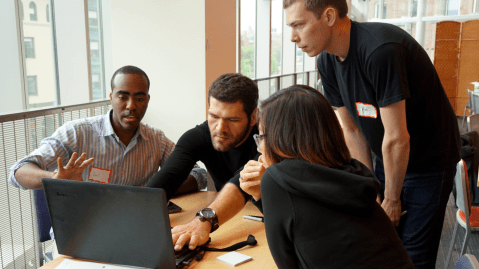
The Open Music Initiative (OMI) is seeking student software developers, musicians and visual artists for the 2017 OMI Summer Lab running June 5-July 28 in Boston, MA. These paid internships will explore the technical challenges of utilizing distributed ledgers and the Open Music Initiative API for:
- Cataloging, attributing and distributing live DJ mixes
- Commercializing mixtapes built from original material and back catalogs
- Compensating musicians for visual works using their songs as data
- Identifying individuals for their contribution to single tracks in new works


The eight week program will be facilitated by globally renowned innovation and design firm, IDEO, and Berklee College of Music’s Berklee ICE, and supported by sponsors which include Intel and the Inter-American Development Bank. At the end of the summer, teams will demo new art works utilizing blockchain registration, share evolved use cases and make recommendations for additional features to the Open Music Initiative API based upon their experience.
We are seeking currently enrolled college students that are collaborative, curious, flexible, detail oriented, and technically interested with the following skills:
- Blockchain Developer… you’ve made your own crypto currency, maybe your own virtual wallet or market, you have an opinion about how this stuff should work in the future
- User Experience Designer or Front End Developer… you can code data into art, you can code a website from scratch, you’ve moved beyond the hamburger menu
- Graphic Designer… you simplify complicated ideas artistically, you’re marketing-minded, you wish you had met Reid Miles
- Business Associate… you’re entrepreneurially minded, you can size a market, you know just enough about the law to be dangerous
- Musicians… you have a favorite genre but you can jam with anyone, you like to experiment with new technology, you’re cool under pressure, you know your way around a turntable
- Visual Artist… your medium is digital data, your art doesn’t know a resting state, you think in an XYZ axis
If you match one of these descriptions then please apply here then join us for a final selection hackathon on Saturday, April 22 at IDEO in Cambridge, MA. You must participate in the hackathon to be selected. Chosen students will receive $3,000 each for full participation in the Summer Lab.
Hypebot Features TuneRegistry In “The Pitch” Series
 Online music industry publication, Hypebot, has featured my startup TuneRegistry in its “The Pitch” series today. Hypebot gave us the opportunity to introduce our platform and tell its readers what makes TuneRegistry special; in 100 words or less. Check it out here.
Pandora Sports Clean New Look
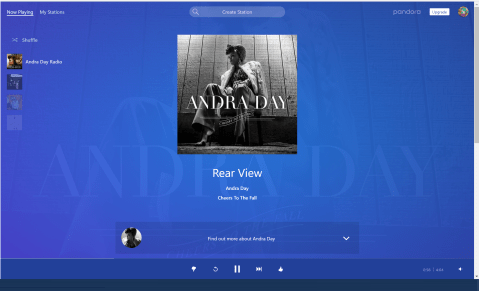
Pandora recently launched its sleeker new look. The centerpiece of the new user interface is the song artwork, which is now bigger and more prominent than ever. The artwork is also used as a color-washed background.
YouTube Announces Major Change To How It Will Handle Music Publishing
In an email sent to YouTube Music partners this week, YouTube announced that it will change the way it handles publishing.
Currently, YouTube allows rights holders to submit metadata and ownership information to a single global composition record. If there are multiple rights holders, their information is aggregated and rolled up into the “global” composition asset. Then various owners of sound recordings can create relationships (matches) between the “global” composition and their sound recordings. For example, 3 cover song recordings matched to a single “global” composition. However, YouTube is changing this process.
YouTube is doing away with a “global” composition and Composition Asset ID, which all rights holders on the composition would share, and now requiring that rights holders submit a “Composition Share” asset (think of it in relationship to a Split Sheet, the writer/publisher share) and provide their own unique Custom ID to YouTube, which associates back to the composition in the rights holder’s own database (e.g. a catalog number).
Notably, YouTube will no longer create composition to sound recording relationships on behalf of rights holders. It will become more important than ever for right holders to stay on top of their ownership splits and submissions. Furthermore, because YouTube will now rely on rights holders own Custom IDs, it will be important to implement and maintain a clean unique ID database. This could be the catalog number or the same unique ID the publishers use when registering works to PROs via CWR.
Read the full email below…
Dear YouTube Music Publishing Partner,
We are launching a new publishing data model to give you more transparency into and control over how your rights are associated with sound recording assets. In this new model, we will no longer have one “global” composition asset with metadata, ownership, and embedded relationships provided by various owners. Instead, each owner will have their own “Composition Share” assets. These “Composition Share” assets represent only the metadata and ownership information provided by a single owner. Your provided embedded relationships between “Composition Share” assets and sound recording assets will always be applied.
Our current planned launch date for this change is four weeks from now, on Monday, April 3.
This new model will require one major change on your side. Because we will be deprecating our historical Composition Assets and replacing them with a new asset type, today’s Composition Asset IDs will no longer be used. In most cases where you now use Composition Asset ID (including delivery and reporting), you should transition to using the Custom ID field. We recommend that the data you provide in this field always mirror the proprietary work codes that you use in your own database. In order for your Custom IDs to behave in a sensical and deterministic manner, it is critically important that your Custom IDs function as a primary key. That is, every Composition Share must have a Custom ID, and each Custom ID must refer to one and only one Composition Share. We strongly urge you to examine your Custom ID data now and confirm that your Custom IDs refer to only a single work each. If you suspect that this is not the case, please reach out to [omitted] for assistance. We would be happy to send you reports of how you are currently using Custom ID and where any gaps in your data may exist. If your Custom IDs do not function as a primary key in our new model, you may experience errors and ingestion failures.
Because this is a major change, this may require some workflow adjustments on your side. A few important things you should be aware of:
You will have greater control of embedded relationships between Sound Recordings and “Composition Shares.” Any embedded relationships delivered by any publishing partner will always be applied. If partners deliver conflicting data, these conflicts will immediately manifest in the YouTube Content Manager. By the same token, if you do not deliver us a Composition-Share-to-Sound-Recording relationship, we will not create one for you based on other partners’ data. You can continue to create these relationships through CSV ingestions, and we will be adding the ability to delete these relationships in bulk via CSV ingestions. We are also adding functionality to the Content Manager to allow you to edit these relationships directly in the user interface.
Conflicts now exist at the Sound Recording level, rather than at the Composition level. This means that you will see a larger number of conflicts in your conflicts queue. This increase in the number of assets in conflict does not necessarily represent a larger number of views in conflict; conflicts are merely being reported to you on a more granular level. Given that you will now have greater control over embedded relationships, conflicts caused by bad data should be much easier to resolve. When communicating about conflicts with other partners, you should now use Sound Recording Asset IDs instead of Composition Asset IDs.Asset revenue will be reported at the Sound Recording level, rather than at the Composition level. This means that your asset revenue reports will grow (they will have more lines). To see revenue reported to you at the Composition level, simply pivot the asset revenue report on Custom ID. If you need assistance processing these larger reports, please reach out to your technical account manager or send an email to [omitted].
We recognize that this is a major change that may result in substantial changes to your current workflows. We want to make this change as easy as possible for you and we are here to help and to listen to your feedback. If you have any questions not addressed in this email or on the Help Center, please contact your regular YouTube representatives. To submit feedback directly to our product specialists, please hit the “Help & Feedback” button in CMS. For operational or technical support, please reach out to [omitted]. We will also be hosting office hours and workshops at our New York City office, at our Los Angeles office, and in Nashville in the weeks after the new model is launched. If you are interested in attending, please reach out to your regular YouTube contacts.
Best,
Taylor Fife
YouTube Music Publishing Team
Global Recorded Music Revenues Grew By $1.1 Billion In 2016

Following on from the global market share numbers we released on Sunday, here are our findings regarding the growth of the overall market.
Throughout 2016 as the major label earnings were coming in there was a growing awareness that 2016 was going to be a landmark year for the recorded music business. It finally looked like streaming was going to push the industry into growth. Now with full year numbers in, the picture is even more positive than it first appeared. The recorded music market grew by 7% in 2016, adding $1.1 billion, reaching $16.1 billion, by far the largest growth the recorded music business has experienced since Napster and co pushed revenues into free fall.
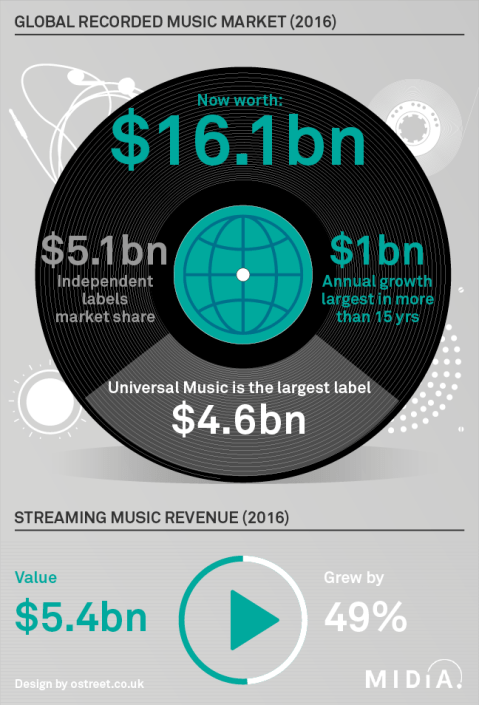
While it is too early to state that the corner has been turned, this is clearly a turning point of some form for the business. Underpinning the growth was streaming which grew by…
View original post 433 more words
Global Recorded Market Music Market Shares 2016
The Independent Music Sector Continues To Claim Significant Market Share Over Any One Of The Big 3 – Indie Publishers Capture Over 50% Of The Market
MIDiA and Music Business Worldwide have been tracking record label and publisher financial releases throughout 2016. In addition MIDIA has conducted market sizing work on the publishing sector and research for the Worldwide Independent Network’s (WIN) indie label market share project. Pulling all of these inputs together, along with reports from country trade bodies and PROs, MIDiA has created a recorded music market share model to provide a unique view of where the revenue flows in the global business. To ensure as representative a picture as possible all local currency data has been converted into US dollars at the currency conversion rates for the respective quarters. This removes the distortion effect that occurs when data historical data is retrospectively converted at today’s conversion rates.

The Recorded Music…
View original post 619 more words
The Elephant In The Room: Unclaimed / Undistributed Royalties
In the United States, there are several “unclaimed / undistributed royalties” funds held by music rights organizations. These funds collectively consist of tens of millions of dollars in undistributed earnings generated by the use of music within the greater music industry, from legislative appropriations imposed on manufacturers of audio home recording media, and from agreements with foreign entities.
Some of the organizations (SoundExchange, AFM & SAG-AFTRA Intellectual Property Rights Distribution Fund, Film Musicians Secondary Markets Fund, Live Television Videotape Supplemental Market Fund, and although this is not royalties per say, the US Copyright Office has a Section 115 NOIs Filing database that can be used to track down missing mechanical royalties) have created public databases so that music creators can search to see if they have royalties sitting in these funds. However, the biggest funds do not have public databases and often music creators can not be reached by any of these funds to be notified that they have unclaimed royalties.
I am working on a side project called RoyaltyClaim.com to address this issue of unclaimed / undistributed royalties. The goal is to get each of these funds to join the RoyaltyClaim.com Disclosure Program and to encourage them to submit very basic information to us on a periodic basis regarding the income participants who are due royalties. We will then aggregate these disclosures and maintain one searchable public database accessible for free by music creators and income participants.
By aggregating these lists of unclaimed / undistributed royalties information, we can aid income participants — including songwriters, recording artists, publishers, labels, musicians, background vocalists, composers, and beneficiaries (in the event of musician parents or spousals who passed away, but their music still generates royalties) — in locating and claiming their monies.
If you are a music creator, you should signup at RoyaltyClaim.com to be notified of our launch. We are currently in conversations with the various funds to get them to cooperate and help creators and their families.
I’m Meeting With Congressman Adam Schiff To Discuss The Rights of Music Creators #GIMD

Congressman Adam Schiff represents California’s 28th District
On Wednesday, as part of the “GRAMMYs in My District” initiative, I will join a select group of fellow The Recording Academy / The GRAMMYs members to meet with Congressman Adam Schiff to discuss the rights of music creators. And across the United States, other members will be meeting with their district’s Congress persons as well.
I hope to be able to address the issues that I care about, which affects music creators across the US. I want to urge my Congressman Schiff to support the Fair Play Fair Pay Act, which would create an income stream for artists when their music is played on AM/FM radio (much like the rest of the world) and support the AMP Act, which would allocate royalties to music producers and engineers when the music they’ve worked on is performed on SiriusXM, Music Choice, Pandora, and over 2,500 webcasters and digital music services.
In light of the recent firing of the Register of Copyrights, Maria Pallante, which happened oddly at a time when Google and Amazon is using the loopholes of the U.S. Copyright Act to avoid paying thousands of songwriters for the use of millions of songs across their music properties, I want to address if and how Congress plans to close these loopholes that enable wealthy multinational corporations to stiff the little guys. And I would like Congress to help us move towards a system of equitable representation of songwriters and fair market royalty rates for compulsory licenses.
We will be posting updates during and after these meetings across social media. Follow the hashtag #GIMD for posts. Learn more about The Recording Academy’s Advocacy & Public Policy at www.grammy.org/recording-academy/advocacy.
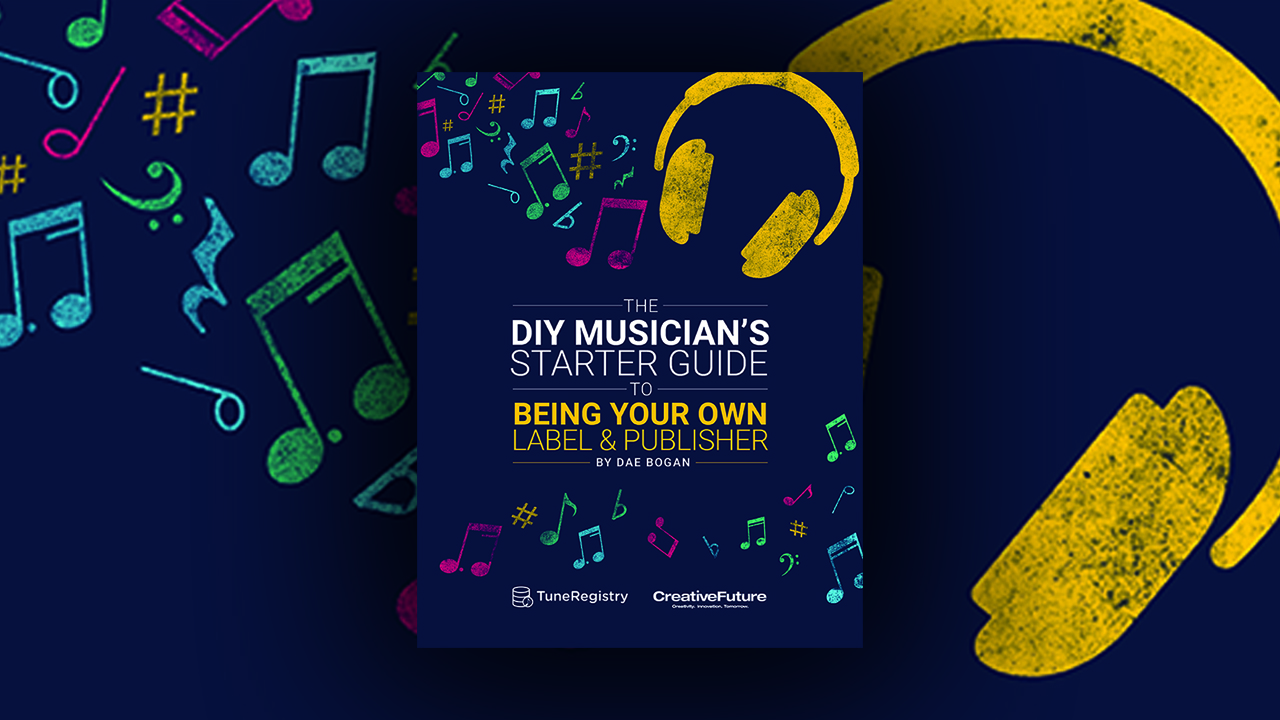
Free DIY eBook
CONNECT WITH ME


 Dae Bogan Music