
Who’s Leading The Streaming Pack?

At MIDiA Research we are currently in the final stages of producing the update to our annual landmark report: The State Of The Streaming Nation, a report which compiles every streaming market data point you could possibly need.
In advance of its release in June we want to give you a sneak peak into a couple of the key areas of focus: streaming app usage and major label streaming revenue.

Subscriber numbers only tell part of the streaming story. They are solid indicators of commercial success, but can often obscure how well a service is doing in terms of engaging its user base. That’s why we track the main music services’ active user bases every quarter. But rather than tracking Monthly Active Users (MAUs), we track Weekly Active Users (WAUs). The MAU metric is past its sell by date. In today’s always on, increasingly mobile digital landscape, doing something just…
View original post 448 more words
#NewToolTuesday: Music Streaming Royalties Calculators

If Only Artists and Managers Had Listened To Us : Spotify Per Stream Rates Keep Dropping
An alarming truth about Spotify royalties…

We hate to say we told ya so, but… Below is our post from September 2015. Two years ago we predicted the inevitable truth of the all you can eat Spotify subcription model. Like many of our predictionsand proposals (example; windowing titles) we’ve had to wait for the industry to catch up to us. Today, two years later, Digital Music News confirms our prediction.
Read the report from Digital Music News by clicking the headline link here.
Exclusive Report: Spotify Artist Payments Are Declining In 2017, Data Shows | Digital Music News
Our original post from 2015 is below…
Down, down, down it goes, where it stops nobody knows… The monthly average rate per play on Spotify is currently .00408 for master rights holders.
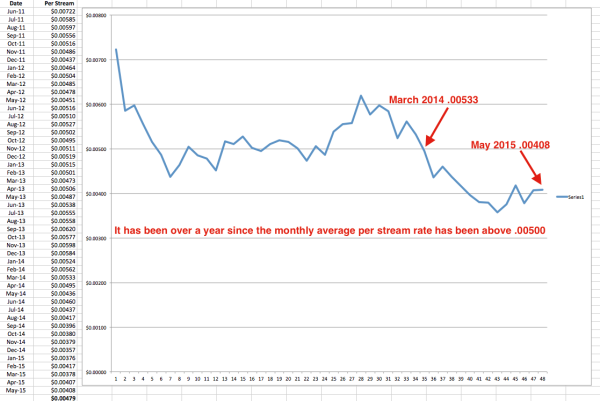
48 Months of Spotify Streaming Rates…
View original post 205 more words
Spotify Moves Spotify Ad Studio Into Beta – Opens Up To Indie Artists & Managers

I’ve been hearing that Spotify is rolling out their BETA for their new Spotify Ad Studio, which they are comparing to Google Adwords and Facebook. Some artist managers I’ve spoken with are already in the beta and using it to run ad campaigns on Spotify.
One manager posted in a group that I’m in:
Everyone go to adstudio.spotify.com and check it out for yourselves. Apparently I already have access. The targeting doesn’t get as fine as Facebook, for example, and there’s a $250 minimum spend which gets about 10,000 airings at $0.025 each. There’s also a $5,000 maximum, I presume per campaign, and above that you’re getting into their Spotify For Brands territory which has a $25,000 campaign minimum spend.
They also specify that they don’t currently support driving traffic to songs or playlists. Their ad objectives are ‘Announce an event,’ ‘Raise brand awareness,’ ‘Drive people to my website,’ and ‘Other.’
If you’re interested in advertising content, they encourage you to email adstudio@spotify.com
Want to learn more, here’s a Google Doc with FAQs:
Career Transition Tips: Moving From The Financial Industry To The Music Industry

Generally speaking, with the industry being the Big Data industry that it has become, I feel that many of you how have experience with financial data modeling, forecasting, and other “financial/number people skills” could be a viable asset to numerous music companies.
Here are a few companies who specifically exist at the intersection of music and money, which could be a good transitional outlet for the right candidates:
Good luck!
What Every Small Artist Management Firm Must Do Immediately
Artist Management Firms: If you do not have someone on your team whose sole responsibility is to utilize online music sync agencies, pitch ad agencies, and cozy up with music supervisers, you’re missing out, bigly.
When I owned/operated Renaissance Artist Management (aka RAM Artist), I established an in-house position for the sole purpose of securing music sync opportunities. This was during the early days of micro-sync and the boom of online sync agencies.
We leveraged online agencies (at the time that included Rumblefish before they were acquired by HFA and pivoted). Check out Songtradr, Music Bed, MusicDealers, YouLicense, Pump Audio, and many others like them.
Consider giving some tracks to exclusive libraries who do well pitching your artists’ sound. Red Bull Media House is always looking for good music and they get YUGE placements.
Make sure to read the deats of their contracts.
Here’s a few things to look out for:
- Exclusivity – Try not to give micro sync agencies exclusivity. If you’re giving a company exclusivity, it better be a solid library. (TuneCore PRO users…did you know when you opt-in to their sync licensing program, you’re giving them exclusivity?)
- SoundExchange Royalties – Some pitch houses and libraries have tried to sneak in a cut of your SoundExchange royalties. Don’t let them get it. They are not getting your music placed on digital radio, so they do not participate in your digital radio royalties. I successfully helped an indie artist negotiate that clause out of a library agreement.
- Tagging/ReTitling– Tagging is the practice of adding an identifier to your song title when the song is registered with a PRO. Retitling is creating a new title for the song when registering. The goal of both methods is to disambiguate any performance royalties generated as a result of the libraries sync placement activities. This is necessary when you have multiple non-exclusive libraries getting places of the same song. They want to make sure that when the cue sheet from the TV show gets to the PRO, the royalties earned against that specific placement gets to the right entity. It’s not unheard of for one song to be placed by several non-exclusive sync agencies, each with retitles or tagging and capturing royalties for their specific placement. Do know that the writer gets the writer share for all of the placements. The agencies/libraries participate in the publishers share of their specific title.
- Duration of Term – Exclusive libraries may want up to 3 years exclusivity. Aim for 1 year for the first term.
Learn about royalty forensics, that is the art(science?) of tracking down uses of your music and capturing associated royalties (this is definitely important when it comes to big multi territory placements, TV syndication, and film secondary market distributions). Tunesat and ACRCloud are two audio detection platforms that’ll detect performances of your music in sync media.
You may want to setup your own music licensing store, so that when you meet music sups, you can send them to an easy-to-search library of your own music. Check out Soundgizmo and LicenseQuote for this.
And of course, don’t forget to make sure the music is registered before it starts to generate royalties, with TuneRegistry.
[Video] Dae Talks Blockchain At XLIVE Data & Analytics Summit
If you missed me at the XLIVE Data & Analytics Summit yesterday, here’s a clip of me talking about blockchain.
GRAMMY Showcase Call for Entries!
CALL FOR ENTRIES!
Entry Deadline: April 21, 2017
Showcase: June 8, 2017
CLICK HERE TO ENTER
GRAMMY Showcases have built a successful track record of exposing new emerging talent to industry professionals and fans. This is your opportunity to perform live at the Los Angeles GRAMMY Showcase.
To enter and for a complete list of rules and regulations, click here.
The event is open to unsigned artists and/or artists without major label distribution
Open Music Initiative Announces Applications Open For 2017 OMI Summer Lab – Paid Internships

The Open Music Initiative (OMI) is seeking student software developers, musicians and visual artists for the 2017 OMI Summer Lab running June 5-July 28 in Boston, MA. These paid internships will explore the technical challenges of utilizing distributed ledgers and the Open Music Initiative API for:
- Cataloging, attributing and distributing live DJ mixes
- Commercializing mixtapes built from original material and back catalogs
- Compensating musicians for visual works using their songs as data
- Identifying individuals for their contribution to single tracks in new works


The eight week program will be facilitated by globally renowned innovation and design firm, IDEO, and Berklee College of Music’s Berklee ICE, and supported by sponsors which include Intel and the Inter-American Development Bank. At the end of the summer, teams will demo new art works utilizing blockchain registration, share evolved use cases and make recommendations for additional features to the Open Music Initiative API based upon their experience.
We are seeking currently enrolled college students that are collaborative, curious, flexible, detail oriented, and technically interested with the following skills:
- Blockchain Developer… you’ve made your own crypto currency, maybe your own virtual wallet or market, you have an opinion about how this stuff should work in the future
- User Experience Designer or Front End Developer… you can code data into art, you can code a website from scratch, you’ve moved beyond the hamburger menu
- Graphic Designer… you simplify complicated ideas artistically, you’re marketing-minded, you wish you had met Reid Miles
- Business Associate… you’re entrepreneurially minded, you can size a market, you know just enough about the law to be dangerous
- Musicians… you have a favorite genre but you can jam with anyone, you like to experiment with new technology, you’re cool under pressure, you know your way around a turntable
- Visual Artist… your medium is digital data, your art doesn’t know a resting state, you think in an XYZ axis
If you match one of these descriptions then please apply here then join us for a final selection hackathon on Saturday, April 22 at IDEO in Cambridge, MA. You must participate in the hackathon to be selected. Chosen students will receive $3,000 each for full participation in the Summer Lab.
Dae Bogan Added To Speak At The Business of Music Conference
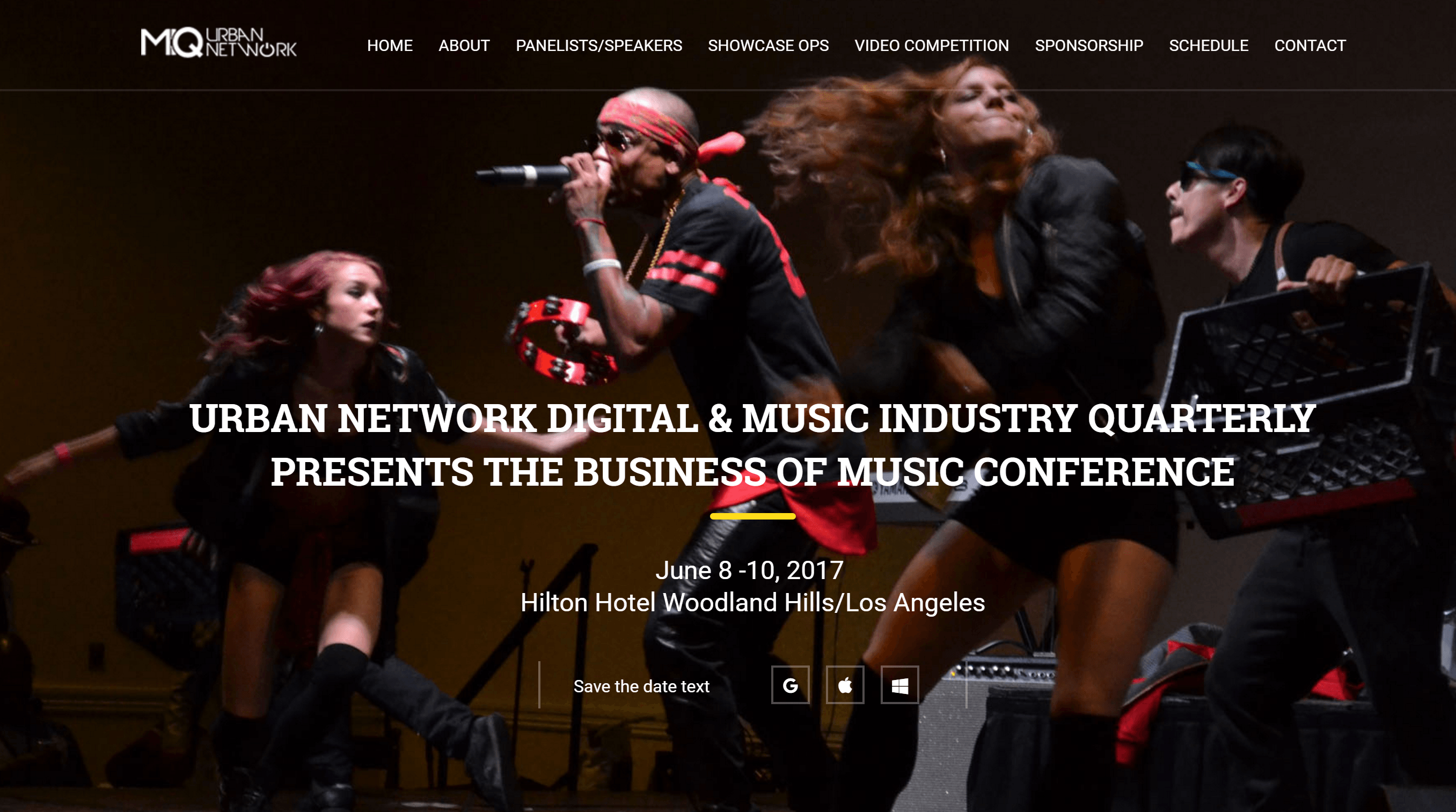
Known as the longest running conference serving the urban music community (1989-2009 and returning in 2014), Urban Network Digital & Music Industry Quarterly Magazine (MIQ)’s Business of Music Conference boasted over 1000 attendees in 2016, with over 70 independent recording acts performing over the 3 day conference.
This year, The Business of Music Conference will feature nearly a dozen panels and seminars with top executives from major & indie labels, publishing companies, radio broadcasters, music streaming services, and music supervisors, sharing their expertise and knowledge.
Dae Bogan has been added to speak on the panel “Digital Rebellion Pt. 2: Navigating the World of Music Streaming” on Friday, June 9, 2017, from 2:30pm – 3:45pm.
Complete details and tickets can be found at http://urbannetworkdigitalconference.com
Free DIY eBook
CONNECT WITH ME


