
5 Royalty Streams Every Indie Artist Should Know

This post was originally written for and published on Repost Network’s blog.
With the rise of music distributors and digital music aggregators, it has never been easier for an indie artist to release and monetize their music across the global digital music ecosystem. The Digital Music Era has significantly lowered the barriers to entry to the top outlets for music search and discovery; and startup entrepreneurs continue to develop and launch new platforms to innovate search, discovery, sharing, and access.
Today, music fans can easily access music from their favorite artists or discover new artists to fall in love with, pitting major established artists against their up-and-coming indie artist counterparts. And the music industry is changing for the better as a result (the Recording Academy now recognizes music released on free services for GRAMMY Award consideration and Billboard has accepted YouTube and SoundCloud streams for the purpose of charting).
Innovation in technology has made it possible for any indie artist with decent enough production tools and access to the Internet to record and release new music at any time. And with thousands of artists pumping out new music, it is no wonder that the industry has grown to over one million new tracks entering the global music market every month.
Each of these tracks begin earning royalties from its first play on any of the 400+ digital music services and 3,000+ webcasters operating around the world. And all of these royalties, billions of dollars of royalties, flow through a complex network of pipelines into various buckets of royalty collection with the ultimate goal of trickling down to the appropriate music creators and rightsholders. While this sounds straight-forward for a number of reasons this is far from a smooth process; and millions of dollars in royalties are in fact not making its way to the music creators and rightsholders to which they are due.
Part of the reason starts with you, the music creator. It is especially important for independent artists to understand the various income streams that your releases generate and the ways in which you must be setup to collect your royalties.
Here is an awesome infographic created by Future Music Coalition that visually breaks down how creators are compensated. Below it, I highlight five royalty streams that every indie artist should be setup to collect.
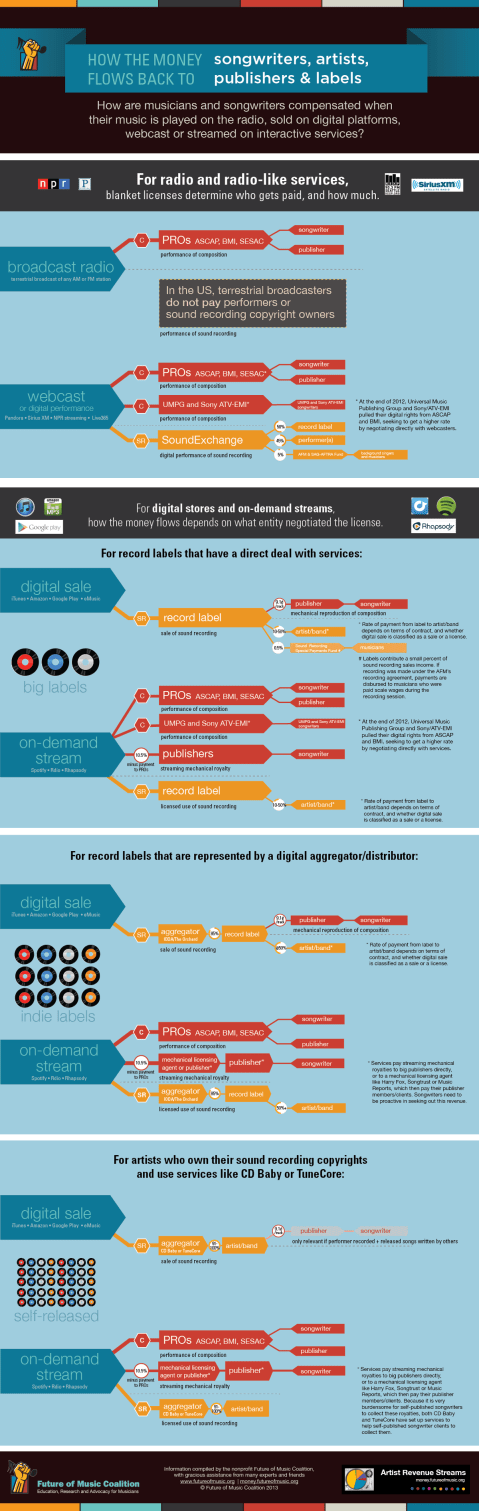
If you plan to release music digitally, you should be aware of and setup to collect all of the royalty streams that your music earns. Your music earns royalties for the use of two different copyrights. The first is the copyright for the composition (song). The second is the copyright for the sound recording (master). These two copyrights earn royalty streams that are collected and paid out by different sources to different income participants, as explained below.
Royalty Stream 1: Performance Royalties for Compositions
With few exceptions, virtually all uses of your composition earns performance royalties. Performance royalties are earned when your composition is played on digital radio-like services (e.g. Pandora), when your composition is accessed and played through on-demand streaming services (e.g. Spotify), and when your composition is performed in venues, bars, and restaurants. All of these companies have performance licenses from one or more performing rights organization (PRO). In the United States, ASCAP, BMI, SESAC, and Global Music Rights are the PROs who issue blanket licenses for the performance rights in compositions to digital music services. In return, these services pay royalties to these PROs. The PROs then pay 50% to the songwriter(s) of the composition and 50% to the publisher(s), in accordance with the publishing splits reported to the PRO by the copyright owners. In order to collect performance royalties, you must join a PRO and register your composition (your songs) and the associated ownership splits (for example, 4 Writers might have equal ownership (25% each) or varied ownership (Writer 1 – 25%, Writer 2 – 50%, Writers 3 – 12.5%, Writer 4 – 12.5%)) to the PRO in a timely manner. One of the reasons music creators and rightholders do not receive the performance royalties that their compositions earn is because they have not joined a PRO or have not registered their songs with their PRO.
Royalty Stream 2: Mechanical Royalties for Compositions
Mechanical royalties are earned when your composition is reproduced and distributed in phonorecords (a medium in which a sound recording is stored). This includes compositions embodied in sound recordings stored in physical formats (CDs, vinyl, cassette), MP3 permanent downloads (e.g. iTunes), and interactive streams (e.g. Spotify). In the digital music sector, streaming services secure mechanical licenses either directly from copyright owners or by utilizing the compulsory license as provided by copyright laws. Regardless of how they secure their mechanical license, the major services pay mechanical royalties to Harry Fox Agency (HFA) and Music Reports Inc. (MRI), who then pay the publishers of the composition. One of the reasons music creators and rightsholders do not receive the mechanical royalties that their compositions earn is because they have not registered their songs with HFA or MRI, who help digital music services secure the mechanical licenses. For unsigned indie artists, this can be much more difficult if you do not have a publisher because HFA only represents eligible publishers who’ve affiliated with them. MRI is a rights administrator and will issue notices to copyright owners if their digital music service clients intend to utilize the copyright owner’s composition in a manner that requires a mechanical license. Spotify pays HFA mechanical royalties for the compositions used in their platform. Amazon Music pays MRI mechanical royalties for the compositions used in their platform. (Note that in the United States, iTunes passes the mechanical royalty to the distributor, who then pays the label. If you’re an unsigned artist, then you receive the income since you are your own label. Outside of the United States, iTunes and on-demand services such as Spotify pay mechanical royalties to a mechanical licensing society in the territory represented by the society. In order to capture these foreign mechanical royalties, a publisher or administrator must affiliate with and register the compositions with the foreign mechanical collection society.)
Royalty Stream 3: Permanent Download Royalties for Masters
A permanent download is generally a sales transaction through a digital retail store (e.g. iTunes). This income is passed along to the distributor, who then pays the label (less any applicable commissions). If you’re unsigned artist, then you receive the income since you are your own label.
Royalty Stream 4: Interactive/On-demand Streaming Royalties for Masters
Just like a permanent download, interactive/on-demand streams (e.g. Spotify) of sound recordings generates master use royalties that is passed along to the distributor, who then pays the label (less any applicable commissions). If you’re unsigned artist, then you receive the royalties since you are your own label.
Royalty Stream 5: Non-Interactive Streaming Royalties for Masters
Unlike a permanent download or interactive/on-demand streams of sound recordings, non-interactive streams are not paid to your distributor. Webcasters and digital services that broadcast recordings over the Internet (e.g. Pandora, iHeart Radio), cable (e.g. Music Choice), and satellite (e.g. SiriusXM) in radio-style programming where the end users/listeners have limited to no control over the selection of music (non-interactive) pay a royalty for the digital performance of sound recordings to SoundExchange. SoundExchange then pays out 45% of the royalties to the featured performers on the recording, 50% to the copyright owner of the master recording, and 5% to a fund for background vocalists and session musicians maintained by AFM & SAG-AFTRA Intellectual Property Rights Distribution Fund. One of the reasons music creators and rightholders do not receive the non-interactive royalties that their masters earn is because they have not joined SoundExchange or have not registered their tracks with their SoundExchange.
When you release music digitally, you should be aware of the various royalty streams that your music earns, where those royalties are collected, and how to claim your earnings. Your distributor is one source of income for two of the royalty streams mentioned. To unlock the rest of your royalties, you’d need a capable publisher and a record company or you’d need to stay on top of the administration yourself.
A great way to keep track of all of these royalties is a service we recommend called TuneRegistry.
TuneRegistry is an all-in-one music rights and metadata management platform for the independent music community. Easily organize and store your song details, recording metadata, credits and ownership splits, and release information in your TuneRegistry account. It’s your robust music catalog manager that’s accessible online, so you don’t have to worry about tracking down emails, storing through documents in various desktop and cloud folders, losing collaborator contact information, or any of the other messy issues that most indie artists face.
TuneRegistry is your one-stop source for keeping your music catalog in check.
The advantage of TuneRegistry over other catalog management systems is that we’ve integrated the registrations process directly to ASCAP, BMI, SESAC, Music Reports, SoundExchange, and many more. Save time, reduce errors, and unlock royalties with our integrated registrations module. We make it super easy to get your music registrations to the organizations and data services who need it.
Catch Me At SXSW

Monday, 3/13 – I am exhibiting with the TuneRegistry at the SXSW Trade Show (Booth 1939)
Tuesday, 3/14 – I am exhibiting TuneRegistry at the Music Startup Spotlight
Wednesday, 3/15 – I am moderating the panel “Rights & Metadata in Evolving Digital Music Space”
Friday, 3/17 – I am participating as a mentor. I have limited slots available for 1-on-1 mentorship.
See more of the things I’ll be involved in at www.tuneregistry.com/SXSW2017
Hypebot Features TuneRegistry In “The Pitch” Series
 Online music industry publication, Hypebot, has featured my startup TuneRegistry in its “The Pitch” series today. Hypebot gave us the opportunity to introduce our platform and tell its readers what makes TuneRegistry special; in 100 words or less. Check it out here.
Pandora Sports Clean New Look
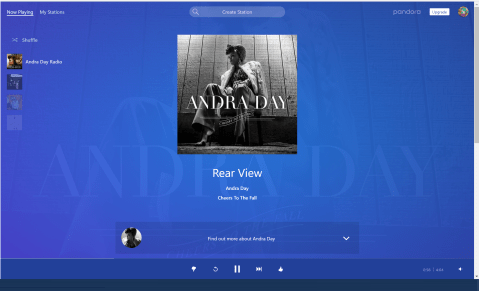
Pandora recently launched its sleeker new look. The centerpiece of the new user interface is the song artwork, which is now bigger and more prominent than ever. The artwork is also used as a color-washed background.
See You At SXSW!
I’m looking forward to moderating a panel, providing mentorship, promoting TuneRegistry, and having a good time at SXSW 2017! See you there!
YouTube Announces Major Change To How It Will Handle Music Publishing

In an email sent to YouTube Music partners this week, YouTube announced that it will change the way it handles publishing.
Currently, YouTube allows rights holders to submit metadata and ownership information to a single global composition record. If there are multiple rights holders, their information is aggregated and rolled up into the “global” composition asset. Then various owners of sound recordings can create relationships (matches) between the “global” composition and their sound recordings. For example, 3 cover song recordings matched to a single “global” composition. However, YouTube is changing this process.
YouTube is doing away with a “global” composition and Composition Asset ID, which all rights holders on the composition would share, and now requiring that rights holders submit a “Composition Share” asset (think of it in relationship to a Split Sheet, the writer/publisher share) and provide their own unique Custom ID to YouTube, which associates back to the composition in the rights holder’s own database (e.g. a catalog number).
Notably, YouTube will no longer create composition to sound recording relationships on behalf of rights holders. It will become more important than ever for right holders to stay on top of their ownership splits and submissions. Furthermore, because YouTube will now rely on rights holders own Custom IDs, it will be important to implement and maintain a clean unique ID database. This could be the catalog number or the same unique ID the publishers use when registering works to PROs via CWR.
Read the full email below…
Dear YouTube Music Publishing Partner,
We are launching a new publishing data model to give you more transparency into and control over how your rights are associated with sound recording assets. In this new model, we will no longer have one “global” composition asset with metadata, ownership, and embedded relationships provided by various owners. Instead, each owner will have their own “Composition Share” assets. These “Composition Share” assets represent only the metadata and ownership information provided by a single owner. Your provided embedded relationships between “Composition Share” assets and sound recording assets will always be applied.
Our current planned launch date for this change is four weeks from now, on Monday, April 3.
This new model will require one major change on your side. Because we will be deprecating our historical Composition Assets and replacing them with a new asset type, today’s Composition Asset IDs will no longer be used. In most cases where you now use Composition Asset ID (including delivery and reporting), you should transition to using the Custom ID field. We recommend that the data you provide in this field always mirror the proprietary work codes that you use in your own database. In order for your Custom IDs to behave in a sensical and deterministic manner, it is critically important that your Custom IDs function as a primary key. That is, every Composition Share must have a Custom ID, and each Custom ID must refer to one and only one Composition Share. We strongly urge you to examine your Custom ID data now and confirm that your Custom IDs refer to only a single work each. If you suspect that this is not the case, please reach out to [omitted] for assistance. We would be happy to send you reports of how you are currently using Custom ID and where any gaps in your data may exist. If your Custom IDs do not function as a primary key in our new model, you may experience errors and ingestion failures.
Because this is a major change, this may require some workflow adjustments on your side. A few important things you should be aware of:
You will have greater control of embedded relationships between Sound Recordings and “Composition Shares.” Any embedded relationships delivered by any publishing partner will always be applied. If partners deliver conflicting data, these conflicts will immediately manifest in the YouTube Content Manager. By the same token, if you do not deliver us a Composition-Share-to-Sound-Recording relationship, we will not create one for you based on other partners’ data. You can continue to create these relationships through CSV ingestions, and we will be adding the ability to delete these relationships in bulk via CSV ingestions. We are also adding functionality to the Content Manager to allow you to edit these relationships directly in the user interface.
Conflicts now exist at the Sound Recording level, rather than at the Composition level. This means that you will see a larger number of conflicts in your conflicts queue. This increase in the number of assets in conflict does not necessarily represent a larger number of views in conflict; conflicts are merely being reported to you on a more granular level. Given that you will now have greater control over embedded relationships, conflicts caused by bad data should be much easier to resolve. When communicating about conflicts with other partners, you should now use Sound Recording Asset IDs instead of Composition Asset IDs.Asset revenue will be reported at the Sound Recording level, rather than at the Composition level. This means that your asset revenue reports will grow (they will have more lines). To see revenue reported to you at the Composition level, simply pivot the asset revenue report on Custom ID. If you need assistance processing these larger reports, please reach out to your technical account manager or send an email to [omitted].
We recognize that this is a major change that may result in substantial changes to your current workflows. We want to make this change as easy as possible for you and we are here to help and to listen to your feedback. If you have any questions not addressed in this email or on the Help Center, please contact your regular YouTube representatives. To submit feedback directly to our product specialists, please hit the “Help & Feedback” button in CMS. For operational or technical support, please reach out to [omitted]. We will also be hosting office hours and workshops at our New York City office, at our Los Angeles office, and in Nashville in the weeks after the new model is launched. If you are interested in attending, please reach out to your regular YouTube contacts.
Best,
Taylor Fife
YouTube Music Publishing Team
TuneRegistry’s Schedule of Events at SXSW

We’re just one week away from SXSW. Check out the complete TuneRegistry schedule at www.tuneregistry.com/SXSW2017
Why United States Music Creators Earn Fewer Royalty Streams

This post was originally written for and published on Tradiio’s blog.
Did you know that music creators in the United States earn fewer royalty streams than their international counterparts?
In the United States, there is no national performance right in sound recordings. The US Copyright Act sets out several rights for compositions (songs), such as the right to reproduce and distribute compositions in phonorecords, but thanks to a combination of outdated rules and tough opposition from lobbying organizations that represent broadcasters, the law does not include a performance right for sound recordings.
This means that whenever a recording is performed on AM/FM radio in the US, broadcasters are not required to pay artists or record companies any royalties from the advertisements revenue that they earn on the back of those performances. Considering that there are over 15,000 radio stations across the US performing hundreds of thousands of plays of music each week, US music creators and labels are potentially missing out on millions of dollars in royalties.
Virtually all other developed nations outside of the US have a performance right in sound recordings, which is known as neighbouring rights. When a US artist’s recording is performed on BBC in the UK, it earns neighbouring rights royalties for the US artist.
The fact that recordings earn royalties outside of the US is good news, right? Not so much.
Because the US does not have a national performance right in sound recordings (no neighbouring right), no recording earns these royalties. This includes recordings by artists from countries that do recognize neighbouring rights. So yeah, insert your favorite European band who gets high rotation on US radio.
As a result, the countries who do recognize neighbouring rights do not send the neighbouring rights royalties generated from the performance of recordings by US artists in their territory back to any of the US music rights organizations. They keep it or distribute it to the artists and labels in their territory.
Generally speaking, most indie artists who earn neighbouring rights royalties outside of the US will never see this royalty stream unless the US government makes a change to copyright law. Although there are some small companies who try to capture neighbouring rights royalties on behalf of US music creators, they tend to focus on a select roster of more established artists, leaving up-and-coming indie artists with no support.
So what now?
Well, now that you know US artists earn less royalty streams from their music than their international counterparts, it is really important to maximize the royalty streams that they do earn.
Many independent artists miss out on royalties that their music does earn because they do not properly register their songs, recordings, and releases with the various music rights organizations and licensing agencies who collect and distribute royalties. This is understandable, as it can be a pain to keep up with the many different registration processes across a number of organizations (ASCAP, BMI, SESAC, Music Reports, Harry Fox Agency, SoundExchange, the Alliance for Artists and Record Companies, and more). It can be burdensome, time consuming, and often confusing to properly register a complete album. However, missing just one registration or filing registrations late can result in lost royalties, or even disputes over ownership.
This is where TuneRegistry steps in to help.
TuneRegistry is an all-in-one music rights and metadata management platform for the independent music community. Easily organize and store your song details, recording metadata, credits and ownership splits, and release information in your TuneRegistry account. It’s your robust music catalog manager that’s accessible online, so you don’t have to worry about tracking down emails, storing through documents in various desktop and cloud folders, losing collaborator contact information, or any of the other messy issues that most indie artists face.
TuneRegistry is your one-stop source for keeping your music catalog in check.
The advantage of TuneRegistry over other catalog management systems is that we’ve integrated the registrations process directly to ASCAP, BMI, SESAC, Music Reports, SoundExchange, and many more. Save time, reduce errors, and unlock royalties with our integrated registrations module. We make it super easy to get your music registrations to the organizations and data services who need it.
I’m Going To Start Trolling My Music Creator Friends, But Not How You’d Think…

I’m going to start trolling my music creator friends.
Not by commenting on their “check out my new release posts.”
No.
I’m going to troll them by capturing the royalties that they WILLINGLY leave on the table by refusing to be more proactive when it comes to the business of music.
The independent music community turns its collective back on nearly a billion dollars in unclaimed royalties and unlicensed usage every year from domestic and international sources, despite the fact that artists are generally distributing music wider and further across more varied platforms and apps than ever before.
If you’re going to leave money on the table, I’ll go ahead and pull up a seat and take your share.
Global Recorded Music Revenues Grew By $1.1 Billion In 2016

Following on from the global market share numbers we released on Sunday, here are our findings regarding the growth of the overall market.
Throughout 2016 as the major label earnings were coming in there was a growing awareness that 2016 was going to be a landmark year for the recorded music business. It finally looked like streaming was going to push the industry into growth. Now with full year numbers in, the picture is even more positive than it first appeared. The recorded music market grew by 7% in 2016, adding $1.1 billion, reaching $16.1 billion, by far the largest growth the recorded music business has experienced since Napster and co pushed revenues into free fall.
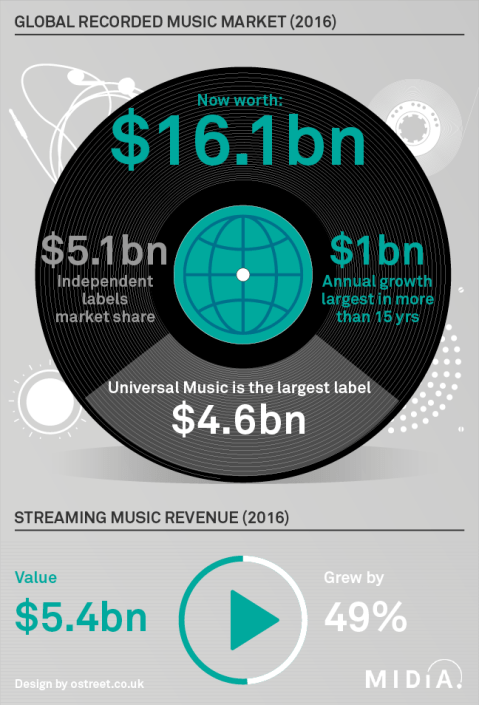
While it is too early to state that the corner has been turned, this is clearly a turning point of some form for the business. Underpinning the growth was streaming which grew by…
View original post 433 more words
Free DIY eBook
CONNECT WITH ME


