
If Only Artists and Managers Had Listened To Us : Spotify Per Stream Rates Keep Dropping
An alarming truth about Spotify royalties…

We hate to say we told ya so, but… Below is our post from September 2015. Two years ago we predicted the inevitable truth of the all you can eat Spotify subcription model. Like many of our predictionsand proposals (example; windowing titles) we’ve had to wait for the industry to catch up to us. Today, two years later, Digital Music News confirms our prediction.
Read the report from Digital Music News by clicking the headline link here.
Exclusive Report: Spotify Artist Payments Are Declining In 2017, Data Shows | Digital Music News
Our original post from 2015 is below…
Down, down, down it goes, where it stops nobody knows… The monthly average rate per play on Spotify is currently .00408 for master rights holders.
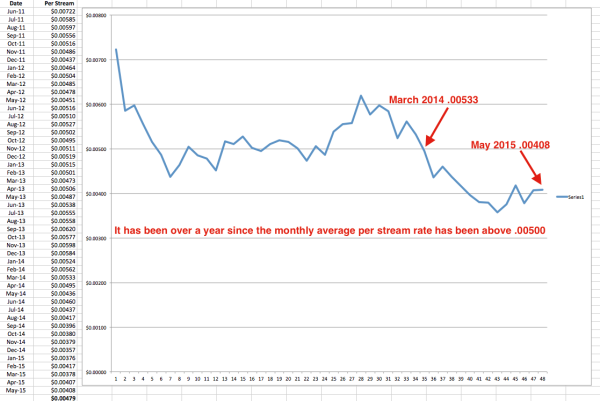
48 Months of Spotify Streaming Rates…
View original post 205 more words
Spotify Moves Spotify Ad Studio Into Beta – Opens Up To Indie Artists & Managers

I’ve been hearing that Spotify is rolling out their BETA for their new Spotify Ad Studio, which they are comparing to Google Adwords and Facebook. Some artist managers I’ve spoken with are already in the beta and using it to run ad campaigns on Spotify.
One manager posted in a group that I’m in:
Everyone go to adstudio.spotify.com and check it out for yourselves. Apparently I already have access. The targeting doesn’t get as fine as Facebook, for example, and there’s a $250 minimum spend which gets about 10,000 airings at $0.025 each. There’s also a $5,000 maximum, I presume per campaign, and above that you’re getting into their Spotify For Brands territory which has a $25,000 campaign minimum spend.
They also specify that they don’t currently support driving traffic to songs or playlists. Their ad objectives are ‘Announce an event,’ ‘Raise brand awareness,’ ‘Drive people to my website,’ and ‘Other.’
If you’re interested in advertising content, they encourage you to email adstudio@spotify.com
Want to learn more, here’s a Google Doc with FAQs:
Career Transition Tips: Moving From The Financial Industry To The Music Industry

Generally speaking, with the industry being the Big Data industry that it has become, I feel that many of you how have experience with financial data modeling, forecasting, and other “financial/number people skills” could be a viable asset to numerous music companies.
Here are a few companies who specifically exist at the intersection of music and money, which could be a good transitional outlet for the right candidates:
Good luck!
What Every Small Artist Management Firm Must Do Immediately
Artist Management Firms: If you do not have someone on your team whose sole responsibility is to utilize online music sync agencies, pitch ad agencies, and cozy up with music supervisers, you’re missing out, bigly.
When I owned/operated Renaissance Artist Management (aka RAM Artist), I established an in-house position for the sole purpose of securing music sync opportunities. This was during the early days of micro-sync and the boom of online sync agencies.
We leveraged online agencies (at the time that included Rumblefish before they were acquired by HFA and pivoted). Check out Songtradr, Music Bed, MusicDealers, YouLicense, Pump Audio, and many others like them.
Consider giving some tracks to exclusive libraries who do well pitching your artists’ sound. Red Bull Media House is always looking for good music and they get YUGE placements.
Make sure to read the deats of their contracts.
Here’s a few things to look out for:
- Exclusivity – Try not to give micro sync agencies exclusivity. If you’re giving a company exclusivity, it better be a solid library. (TuneCore PRO users…did you know when you opt-in to their sync licensing program, you’re giving them exclusivity?)
- SoundExchange Royalties – Some pitch houses and libraries have tried to sneak in a cut of your SoundExchange royalties. Don’t let them get it. They are not getting your music placed on digital radio, so they do not participate in your digital radio royalties. I successfully helped an indie artist negotiate that clause out of a library agreement.
- Tagging/ReTitling– Tagging is the practice of adding an identifier to your song title when the song is registered with a PRO. Retitling is creating a new title for the song when registering. The goal of both methods is to disambiguate any performance royalties generated as a result of the libraries sync placement activities. This is necessary when you have multiple non-exclusive libraries getting places of the same song. They want to make sure that when the cue sheet from the TV show gets to the PRO, the royalties earned against that specific placement gets to the right entity. It’s not unheard of for one song to be placed by several non-exclusive sync agencies, each with retitles or tagging and capturing royalties for their specific placement. Do know that the writer gets the writer share for all of the placements. The agencies/libraries participate in the publishers share of their specific title.
- Duration of Term – Exclusive libraries may want up to 3 years exclusivity. Aim for 1 year for the first term.
Learn about royalty forensics, that is the art(science?) of tracking down uses of your music and capturing associated royalties (this is definitely important when it comes to big multi territory placements, TV syndication, and film secondary market distributions). Tunesat and ACRCloud are two audio detection platforms that’ll detect performances of your music in sync media.
You may want to setup your own music licensing store, so that when you meet music sups, you can send them to an easy-to-search library of your own music. Check out Soundgizmo and LicenseQuote for this.
And of course, don’t forget to make sure the music is registered before it starts to generate royalties, with TuneRegistry.
[Video] Dae Talks Blockchain At XLIVE Data & Analytics Summit
If you missed me at the XLIVE Data & Analytics Summit yesterday, here’s a clip of me talking about blockchain.
GRAMMY Showcase Call for Entries!
CALL FOR ENTRIES!
Entry Deadline: April 21, 2017
Showcase: June 8, 2017
CLICK HERE TO ENTER
GRAMMY Showcases have built a successful track record of exposing new emerging talent to industry professionals and fans. This is your opportunity to perform live at the Los Angeles GRAMMY Showcase.
To enter and for a complete list of rules and regulations, click here.
The event is open to unsigned artists and/or artists without major label distribution
Open Music Initiative Announces Applications Open For 2017 OMI Summer Lab – Paid Internships

The Open Music Initiative (OMI) is seeking student software developers, musicians and visual artists for the 2017 OMI Summer Lab running June 5-July 28 in Boston, MA. These paid internships will explore the technical challenges of utilizing distributed ledgers and the Open Music Initiative API for:
- Cataloging, attributing and distributing live DJ mixes
- Commercializing mixtapes built from original material and back catalogs
- Compensating musicians for visual works using their songs as data
- Identifying individuals for their contribution to single tracks in new works


The eight week program will be facilitated by globally renowned innovation and design firm, IDEO, and Berklee College of Music’s Berklee ICE, and supported by sponsors which include Intel and the Inter-American Development Bank. At the end of the summer, teams will demo new art works utilizing blockchain registration, share evolved use cases and make recommendations for additional features to the Open Music Initiative API based upon their experience.
We are seeking currently enrolled college students that are collaborative, curious, flexible, detail oriented, and technically interested with the following skills:
- Blockchain Developer… you’ve made your own crypto currency, maybe your own virtual wallet or market, you have an opinion about how this stuff should work in the future
- User Experience Designer or Front End Developer… you can code data into art, you can code a website from scratch, you’ve moved beyond the hamburger menu
- Graphic Designer… you simplify complicated ideas artistically, you’re marketing-minded, you wish you had met Reid Miles
- Business Associate… you’re entrepreneurially minded, you can size a market, you know just enough about the law to be dangerous
- Musicians… you have a favorite genre but you can jam with anyone, you like to experiment with new technology, you’re cool under pressure, you know your way around a turntable
- Visual Artist… your medium is digital data, your art doesn’t know a resting state, you think in an XYZ axis
If you match one of these descriptions then please apply here then join us for a final selection hackathon on Saturday, April 22 at IDEO in Cambridge, MA. You must participate in the hackathon to be selected. Chosen students will receive $3,000 each for full participation in the Summer Lab.
Dae Bogan Added To Speak At The Business of Music Conference
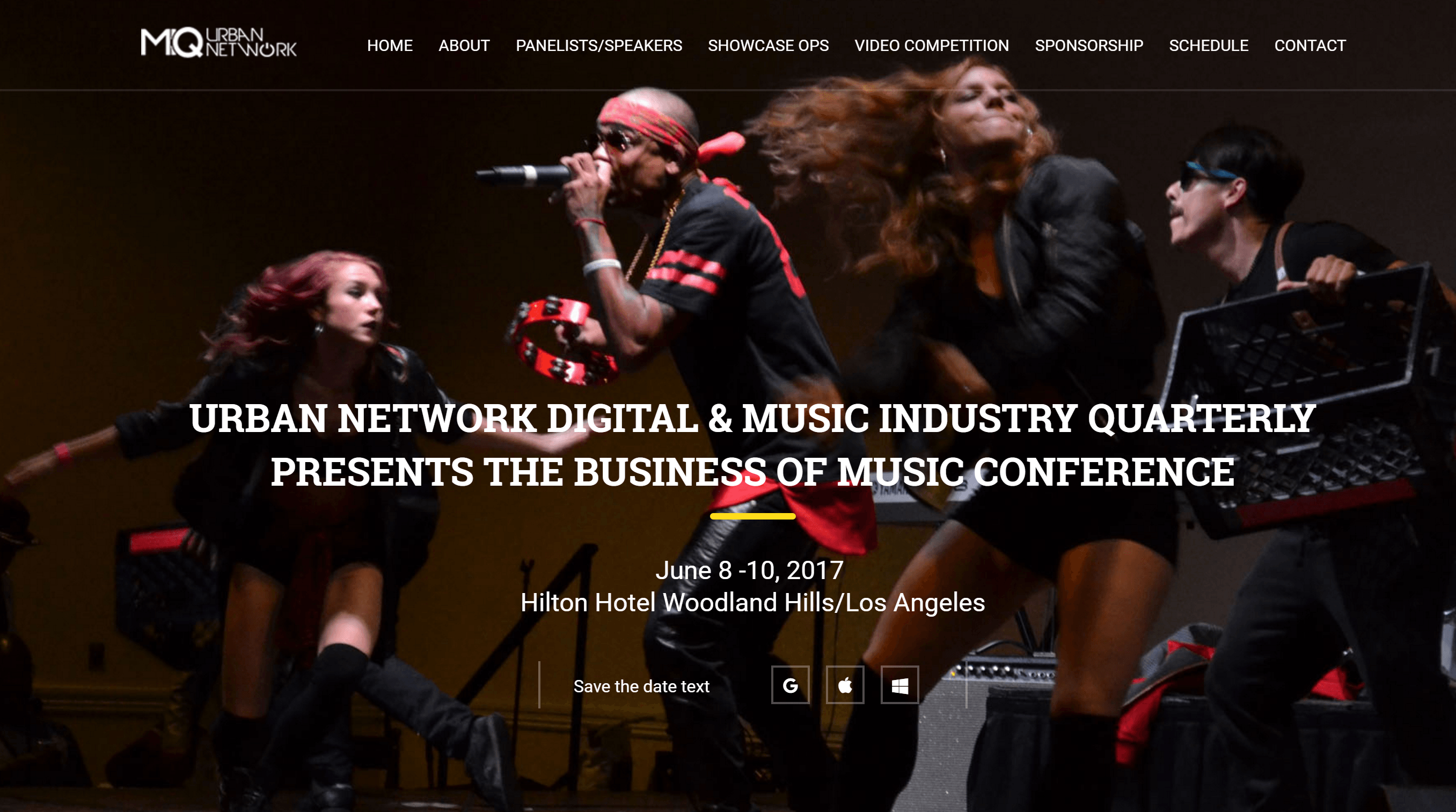
Known as the longest running conference serving the urban music community (1989-2009 and returning in 2014), Urban Network Digital & Music Industry Quarterly Magazine (MIQ)’s Business of Music Conference boasted over 1000 attendees in 2016, with over 70 independent recording acts performing over the 3 day conference.
This year, The Business of Music Conference will feature nearly a dozen panels and seminars with top executives from major & indie labels, publishing companies, radio broadcasters, music streaming services, and music supervisors, sharing their expertise and knowledge.
Dae Bogan has been added to speak on the panel “Digital Rebellion Pt. 2: Navigating the World of Music Streaming” on Friday, June 9, 2017, from 2:30pm – 3:45pm.
Complete details and tickets can be found at http://urbannetworkdigitalconference.com
Dae Bogan And Warner Brothers Records’ VP, A&R Eesean Bolden Join Panel At XLIVE Data & Analytics Summit 2017

Dae Bogan, the Co-founder & CEO of music rights and metadata management tech startup TuneRegistry and a Lecturer of Musicology at the UCLA Herb Alpert School of Music, will be joining music industry consultant, Geoff Mayfield, and Warner Brothers Records’ Vice President of A&R, Eesean Bolden, on a panel at the XLIVE Data & Analytics Summit 2017, which takes place April 4th – 5th, 2017 at The Paley Center for Media in Beverly Hills, California.
For 14 years XLIVE has been providing resources and information to the festival and live event industry. The XLIVE Data & Analytics Summit will convene festival and live event producers, leading data and analytics executives, in addition to brands hosting their own corporate events and festivals. With over $1.1 billion invested in event technology in 2016, the digital transformation in the live event sector is growing at unprecedented levels. As live events and festivals experience increased competition from one another and strive to provide unique experiences for fans and attendees alike, technology will serve as a cornerstone in this effort for years to come. With this digitization of the live event experience – event organizers can now harness the power of their data to more effectively engage attendees, understand customer behavior, increase revenue, analyze competition, identify talent trends, monetize assets, enhance sponsorship activation and more!
Bogan, Mayfield, and Bolden will offer insight and commentary on the panel “MUSICOLOGY – HOW EMERGING ARTISTS IN MUSIC USE DATA AND ANALYTICS TO GROW AND MONETIZE THEIR FANBASE” which will take place on Wednesday, April 5th, 2017 from 2:50pm – 3:30pm.
The panel description is as follows: The music industry has undergone a transformation over the past decade thanks to the emergence of digital streaming as the primary means for Millennial audiences discovering new artists. Our afternoon fireside chat will convene music industry experts to discuss the use of analytics in digital music streaming to help emerging artists build their fanbase through planning their tour schedules and festival calendars. We’ll also explore the issue of data ownership in the music industry to uncover how emerging artists can more effectively monetize their fans through digital streaming before and after they go on tour.
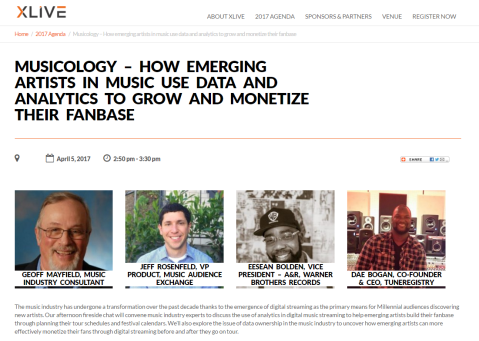
Tickets are available online. Get 10% OFF with code XLDAEB15
How To Legally Record And Sell A Cover Song In 3 Steps

This post was originally written for and published on Dozmia’s blog.
If the popularity of user generated content (UGC) platforms, such as YouTube and SoundCloud, has taught us anything about the music industry in the Digital Age, it is that aspiring artists from anywhere can amass huge online audiences and earn global reach by putting out cover songs that spark a reaction.
Success stories like those of Justin Bieber, Tori Kelly, 5 Seconds of Summer, Charlie Puth, Shawn Mendes, and Ed Sheeran are no longer rare phenomena. Talented unsigned artists like Jade Novah and Austin Mahone have earned tens of millions of views and plays across their UGC accounts. Previously undiscovered talent have gone on to land brand sponsorships, live performances with major recording artists, appearances on TV, casting in commercials, and more– all without the backing of a major record label.
However, while recording and uploading cover songs to UGC platforms can be a great first step to building a fanbase, monetizing those songs on traditional digital music services can be a legal nightmare if not done correctly. Furthermore, knowing when, where, and how to capture all of the royalty streams that your cover recording earns will put you in a better position to reap all of the rewards from releasing a cover recording that takes off.
Here are three steps that you should take if you plan to legally record and release a cover song:
Step 1: Secure the proper licenses to reproduce and distribute the original composition.
The U.S. Copyright Act grants copyright owners six exclusive rights including the right to reproduce and the right to distribute their compositions in phonorecords. When you record a cover of an existing song, you are effectively using someone else’s copyrighted work and they must be compensated for the use when you distribute the recording in physical and/or digital media.
The law includes a provision that enables anyone to reproduce and distribute a composition by following the specific requirements set out in the compulsory license. These requirements basically state that you must notify the copyright owner of your intent to use their song and you must account to (provide reports and statements on usage) and pay statutory mechanical royalties to the copyright owner for each use.
The term “mechanical” refers to when songs were mechanically reproduced in phonorecords. The statutory mechanical royalty rates are set by the Copyright Royalty Board.
Currently, the statutory mechanical royalty rate for physical formats (CDs, cassettes, LPs) and permanent digital downloads (e.g. iTunes) is 9.1¢ for songs 5 Minutes or less or 1.75¢ per minute or fraction thereof for songs over 5 Minutes.
Harry Fox Agency (HFA), Loudr, and Easy Song Licensing are just three of the resources for securing a mechanical license.
HFA is a membership-based mechanical licensing agency owned by SESAC. HFA represents and issues mechanical licenses in the U.S. on behalf of their U.S. music publisher members. HFA’s website claims that they currently represent over 48,000 music publishers. This makes it easier for you to go to them for most of the top popular songs released in the U.S. HFA’s service for obtaining a mechanical license is called SongFile.
Through SongFile, you pay upfront for the number of physical or digital phonorecords that you project to sell. For example, if you will sell 1,000 CDs, then you’ll pay 9.1¢ x 1,000 = $91 per cover song, which will then be paid to the publisher(s) to compensate the songwriter(s). You can also secure a license for interactive streams. However, in the United States, some interactive streaming services already pays the mechanical interactive streaming rate, so you do not have to when releasing to these platforms in the United States. Spotify, for example, pays HFA for the mechanical license for songs used on their platform in the United States, so you do not have to worry about securing a mechanical license if you’re only releasing to Spotify.
The rates for interactive streams (e.g. Spotify) and limited downloads (e.g. offline mode) are determined by a formula that takes into account the service type, license type, whether or not it’s ad-supported, amounts paid to labels, and other factors. Spotify’s rate comes out to about $0.0007 per stream. Again, they pay this to HFA so you don’t have to!
Loudr and Easy Song Licensing are independent services that charge a small service fee (about $15 per song) to secure a mechanical license for any song that you’d like to cover. This is awesome because if you’re covering some obscure song from an indie band in Wyoming or an international songwriter from France, you wouldn’t be able to license the song through HFA’s SongFile, which only represents and licenses U.S. publishers.
When you’re getting a license through Loudr or Easy Song Licensing, do not select interactive streams. Like I mentioned above, Spotify is already paying this to HFA and other services are paying Music Reports, Inc. (MRI), which is a rights administrator that represents a number of digital music platforms. Outside of the U.S., digital services pay local collection societies, who then pay the publishers.
So, definitely secure a license if you’re releasing a cover song on a physical format. Definitely secure a license if you’re releasing a cover song as a digital download. If you’re releasing only to major interactive streaming platforms, then you may not have to secure a license because most of these companies pay HFA or MRI already.
Step 2: Get a unique code to distinguish your recording.
If you’re planning to do a cover of a popular song, chances are that many other artists have or will cover the same song. With multiple releases of the same song to the global music ecosystem, it is important to distinguish your recorded version of the original song from all others. This is done with a unique identifier called the International Standard Recording Code or ISRC for short.
The ISRC code is a unique 12-character alphanumeric code assigned to each version/mix of a recording (ie. QMZTA1700001). For example, if you have a live version and a studio version of your cover song, each will need its own ISRC. If you get a dance remix of your cover or do a stripped down acoustic version of your studio-produced cover, again each of these versions will require a unique ISRC.
When you distribute music digitally, almost all digital platforms require an ISRC for each recording. Your ISRC can and should also be embedded in the metadata of your recording file so that when your recordings are released as a digital download or on physical formats, the ISRC is attached to the recording.
Be very careful to only purchase ISRC codes from official ISRC Managers. ISRC Managers appointed by the US ISRC Agency, the Recording Industry Association of America (RIAA), are the only companies approved to assign ISRCs on behalf of the owner of a recording. These companies have guaranteed that they will abide by the Procedures for Assignment of ISRCs by ISRC Managers.
Other companies claiming to assign ISRCs on behalf of their clients are not authorized to do so and the ISRC’s they generate are invalid and risk collisions with codes issued by authorized registrants and ISRC Managers. This happens when fake ISRCs are issued or legitimate ISRCs are re-used. This results in erroneous metadata being disseminated across the digital music ecosystem, which can result in missing or misallocated royalties and disputes.
TuneRegistry is an all-in-one music rights and metadata management platform that’s also an approved ISRC Manager offering free and discounted ISRC codes included in its subscription plans. You can quickly and easily obtain ISRCs for each of your versions/mixes inside your account and immediately use the ISRC with any digital distributor to get your cover song distributed. You can view a complete list of approved ISRC Managers at http://www.usisrc.org/managers/index.html.
Step 3: Unlocking your royalties and getting paid.
The goal of virtually all aspiring artists is to have their music heard as wide and as far as possible. When songs are hits, earning national and even international reach can happen literally overnight. And even when there is slow momentum as buzz picks up across blogs and social sites, the right mention, the right placement on a playlist can break a song within a matter of weeks.
Whether or not your cover song blows up to international success, you may still earn and be due royalties for the exploitation of your cover song recording. Although you will not earn publishing royalties related to the underlying composition (remember, the original songwriter is the copyright owner and compulsory license enables you to record and distribute a cover), such as performance royalties that are paid out by ASCAP, BMI, and SESAC, you will own the master sound recording and will be able to collect master royalties.
Here are some of the income streams associated with the master sound recording and how you obtain the royalties:
- Sales Income – This is pretty straightforward. You earn income when your recording is sold in physical format or permanent digital downloads. Sales are generally passed on to you through your distributor.
- Interactive Streaming Royalties – When your recording is streamed on interactive platforms (e.g. Spotify), the service pays a streaming master use royalty to the distributor, who then pays you for the streams. The royalty rate is based on a formula that takes into account the type of use, the number of total streams, your share of streams, and territory.
- Non-Interactive Streaming Royalties – Webcasters and digital services that broadcast recordings over the Internet (e.g. Pandora, iHeart Radio), cable (e.g. Music Choice), and satellite (e.g. SiriusXM) in radio-style programming where the end users/listeners have limited to no control over the selection of music pay a royalty for the digital performance of sound recordings to SoundExchange. SoundExchange then pays out 45% of the royalties to the featured performers on the recording, 50% to the copyright owner of the master recording, and 5% to a fund for background vocalists and session musicians maintained by AFM & SAG-AFTRA Intellectual Property Rights Distribution Fund. It is important that you register your track title, the performers, copyright owner (which will be you if you’re independent and not signed to a label), and ISRC to SoundExchange. This helps them to identify you and match incoming usage reports and royalties from digital services to you as the income participant. After joining SoundExchange, you can easily keep on top of registering all of your tracks directly through your TuneRegistry account. This way, you’ll never forget to make sure that you’re raising your hand to capture your non-interactive streaming royalties.
- Master Use for Sync Fees – If your cover song gets licensed to a TV show, a movie, a commercial, or any other audiovisual media, you would need to obtain a synchronization license from the publisher of the composition. While you own the recording of your cover song, the copyright owner owns the composition and still give permission for the composition to be used in audiovisual media (this is a separate license from the compulsory mechanical license). The producer of the content will need to pay the synch fee for the composition and pay a master use fee for the master use license of the sound recording. These negotiations take place directly between the producer of the content (or their representatives) and the owners of the copyrights (you for the master sound recording and the songwriter or publisher for the composition that you’ve covered).
Now that you’re an expert on legally recording and selling cover songs, share the knowledge with your musician friends! No artist should be afraid to record and release cover songs — unless you’re releasing to YouTube, because that’s a different beast! The good news is, many publishers have opted-in to an agreement between YouTube and the National Music Publisher’s Association to earn a revenue share from advertisements placed on videos that feature recordings that embody their compositions. However, getting a license for YouTube could be down through We Are The Hits.
Free DIY eBook
CONNECT WITH ME


