
2021 Prediction: The United States Music Publishing Market Continues To Grow And Fragment, Creating More Silos For Unpaid “Black Box” Royalties — DIY Musicians Hit The Hardest
As the U.S. music publishing industry grows (in terms of revenue, volume of copyrights, and number of income participants), the rights administration and licensing sector becomes ever-more fragmented; giving way to cracks in its foundation through which royalties fall into the so-called “black box” — the industry name for the unmatched and unpaid royalties earned against unidentified works or unidentified or unreachable income participants that accrue in escrow only to be later forfeited and disbursed to entities to which the funds do not belong; primarily major music conglomerates and those acquiring catalogs of copyrights to expand their market share position.
Black Box Royalties Myths, Common Misconceptions Debunked at Music Biz 2018
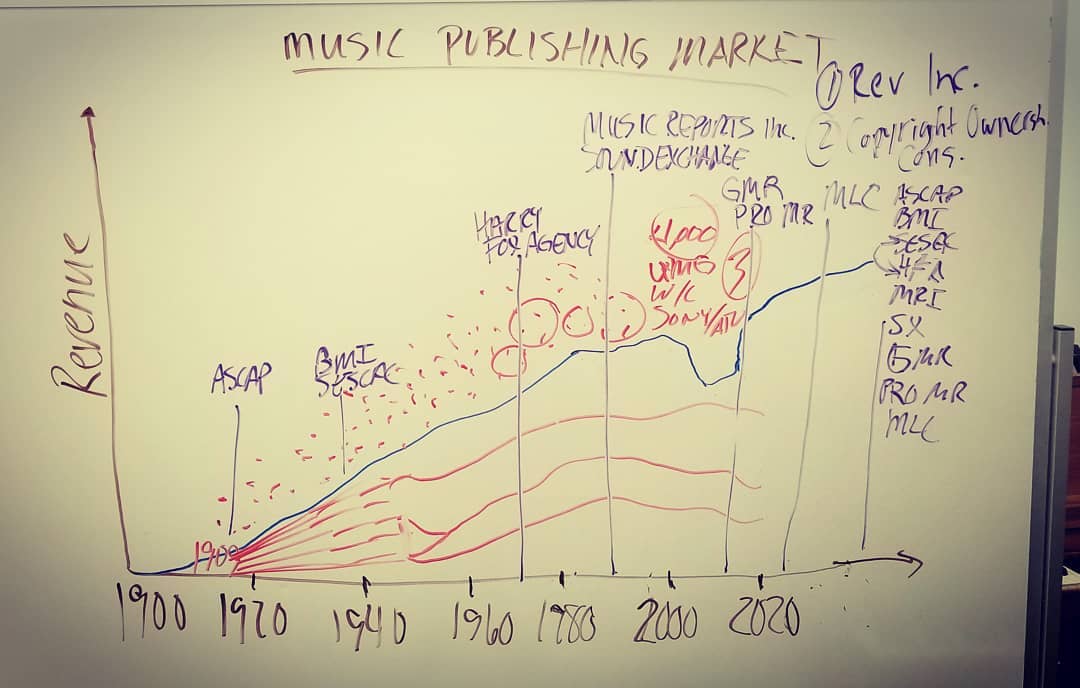
A picture of a white board illustrating the growth and fragmentation of the US Music Publishing Market, specifically the music licensing and royalty ecosystem, drawn during Dae Bogan’s lecture in his class, “Music Industry Entrepreneurship and Innovation” at the UCLA Herb Alpert School of Music, Winter Quarter 2019
In 1909, when the first federal copyright law that protected music creators and rights-holders was enacted, there were no massive music rights organizations as we’ve come to know them today. Although unions had existed — the American Federation of Musicians was founded 13 years earlier in 1896, but focused more on work conditions than collective bargaining, as it does today — ASCAP was formed in 1914 to license the performing rights of composers, authors, and publishers.
Fast forward to 2021 when the newly formed Mechanical Licensing Collective will issue its first blanket digital streaming mechanical license to the likes of Spotify, Google, and Apple. There will be over a dozen music rights and royalty collection organizations issuing thousands of licenses, administering millions of pieces of copyrights, and processing billions of micro-penny transactions.
The music licensing and royalty ecosystem in 1909: Individual music composers, aristocrats who financed or commissioned works, and sheet music publishers.
The music licensing and royalty ecosystem in 2021: Traditional non-profit and private music rights organizations (ASCAP, BMI, SESAC, Global Music Rights, PRO Music Rights, SoundExchange, Mechanical Licensing Collective), royalty funds (AFM & SAG-AFTRA Intellectual Property Rights Distribution Fund, Alliance for Artists and Record Companies, Film Musician’s Secondary Market Fund, Sound Recording Special Payments Fund), unions engaged in collective bargaining (SAG-AFTRA, American Federation of Musicians), licensing clearing houses and agents (e.g. Music Reports, Harry Fox Agency).
If I wrote a popular commercial song that is exploited to the fullest extent — released on a commercial recording; performed live in concert; licensed for use in film or television; placed in a commercial; earns viral success on user generated content platforms and social music apps; covered many times; embodied in a music video; lyrics printed and sold on merchandise; used for a live broadcast sporting event; added to Spotify and Apple playlists where it takes off; picked up on terrestrial, Internet, satellite, and cable radio; etc. — I would need to ensure that my work is registered at all of the places where the royalties earned from the uses I’ve described are paid; the music licensing and royalty ecosystem. If I do not, then my royalties will leak into the black box.
The black box is estimated at over $2 billion — and growing — of which much of it is due to independent music creators, small music rights-holders, and the estates of deceased authors and performers who do not have the access, power, know-how or market share to navigate the web of black boxes; for which there are many.
When entities charged with maintaining these black boxes distribute the funds in market share distributions, the major labels and publishers win and the independent and DIY creators lose. It is unfair and unethical. But what are we going to do about it?
Some artists, knowing that they do not know exactly how this all works, have found creative business ways to “make up” for potential lost royalties. But for the rest — the majority — of DIY musicians, they’re generally left out of the discussion and left to fend for themselves, even when they think they’re doing everything right.
As the industry charges forward with new energy fueled by the growth of music streaming, we have to consider how the continued fragmentation of the music licensing ecosystem affects the most vulnerable — DIY musicians. Major labels have direct deals with DSPs and digital services that pay them advances and account to and pay them royalties. DIY musicians rely on music rights organizations, who are often disproportionately influenced by the majors, to handle these things for them.
I founded TuneRegistry to help DIY musicians be their own advocate, to demystify the music licensing and royalty ecosystem by aggregating the fragmented world of rights administration into one economical platform. To this end, our team has helped hundreds of small to medium-sized music rights-holders and DIY musicians unlock thousands of dollars in new found royalties and to register their works to ensure that they are identified and accounted to in the future. Not all music rights organization have joined our network, but we will continue to advocate and fight for the rights and entitlements of DIY music creators as long as we can.
Are Founders Of AI Music Services Being Disingenuous When They Tell Human Music Creators Not To Worry Or Are They Just Clueless?

If AVIA is a composer and Endel is a recording artist, and they can produce massive volumes of content (WMG is releasing 20 albums by Endel this year alone), what does this mean for the quality and pace of human-created music?
A Curated List Of My Thoughts On The Music Modernization Act (And Related Topics)
I am a very vocal music creators’ rights advocate and copyright purist. Often, I have the opportunity to share my *opinions* on topics within and circling the music industry that impact the ways in which music creators — especially DIY musicians — navigate and thrive in the United States.
Over the last ten months I have been especially vocal about the Music Modernization Act. I’ve been quoted in Billboard, Rolling Stone, Pitchfork and Digital Media News. I’ve been invited to panel discussions at music industry conferences and keynotes at universities. And I have written several think pieces (and rants) on the bill, which is now law, and related issues.
Still, I am asked what my thoughts are on the MMA.
I’ll summarize my thoughts by saying that I believe the intent of the MMA is good and admirable on its surface — that is, to improve the way rightsholders are accounted to and paid for the use of their music. I believe there is some good stuff in the MMA; particularly, the entirety of Title 2 (The CLASSICS Act) and Title 3 (The AMP Act). However, I feel that there is still work to be done. I also feel that some compromises, at the expense of DIY music creators, were made too easily (this is partially based on private discussions that I’ve had with individuals with privileged knowledge of the negotiations and dealings that took place during the drafting and subsequent amending of the MMA). That being said, I also believe that the soon to be formed Mechanical Licensing Collective has the opportunity to prove to songwriters that this law was truly about them.
Only time will tell.
Here’s a 2018 curated list of my “thoughts” on the Music Modernization Act (and related topics):
- (Oct 16, 2018) Here Are 10 Ways That The Music Licensing Collective (MLC) Can Set The Bar As A Collective Licensing Organization In The 21st Century – https://bit.ly/2RW9kW2
- (Sep 14th, 2018 in Pitchfork) Why So Many Hip-Hop Producers Are Putting Business Before Beats – https://bit.ly/2PEsi1x
- (Aug 19th, 2018) Another Music Modernization Act Opinion Piece – https://bit.ly/2NLp9LC
- (Aug 15th, 2018 in Rolling Stone) Why More Pop Songwriters Are Stepping Into the Spotlight – https://bit.ly/2ClAuAc
- (Jul 24th, 2018) Songwriters Are Owed Nearly $2B In Unclaimed Royalties!!! — Maybe More — I’ve Been Saying This For Some Time Now (Against Pushback), But Finally The Press Has Confirmed It – https://bit.ly/2CMR6Sp
- (May 15th, 2018 in Billboard) Black Box Royalties Myths, Common Misconceptions Debunked at Music Biz 2018 – https://bit.ly/2q4dhLD
- (May 7th, 2018 in Digital Music News) Is the Music Modernization Act Enabling ‘Legal Theft’ Against Smaller Artists? – https://bit.ly/2IugrCS
- (Apr 25th, 2018) 5 Ways The Music Modernization Act Could Be Fairer To ALL Music Creators – https://bit.ly/2Jzn1tb
- (Apr 20th, 2018) I Was Interviewed By The Congressional Budget Office Regarding The Music Modernization Act, And Now I’m Even More Concerned For DIY Musicians – https://bit.ly/2AdwpN0
- (Jan 17th, 2018) – My Thoughts On The MMA In Light Of The CRB Mechanical License Rate Decision – https://bit.ly/2P6bT98
Where do you stand on the MMA?
Here Are 10 Ways That The Mechanical Licensing Collective (The MLC) Can Set The Bar As A Collective Management Organization In The 21st Century

Title 1 of the MMA, also called Music Modernization Act, sets out provisions and guidance for the formation of a collective mechanical licensing body to be called the Mechanical Licensing Collective (The MLC). The MLC will administer a safe harbor blanket license for the streaming of musical works, collect licensee fees from licensees, prepare and remit statements of earnings to songwriters and music publishers, and make royalty payments to the same.
The MLC will join the ranks of SoundExchange, ASCAP, BMI, and SESAC in the sense that it will become a powerful representative of the collective rights of thousands of music creators and rights-holders in the United States. However, unlike its counterparts, The MLC will be born in the 21st century. And as a 21st century collective licensing organization, The MLC has the unique opportunity to implement, at inception, 21st century business practices utilizing 21st century best practices and technologies.
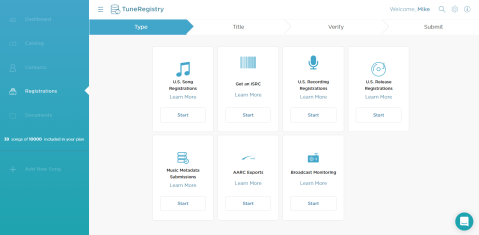
Demystifying TuneRegistry And The Concept Of Subscription-Based Self-Publishing Administration
Music 2020: The Next Era of Innovation in the Music Industry

Wednesday night, at California State University – Northridge (CSUN), I conducted my latest workshop, “Music 2020: The Next Era of Innovation in the Music Industry,” in Professor Andrew L. Surmani’s class for his M.A., Music Industry Administration students.
In this workshop, we explore the art and process of ideation; discuss the differences between invention, disruption, and innovation; and profile a number of developing innovations within the music industry including augmented reality (AR), virtual reality (VR), mixed reality (MR), artificial intelligence (AI), machine learning (ML), blockchain and crypotcurrency. The presentation ends with a design thinking exercise where students break out into groups to work through the fundamental design thinking process of developing a minimum viable product to solve a vetted problem in the music industry.
The students seemed to like the workshop:
Dae, you were fantastic and the CSUN MIA students thoroughly enjoyed your very organized, insightful and forward thinking presentation. That was evident in the line of students waiting to talk to you at the break. Thank you again for coming to talk to our graduate music industry students.
– Andrew Surmani, Associate Professor of Music Industry Studies, California State University – Northridge
I’m looking forward to conducting this workshop next week at the College of the Canyons.
How Blockchain And Cryptocurrency Can Speed Up Spotify International Publishing Royalty Payments To US Songwriters

There’s been a lot of talk about applications of blockchain technology and cryptocurrency payments in the music industry. In fact, there isn’t a single major music industry conference that doesn’t dedicate some programming to related topics. There are several projects and startups currently underway to address licensing, discovery, attribution, remuneration and more with blockchain, smart contracts, and cryptocurrency.
For those of us who aren’t blockchain developers, simply keeping up with the many applications of blockchain in the music industry is the closest we’ll get actually knowing how this all (could) works.
I’ve been thinking about how blockchain and cryptocurrency could speed up the process of paying U.S. songwriters, who wait upwards of 1.5 years to get paid for the use of their songs on Spotify outside the U.S.
The current state of the flow of international publishing income to U.S. Independent Songwriters who own their publishing and use traditional publishing administrators to collect in the U.S. is quite depressing.
As an example, Tommy released a song on Spotify in January 2018. In the United Kingdom, the song earned $100 “publisher share” Spotify UK digital public performance royalties.
Here’s the breakdown:
START: $100 “publisher share” of Spotify UK digital performance royalties in January 2018.
1. PRS collects Tommy’s publishing income in the UK ($100) in January 2018.
2. PRS retains 10% admin fee and remits the balance ($90) to ASCAP in October 2018.
3. ASCAP retains 12% admin fee and remits the balance ($79.20) to the Publishing Administrator in February 2019.
4. Publishing Administrator retains 20% admin fee and pays Tommy ($63.36) in July 2019.
END: Tommy is paid $63.36 for his Spotify UK “publisher share” income (earned $100) after waiting 1.5 years and experiencing a reduction of 37% of his royalties. Imagine $1,000 reduced to $633.60 or $10,000 reduced to $6,336.00.
Had Spotify used blockchain technology to dynamically identify Tommy as the rightsholder in his song and paid him instantly at the close of the month with cryptocurrency, Tommy would have already spent his $100 on studio time!
Why So Many Hip-Hop Producers Are Putting Business Before Beats
I shared my thoughts on music business for Hip-Hop producers in this piece by Cherie Hu for Pitchfork:
“The way many of these companies are trying to match and verify their data? Hundreds of emails,” says Dae Bogan, founder and CEO of TuneRegistry, a rights management platform for indie artists. “Many labels are still using old software and systems to manage their digital catalog, and their rights department is different from the one responsible for metadata, which is different from the one responsible for collecting royalties. There’s a lot of bureaucracy involved.”
Read the full piece here.
Dae Bogan Included In Bobby Owsinski’s ‘The Music Business Advice Book: 150 Immediately Useful Tips from the Pros’

Bobby Owsinski is one of the music industry’s greats. His ability to curate music industry knowledge into easy-to-ready texts across his over 20 books has helped thousands of music creators and music industry professionals in their careers. I’ve had the pleasure of being on Bobby’s podcast, Inner Circle, and participating on several music conference panels with Bobby. He is truly an inspiration. In fact, it was partially my participation in the making of his book “Music 4.0: A Survival Guide for Making Music in the Internet Age” that inspired me to write my first, very short, ebook “The DIY Musician’s Starter Guide To Being Your Own Label & Publisher.”
I am honored, once again, to have been included in Bobby’s latest book, “The Music Business Advice Book: 150 Immediately Useful Tips from the Pros,” available on Amazon.
About the book:
The music business can prove to be a difficult career road when you’re first starting out, but it can be traveled a lot easier with some helpful guidance from a pro who’s willing to share a few hard-earned hints. The Music Advice Book is a compilation of the pearls of experience from 130 top music pros from various segments of the industry who have previously shared their most important tips on Bobby Owsinski’s Inner Circle Podcast over the course of almost 5 years.
These 150 tips cover everything from following your passion, learning to network, and working well with your musical team, to owning your own content and even figuring out how much to charge for your services. Also included are even some useful music production words of wisdom, as well as the indispensable “10 Rules Of Networking.”
The insights in The Music Business Advice Book are essential for those new to the music industry but valuable to seasoned pros as well.
Free DIY eBook
CONNECT WITH ME


 Dae Bogan Music