
Songwriters Are Owed Nearly $2B In Unclaimed Royalties!!! — Maybe More — I’ve Been Saying This For Some Time Now (Against Pushback), But Finally The Press Has Confirmed It

Over the last few years, I’ve been researching and sounding the alarm on the growing problem of unclaimed music royalties or so-called “black box” royalties.
I’ve estimated the value of the collective black box to be nearly or above $2B. I’ve presented research, have written extensively and have spoken publicly about this problem, which disproportionately affect independent and legacy songwriters.
Despite my fanfare, industry insiders and stakeholders have shrugged or have blatantly called my estimates a gross overstatement and have held that unclaimed royalties are at best a few hundreds of thousands of dollars and mostly owed to “long-tail artists” who do not quite understand how the music industry works. This is a very myopic, company-focused view. These talking heads tend to speak from their position of administering one right for some music licensees. My estimates are looking at multiple rights administered by multiple entities, which would make the collective black box exponentially greater than the escrow account of a single entity.
Also Read: State of Unclaimed U.S. Music Royalties and Licenses
Yesterday, Variety published an article on the Music Modernization Act where a very important fact was tucked away on a single sentence in a paragraph near the end of the piece:
The DSPs are holding some $1.5 billion in unmatched mechanical royalties. If the MMA passes, that money would be passed through to the MLC which would match it to the songwriters and publishers. [bold and underline added for emphasis]
via Variety
$1.5B of royalties (I still believe this number is higher) is sitting in, probably, interest-bearing escrow accounts while songwriters and small-to-medium sized music rights holders struggle to understand how and why.
Last year I founded RoyaltyClaim, the world’s first search engine of unclaimed music royalties and licenses, which has recently been acquired by Made In Memphis Entertainment. We’ve helped DIY musicians and rights-holders identify thousands of unclaimed entitlements in just a few months, with one paricular music producer uncovering nearly $150k in unclaimed royalties due to him.
The problem is huge. The system is not transparent. And the people in charge could do a better job communicating these things to rights-holders.
Also Read: I’m Working On A Side Project Addressing ‘Black Box’ Royalties
I’ve been on many panels at music industry conferences where I’ve maintained my position that DIY musicians and small-to-medium sized rights-holders are owed hundreds of millions of dollars, if not several billion, and often my co-panelists have taken a position that my claims are sensational and overstated.
I disagree.
When those on the panel talk about black box we are talking about the aggregate of unclaimed royalties that occur because of any number of factors,’ and not just limited to one service or one collection society, explained moderator Dae Bogan, CEO of TuneRegistry.”
via Billboard
Source: https://www.billboard.com/articles/business/8456271/black-box-royalties-myths-panel-music-biz-2018
Read the Variety article here.
Check out my commentary on black box royalties here.
Coexisting Music Ecosystems

ICYMI, here’s a wonderful piece by Vickie Nauman on the notion of coexisting music ecosystems. I think it offers a fresh and nuanced look at how elements and traces of overlapping music industries — what Nauman calls Music Industry 1.0, Music Industry 2.0, and Music Industry 3.0 — shape our experiences as music industry professionals and consumers.
Have a read and lets discuss in the comments.
The music industry careens fast down the highway, stacked high with cargo and shiny objects. Think of the old CD business as the flat bed, the current digital industry as its loosely tethered, bulky freight, and artist-driven initiatives as sparkly crates hitched on top. Failed startups litter the rearview mirror. Yet all are tied together in a zigzag of relationships and common building blocks.
In practical terms, we’ve got three different music industries operating simultaneously.
Continue reading here.
Black Box Royalties Myths, Common Misconceptions Debunked at Music Biz 2018
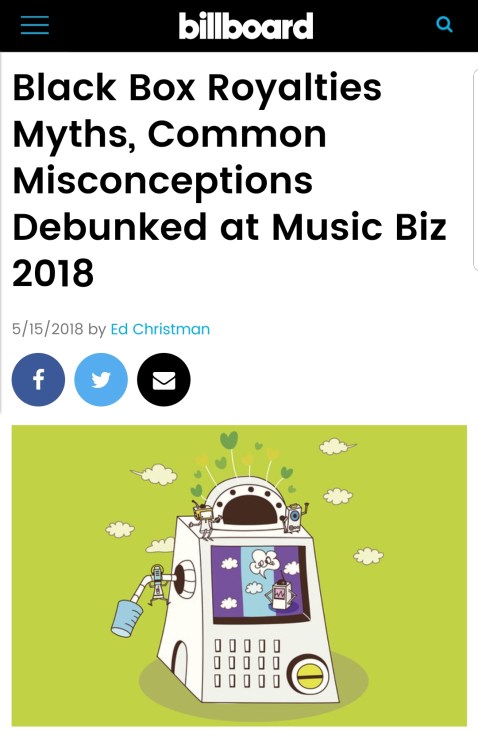
“‘When those on the panel talk about black box we are talking about the aggregate of unclaimed royalties that occur because of any number of factors,’ and not just limited to one service or one collection society, explained moderator Dae Bogan, CEO of TuneRegistry.” via Billboard.
Read the full piece here: https://www.billboard.com/articles/business/8456271/black-box-royalties-myths-panel-music-biz-2018
5 Ways The Music Modernization Act Could Be Fairer To ALL Music Creators

Today, the Music Modernization Act has passed the U.S. House of Representatives with a unanimous 415 – 0 vote (16 reps abstained from voting at all).
The mega bill — which consists of a bundle of Titles that were previously independently proposed bills — will change the way in which musical works are licensed by digital service providers and provide a safe harbor for infringement under a blanket licensing mechanism (Title One – Musical Works Modernization Act); it will bring recordings made before 1972 under federal copyright protection (Title Two – Compensating Legacy Artists for their Songs, Service, and Important Contributions to Society Act or CLASSICS Act); and it will codify an allocation of digital radio royalties to music producers and sound engineers (Title Three – Allocation for Music Producers Act or AMP Act).
On its surface the MMA sounds amazing, when summarized this way.
Accordingly, the passing of the MMA in the House was widely praised by executives from the most recognizable U.S. music rights organizations and trade associations (e.g. NMPA, RIAA, DiMA).
However, there remains many uncertainties in the language of the bill presenting an opportunity for the Senate to course correct before the bill becomes a law that would take over 20 years to improve, again (the Digital Millennium Copyright Act was the last piece of legislation impacting the music business — it was enacted in 1998).
So, what could the Senate do to make the bill more fair to the tens of thousands of music creators who are not represented (or underrepresented) by the industry sponsors of this bill? Well, there’s at least five issues that can be addressed immediately:
- Ban the practice of distributing by market share unclaimed royalties that rightfully belong to DIY musicians and songwriters.
- Mandate that record companies provide complete and accurate (at the time of release) publishing information for each track within the metadata delivered to distributors/aggregators, and that the latter provides that information to DSPs.
- Do not expunge all past copyright infringement claims, only future claims upon the date of the enactment of the law.
- Maintain a representative MLC board of 50% publishers and 50% songwriters (with at least 1 unsigned songwriter on the board (e.g. Chance the Rapper)) as opposed to the BS 10 publishers, 4 songwriters (who’ll likely come from the major publishers anyway) that has been written in the bill.
- Respect the Berne Convention by not disregarding the musical works of non-US songwriters who have not (and will not) register each of their songs with the USCO or MLC.
How else could the MMA be improved? Or do you feel that it is fair enough? Let’s discuss in the comments.
I Was Interviewed By The Congressional Budget Office Regarding The Music Modernization Act, And Now I’m Even More Concerned For DIY Musicians
I just spent the last hour giving a copyright law and music publishing crash course to a Principal Analyst at the Congressional Budget Office who’s tasked with determining the economic impact of the revised Music Modernization Act (which, by the way, now includes the Musical Works Modernization Act (which is an update to the originally proposed MMA, affecting songwriters and publishers), AMP Act (affecting producers and engineers) and CLASSICS Act (affecting recording artists of Pre-1972 records)) on states, DSPs and music creators.
He emailed me yesterday and asked to speak with me about the magnitude of the unclaimed royalties market, although we ended up discussing much more than that. Apparently he had discovered a presentation that I gave at the Music Industry Research Association’s MIRA Conference last year titled “The State of Unclaimed Royalties and Music Licenses in the United States.”

Email from a Principal Analyst at the Congressional Budget Office
At the top of the one hour call he began by stating that he’s had to learn copyright and music publishing in 2 days (2 days!!!). The guy who’s going to contribute to a recommendation to Congress that will impact whether or not 3 different bills will be enacted and change our copyright law has spent only 2 days learning about the complex web of regulations and customs that govern an entire industry and its millions of constituents. I guess this is how legislation is vetted; economically.
The good news is he had a lot of great questions and had did a significant amount of research prior to our call. To be fair, I meet plenty of music industry professionals who have (or at least demonstrate) less knowledge of what’s going on in the world of music rights administration and music publishing than this gentleman; and they’ve spent years in the industry! It is refreshing to know that the government does inquiry with non-lobbyist from time to time when considering the impact of proposed legislation.
At any rate, he was open to hearing my advocacy on behalf of music creators (specifically songwriters, music producers, and recording artists of Pre-1972 records) as well as my substantiated opposition to some features of the revised MMA (generally those features that would disproportionately benefit music licensees (primarily, DSPs) and major publishers while leaving DIY music creators to fend for themselves).
[This paragraph was omitted on 4/20/2018 as a result of a clarification that I received for Title 3 of the MMA]
Another issue I have is with the ownership of the unclaimed mechanical royalties fund(s). The Musical Works Modernization Act (Title 1 of the MMA) would, for the first time, codify the existence of a mechanical royalties black box in the United States. The current US Copyright Act does not give copyright owners a right to earn or collect mechanical royalties if their musical works are not registered with the US Copyright Office.
After the NOI has been filed, it is then the copyright owner’s responsibility to become aware of and locate the NOI, and then take action in order to receive mechanical royalties. The law states, “To be entitled to receive royalties under a compulsory license, the copyright owner must be identified in the registration or other public records of the Copyright Office.” (17 USC 115(c)(1))The law also makes it clear that the licensee is not required to pay mechanical royalties until after the copyright owner has been identified. “The owner is entitled to royalties for phonorecords made and distributed after being so identified…” (17 USC 115(c)(1)) What’s worse, the law does not require the licensee to pay retroactively for mechanical royalties earned before the copyright owner is identified. “…but is not entitled to recover for any phonorecords previously made and distributed.” (17 USC 115(c)(1))
However, intermediaries (e.g. Harry Fox Agency, Music Reports, Loudr) that process NOIs (Notice of Intent to Obtain a Compulsory Mechanical License) on behalf of their DSP clients do encourage their clients to set aside unattributed mechanical royalties into an escrow account (the so-called “black box”). The royalties sit there until the copyright owner raises his/her/their hand to collect the earnings or until the entity decides to disburse or absorb the uncollected funds.
Generally, this is a “good faith” policy.
Now, since the MMA will codify the black box as a matter of law, this private sector matter will become a government matter. The question, then, is will federal government or state governments have the right to maintain the unclaimed royalties black box?
Currently, unclaimed property laws enable states to receive and hold unclaimed property (such as money) when the property owner can not be reached. For example, California’s Unclaimed Property Law requires corporations, businesses, associations, financial institutions, and insurance companies (referred to as “Holders”) to annually report and deliver property to the California State Controller’s Office after there has been no activity on the account or contact with the owner for a period of time specified in the law – generally (3) three years or more. I’ve had a few refunds from services that I used and cancelled when I moved from one place to another. I did not provide the service with a forwarding address, so my refund became unclaimed property and ended up with the California State Controller. By searching the CSC’s database, I was able to find and then claim the property (pictured below).


If your property goes unclaimed too long (each state has their own statute of limitations), the state has the right to liquidate the property (e.g. sale an unclaimed vehicle) and absorb proceeds as miscellaneous revenue to the state’s budget [lawyers, correct me in the comments if I’m wrong].
Because states unintentionally (benefit of the doubt) benefits from unclaimed property, I could see states with significant music industries (e.g. California (Los Angeles), New York (Greater New York City), Tennessee (Nashville), Georgia (Atlanta)) suing the federal government or the Mechanical Licensing Collective (the entity that would be granted under the MMA to administer a new blanket licensing system along with a centralized database of musical and sound recording copyrights to match works with usage reports submitted by digital services) over the right to collect unclaimed royalties, especially if the black box is hundreds of millions of dollars (which I believe it is).
There are many other issues that I have with the MMA such as the proposed formation, structure (especially the imbalance of representation on its board where there would be 10 publishers and only 4 songwriters (why not 7/7?)), and governance of the MLC and similar unclaimed royalties issues related to the CLASSICS Act; among other issues. I’d be happy to discuss, but this post is already yuge!
In a word, I am all here for improving royalty rates, ensuring the fair treatment of music copyrights and moving towards a more equitable representation of music creators. However, the MMA is not quite there yet and passing it as-is, with all of its ambiguity, would be a shame. I don’t know if the music industry will have another shot to make this kind of update to the Copyright Act in the next 20 plus years (the Digital Millennium Copyright Act of 1998 was the last significant update).
We should probably get it right — now.
[Podcast] “How Tech Can Save The Music Industry” Panel Recording From SXSW 2018

I had the pleasure of participating on the panel “How Tech Can Save The Music Industry” at SXSW 2018 with Benji Rogers (Pledge Music & dotBlockchain), Jason Robert (HelloSugoi), and moderated by Eron Bucciarelli (Soundstr).
The music industry is in dire need of change not only to thrive, but survive. Streaming, pirating and the secondary ticket market have dealt serious blows to our industry’s major revenue streams, but technology can be our savior. Join experts from the royalty, rights, ticketing and metadata blockchain sectors to learn not only how tech can provide short-term solutions, but also build a more sustainable industry. Join us to learn how tech can save the music industry.
How To Apply For A Harry Fox Agency Online Account As A DIY Musician – A Step By Step Guide.

Ever since I wrote the article “How To Get A Facebook, Instagram and Oculus Direct License For DIY Musicians & Indie Publishers” for the TuneRegistry blog, musicians who own their publishing have flooded my inbox with questions regarding the Harry Fox Agency Online Account application process.
The Harry Fox Agency represents the reproduction rights in songs for thousands of publishers in the United States and issues millions of direct and complusory mechanical licenses to music users on behalf of its HFA affiliate publisher members. In addition, its Rumblefish division performs an array of licensing and administrative (e.g. royalty accounting) responsibilities for dozens of digital service providers, start-up music apps/websites, and other digital music clients. In a word, HFA issues licenses, collects royalties, and make payments to rights-holders to the tune of hundreds of millions of dollars annually.
An HFA Online Account enables publishing rights-holders who are not eligible to become an HFA affiliate (e.g. DIY musicians) to still receive and enter into some direct licenses for the use of their songs in the products and services of HFA/Rumblefish clients. This includes powerhouses like Spotify, Facebook/Instagram and LyricFind, among many others. Once you’ve entered into a license, you must give HFA a list of your songs with proper metadata. You can remit your catalog of license-ready songs to HFA, and other music rights organizations and rights clearance houses, via directly from within your TuneRegistry account.
Admitingly, I did not go into much detail in the Facebook license blog in regards to how to apply for an HFA Online Account (although, I did include the HFA client services email for additional questions). Having reviewed the application form, I can see how a DIY musician could become confused. The form was designed for publishers and administrators, so a DIY musician who wears the hat as his/her own music publisher may get easily confused.
Download my free ebook, The DIY Musician’s Starter Guide To Being Your Own Label & Publisher here.
To aid in providing clarity to DIY musicians, I have written instructions for each question/field on the application form in the order as it appears. This should clarify the questions that I often receive regarding the application form.
[Note: In writing this article, I sought feedback from John Raso, VP of Client Services at Harry Fox Agency, who verified and approved my field instructions/comments and added his own notes as needed. Where applicable, I have included additional notes from John below.]
Form completion instructions for an HFA Online Account publisher application for DIY musicians who own and control their publishing and do not have a publishing deal or an applicable publishing administration deal:
1. Publisher Name: If you have a publisher or have hired a publishing administrator, stop here. Your publisher should be handling licensing with HFA. You can contact your publishing representative for clarification. If you do not have a publisher, then enter your publishing entity name as used with ASCAP, BMI, or SESAC. If you have not created a publishing company and joined ASCAP, BMI, or SESAC enter your full legal name.
2. HFA Account P#: Skip, unless you’ve received correspondence from HFA with an HFA Account P#.
3. Administrator Title: Enter “Self” if you are representing yourself. Enter the title of your representative if you’re giving them authority to oversee your HFA Online Account (e.g “Manager”, “Attorney”).
4. Administrator Name: Enter your full legal name if you are representing yourself or enter the full name of your authorized representative who will be overseeing your HFA Online Account. This is just who should be contacted aout your catalog.
5. Administrator Mailing Address: Enter the contact information of the individual identified in #4. Where should HFA mail things to?
6. Administrator Settings: This is where much of the confusion arises. Here are some scenarios:
- If you are applying as an individual self-published songwriter with no publishing entity, then select “Individual/Sole proprietor”, enter your tax ID (SSN or ITIN), and enter the name that should appear on tax documents (generally, your legal name).
- If you are applying as an individual self-published songwriter who has hired a publishing administrator, then you should not complete this application in the first place. Contact your publishing administrator.
- If you are applying as an individual self-published songwriter who has setup a business entity for the purpose of administering your own publishing with ASCAP, BMI, or SESAC and you have input this publishing entity in #1, then select the business entity structure that you have setup to form your company. For example, if your entity is a Limited Liability Company, then select “Limited Liability Company”. If it is a DBA, then select “Individual/Sole proprietor.” Enter the tax ID for the entity (this may be your personal SSN/ITIN if you are a sole proprietor or it may be your EIN if you’ve applied for one with the IRS for your LLC, Corporation, or Partnership). Enter the name on tax return that matches the entity type that you’ve selected.
- Note from John Raso, VP of Client Services at HFA: “We run the tax ID and payee name provided (“Name on Tax Return”) against the IRS database. If it doesn’t match, we cannot pay this person (or we will get fined). We hold any royalties until we get a proper name/tax ID match (we reach out several times a year to people we are holding royalties for this reason).“
For additional questions or to check on the status of an HFA application, contact clientservices@harryfox.com.
Was this article helpful? I am considering writing more like it for other music rights organizations’ application processes. Let me know in the comments.
Ask Me Anything About The Music Business, With Dae Bogan
Ask me your music business question and I’ll attempt to provide you with an answer or direct you to a resource with a better answer or guidance. I cannot provide specific legal advice, but I can discuss general music business practices. Join the conversation on Facebook, Twitter, Linkedin, or DaeBoganMusic.com. Simply drop your question in the comments section wherever you see the above image.
500 Spotify Playlists That You Can Pitch To Right Now
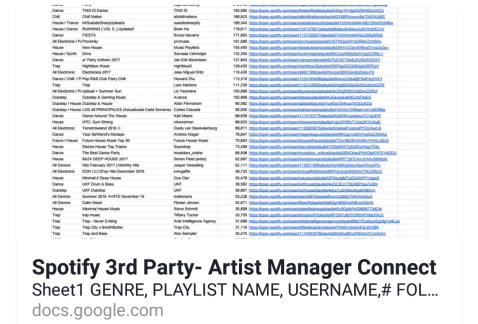
Several members of the Artist Managers Connect Facebook group (a global networking group of artist managers and other music industry professionals such as service providers, music tech founders, and label/publishing reps) curated a list of third-party Spotify playlists.
This amazing resource is a Google Sheet posted by AMC member Jorge Mejias with a caption:
Since I truly hate the fact that there are “PR” companies offering “Spotify Playlist Pitching” for upwards of $1K+ making false promises they know and then saying something around the lines of “it’s just how the industry is” or “Spotify playlisting is tough” or whatever-
Here is a google sheet w/ info on some of the most popular third party Spotify playlists that most of these companies are pitching to because-
1) this information is all public so I don’t feel bad giving it out & saving people some research
2) what you get out of it = how much time you dedicate to it
3) getting scammed in 2017 / not helping prevent it when you can is silly
Contact info is all out there so stop making excuses. Also the follower count on these are outdated.
*Edit* – also this is a thank you to everyone from AMC who has helped me out thus far. you rock~
*Edit2* – also please refrain from publicly posting any contact info- thank youuu!
*Edit3* – this post by no means aims to discredit companies who do properly provide pitching services. Dan put it best by saying “Would like to caveat that some of us work records at Spotify and Apple Music very transparently and based on years of repertoire and success for our artists within the platform’s respective ecosystems. ”
*Edit4* – thank you Dustin for contributing his spreadsheet
The list requires you to do a little bit of work to reach out to the curator, but the awesome thing about the list is that they’ve already done the work to identify the curator’s Spotify username and have tracked followers and genre to help you sort and prioritize.
List: https://docs.google.com/spreadsheets/d/1-jf6HkRHay43pv8f6X_VneDPuEY405YV3Ool8GVdZjs/htmlview
Go forth and pitch your music!
Let me know if you land a placement.
[Podcast] Dae Bogan On “The Business Of Data” Panel At SF MusicTech Summit 2017

Listen here.
SF MusicTech Summit
October 17, 2017
www.sfmusictech.com
PANEL DISCUSSION: This Business of Data
MODERATOR: Cherie Hu, Forbes / Billboard
SPEAKERS:
Scott Ryan, Gracenote
www.gracenote.com
Michael Jeffrey, TiVo
www.tivo.com
Dae Bogan, TuneRegistry
www.tuneregistry.com
Kristin Westcott Grant, Westcott Multimedia
www.westcottmultimedia.com
***********
Recorded by Media One AV
www.mediaoneaudio.com
Listen on SoundCloud here.
Free DIY eBook
CONNECT WITH ME


 Dae Bogan Music