
Have You Searched The Royalty Claim Database? What Are You Waiting For?
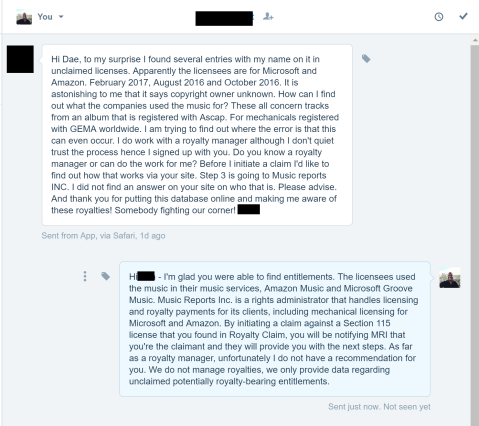
If You’ve Never Received Mechanical Royalties From Google Play Music, This Might Be Why
Is Google Willfully Refusing To Use Its Own Assets To Identify Copyright Owners?
In recent weeks Google and YouTube has come under fire by high-profile music industry professionals in regards to Lyor Cohen’s statements on the royalties it pays to artists. This piece is NOT about that.
At Royalty Claim, we periodically randomly select and investigate records that our researchers and data scientists ingest. Random investigations — sometimes against pre-determined hypotheses and sometimes just to follow down the rabbit hole — has helped us uncover nuances in the music licensing ecosystem that manifest into trends that suggest major systemic issues.
Earlier this month we reported that Google has filed nearly 7 Million Section 115 NOIs on the US Copyright Office for musical works in which it claims to be unable to identify the copyright owner. Then, Lyor Cohen boasted about YouTube’s royalty payouts and its growing ability to match music to videos (Google it, it’s everywhere). And then we remembered that this is only possible due to YouTube Content ID, which is arguably the largest database of copyright information with music codes, audio samples, etc.
So, if the largest submitter of “copyright owner unknown” NOIs is also the owner of the largest private database of copyright owner information, it makes no sense that Google cannot seem to identify copyright owners to pay mechanical royalties for the use of the copyright owner’s songs on Google Play Music.
So, we investigated this.
Do So-called Music Advocacy Groups Avoid Deeper Discussions On Black Box Royalties To Appease Their Major Members?

Over the last few weeks I’ve come to consider the notion that some of the biggest so-called “advocacy” groups for music creators censor their discussions on black box royalties due to the top-heavy makeup of their membership.
I’m Working On A Side Project Addressing ‘Black Box’ Royalties
![[Preview] The State of Unclaimed Royalties and Music Licenses in the United States (7)](https://daeboganmusic.com/wp-content/uploads/2017/08/preview-the-state-of-unclaimed-royalties-and-music-licenses-in-the-united-states-7.jpg?w=479)
Lead Photo by Jonny Clow on Unsplash
Watch As Royalty Claim Uncovers Unclaimed Royalties & Music Licenses For Beyoncé, Carl Cox, Afrojack, and Ellie Goulding
Watch us uncover unclaimed royalties & licenses for Beyoncé, Carl Cox, Afrojack, Ellie Goulding, and more using Royalty Claim Platform v1.0 https://youtu.be/J7nIdFdwlzY
[VIDEO] Full Video Of Royalty Claim Pre-launch Webinar
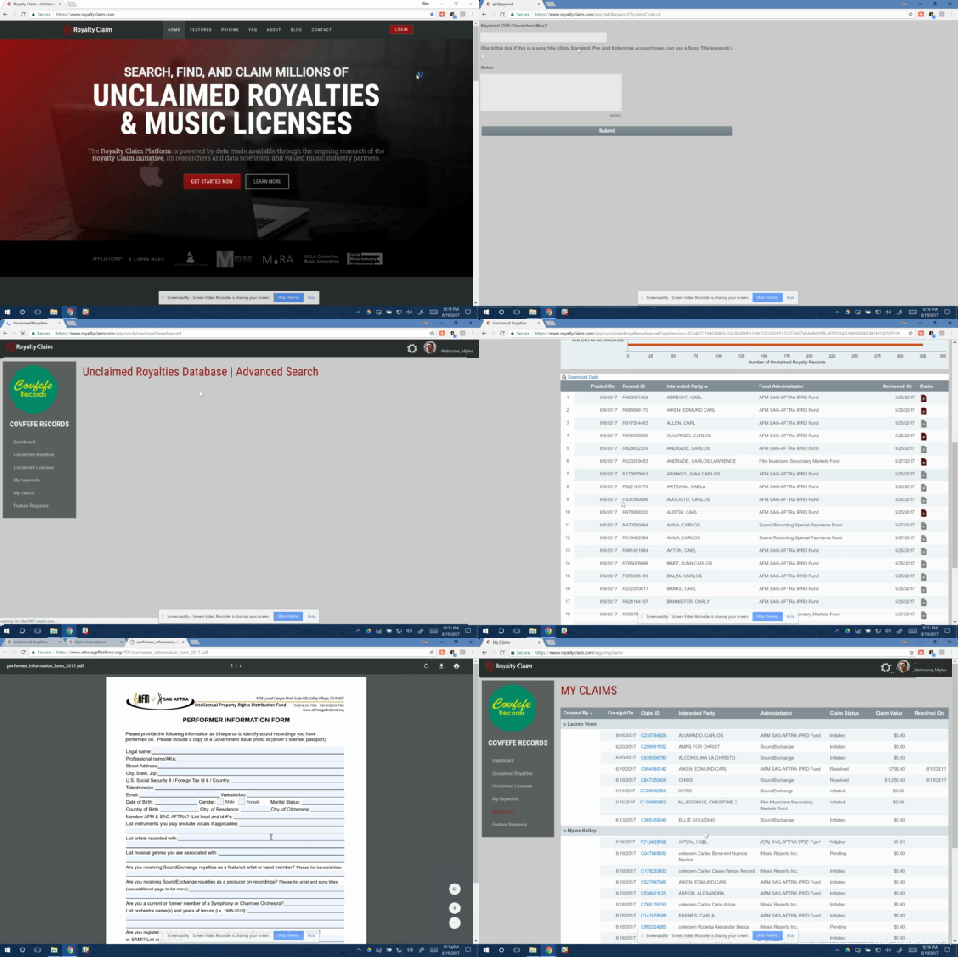
If you missed the Royalty Claim Pre-launch Webinar, watch the full recording here.
(Almost) Everything That You Want To Know About Royalty Claim’s Data

QUESTION: WHERE DOES ROYALTY CLAIM’S DATA COME FROM?
ANSWER: MANY PLACES.
Royalty Claim Initiative researchers and data scientists locate, retrieve, synthesize and ingest an array of published and unpublished data that reference statutory notifications of certain music licenses, unattributed royalties (so-called “Black Box” royalties) and settlements; and income participants (payees) in undistributed royalties that stem from collective bargaining agreements, international reciprocal agreements, statutory royalties, and more. We also analyze data related to music consumption (e.g. downloads, streams, sales), broadcasts, performances, and other types of data to identify trends from which we can interpret insights into the global music licensing ecosystem.
THE FOLLOWING IS JUST A SAMPLE OF THE TYPES OF ROYALTY FUNDS IN WHICH WE ARE INTERESTED:
Royalty Claim’s Full Presentation At The Music Industry Research Association Conference

Royalty Claim attended the Music Industry Research Association‘s first inaugural MIRA Conference at the UCLA Luskin Conference Center this week. Royalty Claim’s Founder and Chief Researcher, Dae Bogan, MIA, had the honor of presenting a preview of our in-progress The State of Unclaimed Royalties and Music Licenses in the United States report before an audience of economists, sociologists, and researchers from universities and institutions from around the world, as well as music industry executives representing firms such as Nielsen, Pandora, Universal Music Group, and Warner Music Entertainment.
For the first time, updated statistics regarding the filing of “address unknown” Section 115 NOIs on the US Copyright Office during the first half of 2017 was revealed. Insights included an overview of the organizations that have utilized the procedure, including Amazon, Google, Spotify, iHeart Communications, and Microsoft. However, those large music users were expected. Interesting inclusions to the list were The Recording Academy and the Christian music service, TheOverflow and interesting omissions from the list are platforms that boast millions of tracks — Apple and Tidal — but may not be reaching every independent rightsowner that may have compositions available on those platforms.

.jpg)
The presentation also discussed the nature and causes of so-called “Black Box royalties”. A black box is an escrow fund in which music royalties are held due to an organization’s inability to attribute the royalties earned to the appropriate payee. Examples were given, including unattributed advances from DSPs to music companies, the US’s limitations on sound recording rights, and other issues.
.jpg)
The presentation concluded with a video demo of the Royalty Claim Platform, which received positive reviews from conference attendees. The full presentation is here.
I’m Working On A Side Project Addressing ‘Black Box’ Royalties

As of this writing, there are currently 116,133 verifiable* payments owed to music creators and rights-holders that are sitting in unclaimed/undistributed royalties escrow accounts (referred to as “Black Box” funds**) in the United States.
The actual number of individual payments owed is likely closer to or exceeds 1 Million, however the actual number is unknown because the administrator(s) of some of the biggest Black Box funds have not made public their list of payees to whom they owe royalties.
Unfortunately, due to the statute of limitations on these funds many of these payments expire. Every month payees unknowingly forfeit their rights to these payments and the interest in the royalties revert back to the administrator. This happens because the payee does not contact the administrator of the fund to claim their royalties. Granted, most payees are unaware that these payments are waiting for them because the administrator is unable to reach the payee for various reasons.
It has been estimated that the global “Black Box” royalties could be in the billions of dollars owed to music creators and rights-holders.
Imagine working somewhere and then you do not receive a paycheck because the HR department does not have your new address. Not a perfect analogy, but not receiving monies that you’ve earned as a result of your hard work seems unfair.
THIS IS A HUGE PROBLEM
So, I am happy to announce that I am working on a side project called Royalty Claim. Royalty Claim will attempt to work with as many of these administrators to aggregate their databases of millions of records of unclaimed/undistributed royalties and make that information available to the public. There are other services and insight that we will offer through Royalty Claim to help educate music creators and rights-holders on Black Box funds and how to limit/prevent their earnings from falling victim to the broken global music licensing ecosystem (such as taking control of your music catalog with TuneRegistry).
Want to get updates on the Royalty Claim project and be the first to know when we have something to reveal? Sign-up for our email list at www.RoyaltyClaim.com.
Also, follow @RoyaltyClaim on Twitter.
* These 116,133 payments are specifically verifiable because the list of payee names can be gathered from several databases.
** I am currently aware of over 30 funds and sub funds being managed in the United States. However, there are definitely many more that are “private”.
5 Royalty Streams Every Indie Artist Should Know

This post was originally written for and published on Repost Network’s blog.
With the rise of music distributors and digital music aggregators, it has never been easier for an indie artist to release and monetize their music across the global digital music ecosystem. The Digital Music Era has significantly lowered the barriers to entry to the top outlets for music search and discovery; and startup entrepreneurs continue to develop and launch new platforms to innovate search, discovery, sharing, and access.
Today, music fans can easily access music from their favorite artists or discover new artists to fall in love with, pitting major established artists against their up-and-coming indie artist counterparts. And the music industry is changing for the better as a result (the Recording Academy now recognizes music released on free services for GRAMMY Award consideration and Billboard has accepted YouTube and SoundCloud streams for the purpose of charting).
Innovation in technology has made it possible for any indie artist with decent enough production tools and access to the Internet to record and release new music at any time. And with thousands of artists pumping out new music, it is no wonder that the industry has grown to over one million new tracks entering the global music market every month.
Each of these tracks begin earning royalties from its first play on any of the 400+ digital music services and 3,000+ webcasters operating around the world. And all of these royalties, billions of dollars of royalties, flow through a complex network of pipelines into various buckets of royalty collection with the ultimate goal of trickling down to the appropriate music creators and rightsholders. While this sounds straight-forward for a number of reasons this is far from a smooth process; and millions of dollars in royalties are in fact not making its way to the music creators and rightsholders to which they are due.
Part of the reason starts with you, the music creator. It is especially important for independent artists to understand the various income streams that your releases generate and the ways in which you must be setup to collect your royalties.
Here is an awesome infographic created by Future Music Coalition that visually breaks down how creators are compensated. Below it, I highlight five royalty streams that every indie artist should be setup to collect.
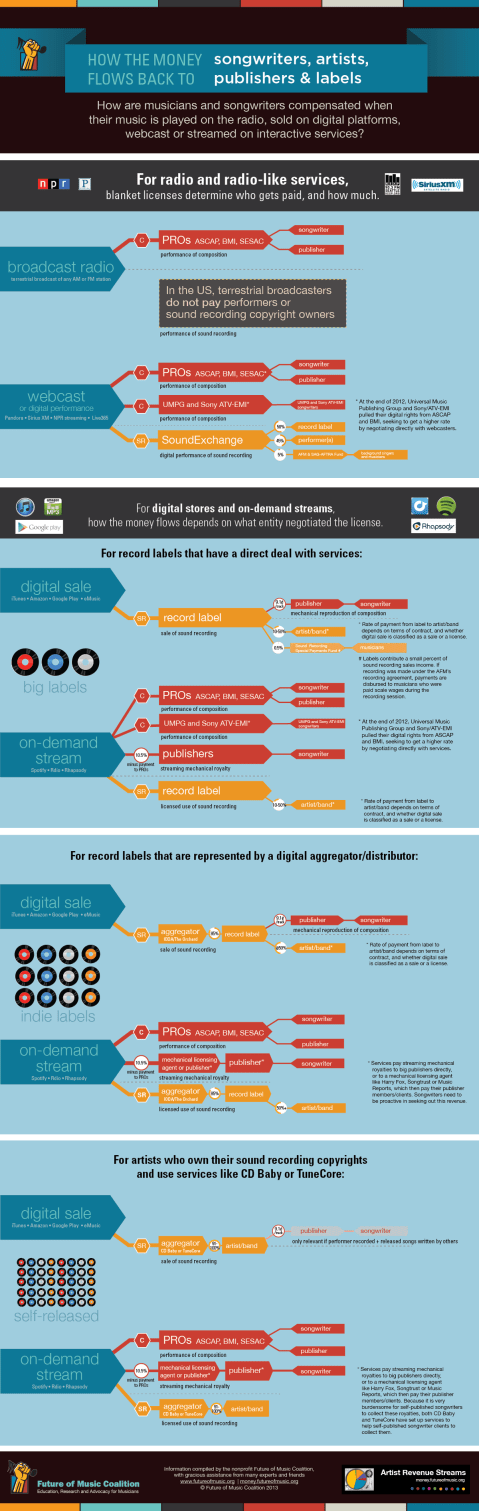
If you plan to release music digitally, you should be aware of and setup to collect all of the royalty streams that your music earns. Your music earns royalties for the use of two different copyrights. The first is the copyright for the composition (song). The second is the copyright for the sound recording (master). These two copyrights earn royalty streams that are collected and paid out by different sources to different income participants, as explained below.
Royalty Stream 1: Performance Royalties for Compositions
With few exceptions, virtually all uses of your composition earns performance royalties. Performance royalties are earned when your composition is played on digital radio-like services (e.g. Pandora), when your composition is accessed and played through on-demand streaming services (e.g. Spotify), and when your composition is performed in venues, bars, and restaurants. All of these companies have performance licenses from one or more performing rights organization (PRO). In the United States, ASCAP, BMI, SESAC, and Global Music Rights are the PROs who issue blanket licenses for the performance rights in compositions to digital music services. In return, these services pay royalties to these PROs. The PROs then pay 50% to the songwriter(s) of the composition and 50% to the publisher(s), in accordance with the publishing splits reported to the PRO by the copyright owners. In order to collect performance royalties, you must join a PRO and register your composition (your songs) and the associated ownership splits (for example, 4 Writers might have equal ownership (25% each) or varied ownership (Writer 1 – 25%, Writer 2 – 50%, Writers 3 – 12.5%, Writer 4 – 12.5%)) to the PRO in a timely manner. One of the reasons music creators and rightholders do not receive the performance royalties that their compositions earn is because they have not joined a PRO or have not registered their songs with their PRO.
Royalty Stream 2: Mechanical Royalties for Compositions
Mechanical royalties are earned when your composition is reproduced and distributed in phonorecords (a medium in which a sound recording is stored). This includes compositions embodied in sound recordings stored in physical formats (CDs, vinyl, cassette), MP3 permanent downloads (e.g. iTunes), and interactive streams (e.g. Spotify). In the digital music sector, streaming services secure mechanical licenses either directly from copyright owners or by utilizing the compulsory license as provided by copyright laws. Regardless of how they secure their mechanical license, the major services pay mechanical royalties to Harry Fox Agency (HFA) and Music Reports Inc. (MRI), who then pay the publishers of the composition. One of the reasons music creators and rightsholders do not receive the mechanical royalties that their compositions earn is because they have not registered their songs with HFA or MRI, who help digital music services secure the mechanical licenses. For unsigned indie artists, this can be much more difficult if you do not have a publisher because HFA only represents eligible publishers who’ve affiliated with them. MRI is a rights administrator and will issue notices to copyright owners if their digital music service clients intend to utilize the copyright owner’s composition in a manner that requires a mechanical license. Spotify pays HFA mechanical royalties for the compositions used in their platform. Amazon Music pays MRI mechanical royalties for the compositions used in their platform. (Note that in the United States, iTunes passes the mechanical royalty to the distributor, who then pays the label. If you’re an unsigned artist, then you receive the income since you are your own label. Outside of the United States, iTunes and on-demand services such as Spotify pay mechanical royalties to a mechanical licensing society in the territory represented by the society. In order to capture these foreign mechanical royalties, a publisher or administrator must affiliate with and register the compositions with the foreign mechanical collection society.)
Royalty Stream 3: Permanent Download Royalties for Masters
A permanent download is generally a sales transaction through a digital retail store (e.g. iTunes). This income is passed along to the distributor, who then pays the label (less any applicable commissions). If you’re unsigned artist, then you receive the income since you are your own label.
Royalty Stream 4: Interactive/On-demand Streaming Royalties for Masters
Just like a permanent download, interactive/on-demand streams (e.g. Spotify) of sound recordings generates master use royalties that is passed along to the distributor, who then pays the label (less any applicable commissions). If you’re unsigned artist, then you receive the royalties since you are your own label.
Royalty Stream 5: Non-Interactive Streaming Royalties for Masters
Unlike a permanent download or interactive/on-demand streams of sound recordings, non-interactive streams are not paid to your distributor. Webcasters and digital services that broadcast recordings over the Internet (e.g. Pandora, iHeart Radio), cable (e.g. Music Choice), and satellite (e.g. SiriusXM) in radio-style programming where the end users/listeners have limited to no control over the selection of music (non-interactive) pay a royalty for the digital performance of sound recordings to SoundExchange. SoundExchange then pays out 45% of the royalties to the featured performers on the recording, 50% to the copyright owner of the master recording, and 5% to a fund for background vocalists and session musicians maintained by AFM & SAG-AFTRA Intellectual Property Rights Distribution Fund. One of the reasons music creators and rightholders do not receive the non-interactive royalties that their masters earn is because they have not joined SoundExchange or have not registered their tracks with their SoundExchange.
When you release music digitally, you should be aware of the various royalty streams that your music earns, where those royalties are collected, and how to claim your earnings. Your distributor is one source of income for two of the royalty streams mentioned. To unlock the rest of your royalties, you’d need a capable publisher and a record company or you’d need to stay on top of the administration yourself.
A great way to keep track of all of these royalties is a service we recommend called TuneRegistry.
TuneRegistry is an all-in-one music rights and metadata management platform for the independent music community. Easily organize and store your song details, recording metadata, credits and ownership splits, and release information in your TuneRegistry account. It’s your robust music catalog manager that’s accessible online, so you don’t have to worry about tracking down emails, storing through documents in various desktop and cloud folders, losing collaborator contact information, or any of the other messy issues that most indie artists face.
TuneRegistry is your one-stop source for keeping your music catalog in check.
The advantage of TuneRegistry over other catalog management systems is that we’ve integrated the registrations process directly to ASCAP, BMI, SESAC, Music Reports, SoundExchange, and many more. Save time, reduce errors, and unlock royalties with our integrated registrations module. We make it super easy to get your music registrations to the organizations and data services who need it.
YouTube Announces Major Change To How It Will Handle Music Publishing
In an email sent to YouTube Music partners this week, YouTube announced that it will change the way it handles publishing.
Currently, YouTube allows rights holders to submit metadata and ownership information to a single global composition record. If there are multiple rights holders, their information is aggregated and rolled up into the “global” composition asset. Then various owners of sound recordings can create relationships (matches) between the “global” composition and their sound recordings. For example, 3 cover song recordings matched to a single “global” composition. However, YouTube is changing this process.
YouTube is doing away with a “global” composition and Composition Asset ID, which all rights holders on the composition would share, and now requiring that rights holders submit a “Composition Share” asset (think of it in relationship to a Split Sheet, the writer/publisher share) and provide their own unique Custom ID to YouTube, which associates back to the composition in the rights holder’s own database (e.g. a catalog number).
Notably, YouTube will no longer create composition to sound recording relationships on behalf of rights holders. It will become more important than ever for right holders to stay on top of their ownership splits and submissions. Furthermore, because YouTube will now rely on rights holders own Custom IDs, it will be important to implement and maintain a clean unique ID database. This could be the catalog number or the same unique ID the publishers use when registering works to PROs via CWR.
Read the full email below…
Dear YouTube Music Publishing Partner,
We are launching a new publishing data model to give you more transparency into and control over how your rights are associated with sound recording assets. In this new model, we will no longer have one “global” composition asset with metadata, ownership, and embedded relationships provided by various owners. Instead, each owner will have their own “Composition Share” assets. These “Composition Share” assets represent only the metadata and ownership information provided by a single owner. Your provided embedded relationships between “Composition Share” assets and sound recording assets will always be applied.
Our current planned launch date for this change is four weeks from now, on Monday, April 3.
This new model will require one major change on your side. Because we will be deprecating our historical Composition Assets and replacing them with a new asset type, today’s Composition Asset IDs will no longer be used. In most cases where you now use Composition Asset ID (including delivery and reporting), you should transition to using the Custom ID field. We recommend that the data you provide in this field always mirror the proprietary work codes that you use in your own database. In order for your Custom IDs to behave in a sensical and deterministic manner, it is critically important that your Custom IDs function as a primary key. That is, every Composition Share must have a Custom ID, and each Custom ID must refer to one and only one Composition Share. We strongly urge you to examine your Custom ID data now and confirm that your Custom IDs refer to only a single work each. If you suspect that this is not the case, please reach out to [omitted] for assistance. We would be happy to send you reports of how you are currently using Custom ID and where any gaps in your data may exist. If your Custom IDs do not function as a primary key in our new model, you may experience errors and ingestion failures.
Because this is a major change, this may require some workflow adjustments on your side. A few important things you should be aware of:
You will have greater control of embedded relationships between Sound Recordings and “Composition Shares.” Any embedded relationships delivered by any publishing partner will always be applied. If partners deliver conflicting data, these conflicts will immediately manifest in the YouTube Content Manager. By the same token, if you do not deliver us a Composition-Share-to-Sound-Recording relationship, we will not create one for you based on other partners’ data. You can continue to create these relationships through CSV ingestions, and we will be adding the ability to delete these relationships in bulk via CSV ingestions. We are also adding functionality to the Content Manager to allow you to edit these relationships directly in the user interface.
Conflicts now exist at the Sound Recording level, rather than at the Composition level. This means that you will see a larger number of conflicts in your conflicts queue. This increase in the number of assets in conflict does not necessarily represent a larger number of views in conflict; conflicts are merely being reported to you on a more granular level. Given that you will now have greater control over embedded relationships, conflicts caused by bad data should be much easier to resolve. When communicating about conflicts with other partners, you should now use Sound Recording Asset IDs instead of Composition Asset IDs.Asset revenue will be reported at the Sound Recording level, rather than at the Composition level. This means that your asset revenue reports will grow (they will have more lines). To see revenue reported to you at the Composition level, simply pivot the asset revenue report on Custom ID. If you need assistance processing these larger reports, please reach out to your technical account manager or send an email to [omitted].
We recognize that this is a major change that may result in substantial changes to your current workflows. We want to make this change as easy as possible for you and we are here to help and to listen to your feedback. If you have any questions not addressed in this email or on the Help Center, please contact your regular YouTube representatives. To submit feedback directly to our product specialists, please hit the “Help & Feedback” button in CMS. For operational or technical support, please reach out to [omitted]. We will also be hosting office hours and workshops at our New York City office, at our Los Angeles office, and in Nashville in the weeks after the new model is launched. If you are interested in attending, please reach out to your regular YouTube contacts.
Best,
Taylor Fife
YouTube Music Publishing Team
Free DIY eBook
CONNECT WITH ME


 Dae Bogan Music