Archive | Music Publishing RSS for this section

The (Not Quite) Definitive Guide To The Exploitation Of Music Royalties

fabian-blank-78637

There’s been a lot of talk lately about music royalties; those pesky micro-pennies that add up to something worth fighting over after millions and billions of streams.

With the music industry seeing revenue growth powered by streaming, coupled with shrinking per-stream royalty rates caused by a combination of horrible statutory royalties, unsustainable subscription models, and more content than ever before splitting up the pie, music royalties have never been more scrutinized in modern music history, IMO.

In the United States alone, there are several legislative measures being proposed that directly address music royalties — Fair Play Fair Pay Act (artist royalties), Songwriter Equity Act (songwriter royalties), AMP Act (music producer royalties), CLASSICS Act (legacy artist royalties) — with powerful proponents (music rights organizations, music creators’ rights advocacy groups, and music industry trade associations) and even more power opponents (digital media and Internet company coalitions, broadcaster lobbying organizations, and in some cases, DSPs themselves) on both sides.

Nevertheless, this is an interesting time for music royalties.

Technologists and music licensing experts have come together to create a variety of offerings to music creators and rightsholders to help them exploit their music royalties. Whether you want to find unpaid royalties, get a loan against future royalties, sell your royalties or allow music fans to invest in your music royalties, there’s a platform for that.

Here’s a (not quite) definitive guide of music royalties tools and services (A-Z):

FIND & CLAIM UNPAID MUSIC ROYALTIES

  • Paperchain (Revenue Share) – Enriching the music supply chain. Paperchain solves the problem of unpaid royalties in the music industry. Paperchain empowers music copyright owners with products and services to solve the problem of unpaid royalties.
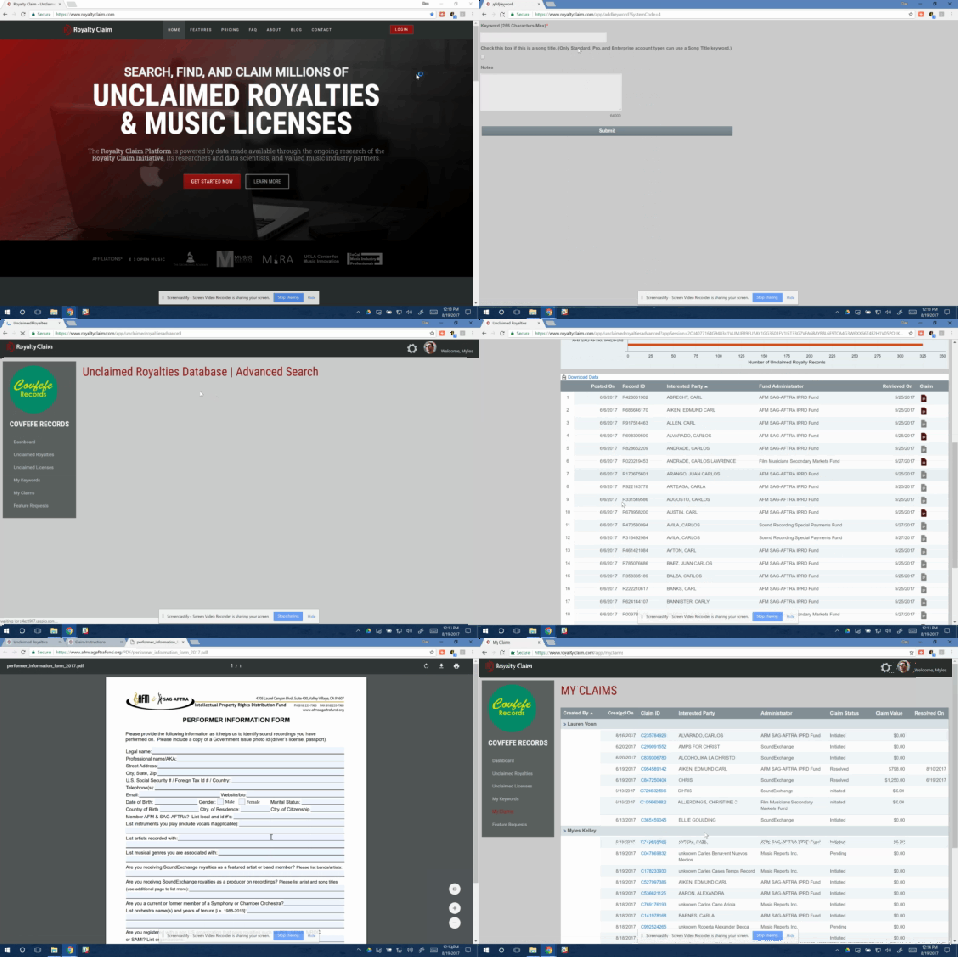
  • Royalty Claim (Free/Subscription) – Search, Find, and Claim Millions of Unclaimed Royalties and Music Licenses. The Royalty Claim Platform is powered by data made available through the ongoing research of the Royalty Claim Initiative, its researchers and data scientists, and valued music industry partners.

GET ADVANCES & LOANS AGAINST FUTURE MUSIC ROYALTIES

  • Sound Royalties (Flexible Repayments Terms) – Next-generation royalty financing. Retain your music rights. Keep your royalties.
  • Lyric Financial (Flexible Repayment Terms) – Advances, Loans, and Financial Solutions for the Music Industry
  • Royalty Advance Funding (Interest Loan) – Royalty Advance Funding has funded hundreds of established music royalty earners including songwriters, composers, publishers, producers, and their successors.

SELL, BUY OR INVEST IN MUSIC ROYALTIES

  • Royalty Exchange (Ownership & Dividends) – Your online marketplace for buying and selling royalties.
  • SongVest (Dividends) – The Stock Market of Music. For the first time ever, both investors and fans can own and get paid by the music that they love.
  • Perdiem (Dividends) – Investment platform for creatives. Start your own record label and build your brand in music.


Featured Photo by Fabian Blank on Unsplash

Have You Searched The Royalty Claim Database? What Are You Waiting For?
royalty claim

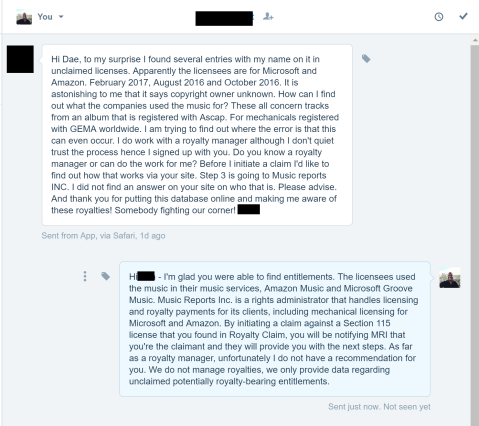
Another Royalty Claim user shocked to find that they have unclaimed entitlements in our database.
 
Are you a music creator or represent music creators? Have you taken the time to create a free account and search our nearly 50 Million records? What are you waiting for? With each day that passes, thousands of unclaimed royalties fall out of the statue of limitations!

If You’ve Never Received Mechanical Royalties From Google Play Music, This Might Be Why
google youtube
Is Google Willfully Refusing To Use Its Own Assets To Identify Copyright Owners?

In recent weeks Google and YouTube has come under fire by high-profile music industry professionals in regards to Lyor Cohen’s statements on the royalties it pays to artists. This piece is NOT about that.

At Royalty Claim, we periodically randomly select and investigate records that our researchers and data scientists ingest. Random investigations — sometimes against pre-determined hypotheses and sometimes just to follow down the rabbit hole — has helped us uncover nuances in the music licensing ecosystem that manifest into trends that suggest major systemic issues.

Earlier this month we reported that Google has filed nearly 7 Million Section 115 NOIs on the US Copyright Office for musical works in which it claims to be unable to identify the copyright owner. Then, Lyor Cohen boasted about YouTube’s royalty payouts and its growing ability to match music to videos (Google it, it’s everywhere). And then we remembered that this is only possible due to YouTube Content ID, which is arguably the largest database of copyright information with music codes, audio samples, etc.

So, if the largest submitter of “copyright owner unknown” NOIs is also the owner of the largest private database of copyright owner information, it makes no sense that Google cannot seem to identify copyright owners to pay mechanical royalties for the use of the copyright owner’s songs on Google Play Music.

So, we investigated this.

Do So-called Music Advocacy Groups Avoid Deeper Discussions On Black Box Royalties To Appease Their Major Members?

jonny-clow-3965

Over the last few weeks I’ve come to consider the notion that some of the biggest so-called “advocacy” groups for music creators censor their discussions on black box royalties due to the top-heavy makeup of their membership.

I’m Working On A Side Project Addressing ‘Black Box’ Royalties

I feel that some directors avoid, or lighten, their criticism of major labels and publishers, at the expense of their independent and DIY members, because representatives of the majors sit on the boards of these organizations. They have deep pockets for annual gifts and dues, and a non-profit can’t afford to see those dwindle.
In my presentation on the state of unclaimed royalties and music licenses at the Music Industry Research Association’s first inaugural MIRA Conference earlier this month, I presented several arguments of how black box royalties manifest. This included cash advances paid to music companies by digital service providers that go unattributed to their artists at the end of the contract term. What I didn’t include are the distribution of unattributed royalties to major publishers, by market share, from music rights organizations.

[Preview] The State of Unclaimed Royalties and Music Licenses in the United States (7)
Major labels and publishers cannibalize most distributions of black box royalties in an unfair and imbalanced manner. It is my belief (and feel free to correct me if I am wrong) that the majors have the resources and manpower to do a better job of registering their works and claiming their earnings. It is my opinion, based on my work through TuneRegistry — a music and rights metadata management platform for the independent music community — that the independent sector have the most difficult time in this respect; especially the DIY segment, which is all but blacklisted from being represented in these secret imbalanced conversations and distributions.

But who should be the outspoken opponents of these types of distributions? The advocacy groups? When “watch dogs” should be shining the light in every dark corner of the royalty vault, some of these groups tend to prefer dim conversations regarding black box royalties and how those funds are cannibalized by their major members.

This is why I believe A2IM (American Association of Independent Music) and AIMP (Association of Independent Music Publishers), despite my concern for how the music industry categorizes independents, is a great thing overall for DIY musicians.

DIY musicians need to do a better job of joining and navigating the worlds of trade associations. After all, they are their own record label and music publisher.

Lead Photo by Jonny Clow on Unsplash

(Almost) Everything That You Want To Know About Royalty Claim’s Data

BigData

QUESTION: WHERE DOES ROYALTY CLAIM’S DATA COME FROM?

ANSWER: MANY PLACES.

Royalty Claim Initiative researchers and data scientists locate, retrieve, synthesize and ingest an array of published and unpublished data that reference statutory notifications of certain music licenses, unattributed royalties (so-called “Black Box” royalties) and settlements; and income participants (payees) in undistributed royalties that stem from collective bargaining agreements, international reciprocal agreements, statutory royalties, and more. We also analyze data related to music consumption (e.g. downloads, streams, sales), broadcasts, performances, and other types of data to identify trends from which we can interpret insights into the global music licensing ecosystem.

THE FOLLOWING IS JUST A SAMPLE OF THE TYPES OF ROYALTY FUNDS IN WHICH WE ARE INTERESTED:
Royalty Claim Overview-blurred

Royalty Claim’s Full Presentation At The Music Industry Research Association Conference

Royalty_Claim_Founder_Dae_Bogan_at_MIRA_Conference

Royalty Claim attended the Music Industry Research Association‘s first inaugural MIRA Conference at the UCLA Luskin Conference Center this week. Royalty Claim’s Founder and Chief Researcher, Dae Bogan, MIA, had the honor of presenting a preview of our in-progress The State of Unclaimed Royalties and Music Licenses in the United States report before an audience of economists, sociologists, and researchers from universities and institutions from around the world, as well as music industry executives representing firms such as Nielsen, Pandora, Universal Music Group, and Warner Music Entertainment.

For the first time, updated statistics regarding the filing of “address unknown” Section 115 NOIs on the US Copyright Office during the first half of 2017 was revealed. Insights included an overview of the organizations that have utilized the procedure, including Amazon, Google, Spotify, iHeart Communications, and Microsoft. However, those large music users were expected. Interesting inclusions to the list were The Recording Academy and the Christian music service, TheOverflow and interesting omissions from the list are platforms that boast millions of tracks — Apple and Tidal — but may not be reaching every independent rightsowner that may have compositions available on those platforms.

A slide from the “[Preview] The State of Unclaimed Royalties and Music Licenses in the United States” presentation at MIRA Conference.

A slide from the “[Preview] The State of Unclaimed Royalties and Music Licenses in the United States” presentation at MIRA Conference.

The presentation also discussed the nature and causes of so-called “Black Box royalties”. A black box is an escrow fund in which music royalties are held due to an organization’s inability to attribute the royalties earned to the appropriate payee. Examples were given, including unattributed advances from DSPs to music companies, the US’s limitations on sound recording rights, and other issues.

A slide from the “[Preview] The State of Unclaimed Royalties and Music Licenses in the United States” presentation at MIRA Conference.


The presentation concluded with a video demo of the Royalty Claim Platform, which received positive reviews from conference attendees. The full presentation is  here.

I’m Working On A Side Project Addressing ‘Black Box’ Royalties

music_and_money_by_bobvogler

As of this writing, there are currently 116,133 verifiable* payments owed to music creators and rights-holders that are sitting in unclaimed/undistributed royalties escrow accounts (referred to as “Black Box” funds**) in the United States.

The actual number of individual payments owed is likely closer to or exceeds 1 Million, however the actual number is unknown because the administrator(s) of some of the biggest Black Box funds have not made public their list of payees to whom they owe royalties.

Unfortunately, due to the statute of limitations on these funds many of these payments expire. Every month payees unknowingly forfeit their rights to these payments and the interest in the royalties revert back to the administrator. This happens because the payee does not contact the administrator of the fund to claim their royalties. Granted, most payees are unaware that these payments are waiting for them because the administrator is unable to reach the payee for various reasons.

It has been estimated that the global “Black Box” royalties could be in the billions of dollars owed to music creators and rights-holders.

Imagine working somewhere and then you do not receive a paycheck because the HR department does not have your new address. Not a perfect analogy, but not receiving monies that you’ve earned as a result of your hard work seems unfair.

THIS IS A HUGE PROBLEM

So, I am happy to announce that I am working on a side project called Royalty Claim. Royalty Claim will attempt to work with as many of these administrators to aggregate their databases of millions of records of unclaimed/undistributed royalties and make that information available to the public. There are other services and insight that we will offer through Royalty Claim to help educate music creators and rights-holders on Black Box funds and how to limit/prevent their earnings from falling victim to the broken global music licensing ecosystem (such as taking control of your music catalog with TuneRegistry).

Want to get updates on the Royalty Claim project and be the first to know when we have something to reveal? Sign-up for our email list at www.RoyaltyClaim.com.

Also, follow @RoyaltyClaim on Twitter.

* These 116,133 payments are specifically verifiable because the list of payee names can be gathered from several databases.
** I am currently aware of over 30 funds and sub funds being managed in the United States. However, there are definitely many more that are “private”.

5 Royalty Streams Every Indie Artist Should Know

pexels-photo

This post was originally written for and published on Repost Network’s blog.

With the rise of music distributors and digital music aggregators, it has never been easier for an indie artist to release and monetize their music across the global digital music ecosystem. The Digital Music Era has significantly lowered the barriers to entry to the top outlets for music search and discovery; and startup entrepreneurs continue to develop and launch new platforms to innovate search, discovery, sharing, and access.

Today, music fans can easily access music from their favorite artists or discover new artists to fall in love with, pitting major established artists against their up-and-coming indie artist counterparts. And the music industry is changing for the better as a result (the Recording Academy now recognizes music released on free services for GRAMMY Award consideration and Billboard has accepted YouTube and SoundCloud streams for the purpose of charting).

Innovation in technology has made it possible for any indie artist with decent enough production tools and access to the Internet to record and release new music at any time. And with thousands of artists pumping out new music, it is no wonder that the industry has grown to over one million new tracks entering the global music market every month.

Each of these tracks begin earning royalties from its first play on any of the 400+ digital music services and 3,000+ webcasters operating around the world. And all of these royalties, billions of dollars of royalties, flow through a complex network of pipelines into various buckets of royalty collection with the ultimate goal of trickling down to the appropriate music creators and rightsholders. While this sounds straight-forward for a number of reasons this is far from a smooth process; and millions of dollars in royalties are in fact not making its way to the music creators and rightsholders to which they are due.

Part of the reason starts with you, the music creator. It is especially important for independent artists to understand the various income streams that your releases generate and the ways in which you must be setup to collect your royalties.

Here is an awesome infographic created by Future Music Coalition that visually breaks down how creators are compensated. Below it, I highlight five royalty streams that every indie artist should be setup to collect.

FMCmoneyflow

If you plan to release music digitally, you should be aware of and setup to collect all of the royalty streams that your music earns. Your music earns royalties for the use of two different copyrights. The first is the copyright for the composition (song). The second is the copyright for the sound recording (master). These two copyrights earn royalty streams that are collected and paid out by different sources to different income participants, as explained below.

Royalty Stream 1: Performance Royalties for Compositions

With few exceptions, virtually all uses of your composition earns performance royalties. Performance royalties are earned when your composition is played on digital radio-like services (e.g. Pandora), when your composition is accessed and played through on-demand streaming services (e.g. Spotify), and when your composition is performed in venues, bars, and restaurants. All of these companies have performance licenses from one or more performing rights organization (PRO). In the United States, ASCAP, BMI, SESAC, and Global Music Rights are the PROs who issue blanket licenses for the performance rights in compositions to digital music services. In return, these services pay royalties to these PROs. The PROs then pay 50% to the songwriter(s) of the composition and 50% to the publisher(s), in accordance with the publishing splits reported to the PRO by the copyright owners. In order to collect performance royalties, you must join a PRO and register your composition (your songs) and the associated ownership splits (for example, 4 Writers might have equal ownership (25% each) or varied ownership (Writer 1 – 25%, Writer 2 – 50%, Writers 3 – 12.5%, Writer 4 – 12.5%)) to the PRO in a timely manner. One of the reasons music creators and rightholders do not receive the performance royalties that their compositions earn is because they have not joined a PRO or have not registered their songs with their PRO.

Royalty Stream 2: Mechanical Royalties for Compositions

Mechanical royalties are earned when your composition is reproduced and distributed in phonorecords (a medium in which a sound recording is stored). This includes compositions embodied in sound recordings stored in physical formats (CDs, vinyl, cassette), MP3 permanent downloads (e.g. iTunes), and interactive streams (e.g. Spotify). In the digital music sector, streaming services secure mechanical licenses either directly from copyright owners or by utilizing the compulsory license as provided by copyright laws. Regardless of how they secure their mechanical license, the major services pay mechanical royalties to Harry Fox Agency (HFA) and Music Reports Inc. (MRI), who then pay the publishers of the composition. One of the reasons music creators and rightsholders do not receive the mechanical royalties that their compositions earn is because they have not registered their songs with HFA or MRI, who help digital music services secure the mechanical licenses. For unsigned indie artists, this can be much more difficult if you do not have a publisher because HFA only represents eligible publishers who’ve affiliated with them. MRI is a rights administrator and will issue notices to copyright owners if their digital music service clients intend to utilize the copyright owner’s composition in a manner that requires a mechanical license. Spotify pays HFA mechanical royalties for the compositions used in their platform. Amazon Music pays MRI mechanical royalties for the compositions used in their platform. (Note that in the United States, iTunes passes the mechanical royalty to the distributor, who then pays the label. If you’re an unsigned artist, then you receive the income since you are your own label. Outside of the United States, iTunes and on-demand services such as Spotify pay mechanical royalties to a mechanical licensing society in the territory represented by the society. In order to capture these foreign mechanical royalties, a publisher or administrator must affiliate with and register the compositions with the foreign mechanical collection society.)

Royalty Stream 3: Permanent Download Royalties for Masters

A permanent download is generally a sales transaction through a digital retail store (e.g. iTunes). This income is passed along to the distributor, who then pays the label (less any applicable commissions). If you’re unsigned artist, then you receive the income since you are your own label.

Royalty Stream 4: Interactive/On-demand Streaming Royalties for Masters

Just like a permanent download, interactive/on-demand streams (e.g. Spotify) of sound recordings generates master use royalties that is passed along to the distributor, who then pays the label (less any applicable commissions). If you’re unsigned artist, then you receive the royalties since you are your own label.

Royalty Stream 5: Non-Interactive Streaming Royalties for Masters

Unlike a permanent download or interactive/on-demand streams of sound recordings, non-interactive streams are not paid to your distributor. Webcasters and digital services that broadcast recordings over the Internet (e.g. Pandora, iHeart Radio), cable (e.g. Music Choice), and satellite (e.g. SiriusXM) in radio-style programming where the end users/listeners have limited to no control over the selection of music (non-interactive) pay a royalty for the digital performance of sound recordings to SoundExchange. SoundExchange then pays out 45% of the royalties to the featured performers on the recording, 50% to the copyright owner of the master recording, and 5% to a fund for background vocalists and session musicians maintained by AFM & SAG-AFTRA Intellectual Property Rights Distribution Fund. One of the reasons music creators and rightholders do not receive the non-interactive royalties that their masters earn is because they have not joined SoundExchange or have not registered their tracks with their SoundExchange.

When you release music digitally, you should be aware of the various royalty streams that your music earns, where those royalties are collected, and how to claim your earnings. Your distributor is one source of income for two of the royalty streams mentioned. To unlock the rest of your royalties, you’d need a capable publisher and a record company or you’d need to stay on top of the administration yourself.

A great way to keep track of all of these royalties is a service we recommend called TuneRegistry.

TuneRegistry is an all-in-one music rights and metadata management platform for the independent music community. Easily organize and store your song details, recording metadata, credits and ownership splits, and release information in your TuneRegistry account. It’s your robust music catalog manager that’s accessible online, so you don’t have to worry about tracking down emails, storing through documents in various desktop and cloud folders, losing collaborator contact information, or any of the other messy issues that most indie artists face.

TuneRegistry is your one-stop source for keeping your music catalog in check.

The advantage of TuneRegistry over other catalog management systems is that we’ve integrated the registrations process directly to ASCAP, BMI, SESAC, Music Reports, SoundExchange, and many more. Save time, reduce errors, and unlock royalties with our integrated registrations module. We make it super easy to get your music registrations to the organizations and data services who need it.