
Dae Bogan Confirmed To Teach ‘Music Publishing & Copyright Administration’ Workshop At The Independent Music Conference In October – Scholarships Available For Attendance

I am excited to return to this year’s Independent Music Conference to teach a basics workshop on Music Publishing & Copyright Administration on Saturday, October 25th. Time TBD. This workshop will explore basic music publishing and copyright administration from the perspective of a DIY independent artist. Attendees will gain a better understanding about self-publishing in the Internet age with key takeaways including resources for music placement, music licensing, and royalty collection around the world. Scholarships are now available to attend the Independent Music Conference taking place October 22th – 26th in Los Angeles. For details, visit http://IndependentMusicConference.com.
Music Licensing: ‘Grand Theft Auto V’ Takes Music Licensing To The Next Level

It isn’t often that we get to learn about the vision behind the musical selections — including licensed music, commissioned music and collaborations — directly from the music supervisors of entertainment products; especially music supervisors of video games. So, this interview of Rockstar Games’ music supervisor Ivan Pavlovich by The Hollywood Reporter on his work for Grand Theft Auto V is a rare peak behind the curtain of creating the sonic identity of one of the top video games of all time. And boy is it insightful!
Demystifying The Music Industry: What’s The Difference Between ASCAP/BMI/SESAC and SoundExchange?

I received an email this morning from a reader who had read my piece, “Demystifying The Music Industry: What’s This About Public Performance Rights?.” He asked, “If SoundExchange was designated by the Library of Congress as the sole PRO to administer public performance licenses and also collect public performances fees for Sound Recording Company Owners, then why do artists still utilize the services provided by the other 3 US PROs (ASCAP / BMI / SESAC) – is [SoundExchange] not sufficient by itself?”
A lot of indie artists are confused about the difference between ASCAP, BMI, SESAC and SoundExchange. I’ll attempt to break down the most important differences between these groups and elaborate towards the end about other considerations and other royalty collection entities. Feel free to comment with any questions (or corrections). Read More…
NMPA Sues Fullscreen: Easy Fix
The National Music Publishers Association has sued Fullscreen, Inc. for the monetization of YouTube channels containing thousands of videos with thousands of copyrighted music covered or synched. The way I see it, Fullscreen has 1 of 2 options to resolve this (which I believe will be handled out of court via a nice settlement):
- Enter into an agreement with NMPA to make sure royalties are flowing to publishers through Harry Fox Agency (the same thing YouTube did last year upon suit from NMPA)
- Enter into direct synch and mechanical license deals with publishers and record companies, like it has already done with Universal Music Publishing earlier this year.
The consequence of both fixes will be a reduction in ad revenue it generates from the over 15,000 YouTube channels with which Fullscreen has monetization agreements.
Read the piece in LA Times.
Grooveshark And The Inherent Problem With User-Generated Content (UGC)
It appears that Grooveshark is a platform that allows end-users to upload and share songs. The problem with that model (if early Napster didn’t teach us anything) is that while even if another end-user pays for the download; Grooveshark is still infringing on the copyright owner rights of reproduction and distribution. Further, one could argue that by allowing website visitors to stream the song before buying and downloading it; Grooveshark is also infringing on public performance rights. And that’s just the songwriter/publisher side. I do not believe Grooveshark is acquiring mechanical licenses for each song it allows to be purchased and downloaded; so they’ll also have a problem with the record labels.
I’m interested to see where this all goes. Read, “Grooveshark Signs an Agreement With the Largest Music Publisher In the World…” on Digital Music News website http://www.digitalmusicnews.com/permalink/2013/20130828grooveshark
Dae Bogan To Teach Workshop ‘Copyrights & Publishing Basics For Music Producers & Recording Engineers’ At The Los Angeles Recording School
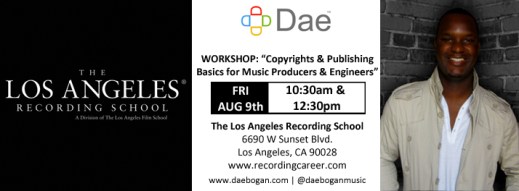
Dae Bogan will be conducting two 1-hr workshops (10:30am and 12:30pm) titled “Copyrights & Publishing Basics for Music Producers & Recording Engineers” at The Los Angeles Recording School.
This engagement is private and only available to LARS students.

Free DIY eBook
CONNECT WITH ME


 Dae Bogan Music