Archive | Music Business RSS for this section

The Elephant In The Room: Unclaimed / Undistributed Royalties
bn-bx232_0313bi_p_20140313163924

In the United States, there are several “unclaimed / undistributed royalties” funds held by music rights organizations. These funds collectively consist of tens of millions of dollars in undistributed earnings generated by the use of music within the greater music industry, from legislative appropriations imposed on manufacturers of audio home recording media, and from agreements with foreign entities.

Some of the organizations (SoundExchange, AFM & SAG-AFTRA Intellectual Property Rights Distribution Fund, Film Musicians Secondary Markets Fund, Live Television Videotape Supplemental Market Fund, and although this is not royalties per say, the US Copyright Office has a Section 115 NOIs Filing database that can be used to track down missing mechanical royalties) have created public databases so that music creators can search to see if they have royalties sitting in these funds. However, the biggest funds do not have public databases and often music creators can not be reached by any of these funds to be notified that they have unclaimed royalties.

I am working on a side project called RoyaltyClaim.com to address this issue of unclaimed / undistributed royalties. The goal is to get each of these funds to join the RoyaltyClaim.com Disclosure Program and to encourage them to submit very basic information to us on a periodic basis regarding the income participants who are due royalties. We will then aggregate these disclosures and maintain one searchable public database accessible for free by music creators and income participants.

By aggregating these lists of unclaimed / undistributed royalties information, we can aid income participants — including songwriters, recording artists, publishers, labels, musicians, background vocalists, composers, and beneficiaries (in the event of musician parents or spousals who passed away, but their music still generates royalties) — in locating and claiming their monies.

If you are a music creator, you should signup at RoyaltyClaim.com to be notified of our launch. We are currently in conversations with the various funds to get them to cooperate and help creators and their families.

I Participated In ‘GRAMMYs In My District’ And Met Congressman Adam Schiff #GIMD #SupportMusic

Today, I joined fellow members of The Recording Academy to participate in the advocacy division’s GRAMMYs in My District initiative, which organized hundreds of music creators and industry professionals across the United States to speak with their Congressional rep about music rights.

I had the pleasure of meeting and speaking with my rep, Congressman Adam Schiff of California’s 28th District. Representative Schiff has the unique pleasure 🙂 of representing a district whose constituents include many creators, possibly the most content creators in the United States. As an attorney and friend of many creators, Representative Schiff stands as a politician who supports the rights of music creators.

I am happy to say that Representative Schiff already sponsors the Songwriter Equity Act, the Fair Play Fair Pay Act, and the Allocation for Music Producers Act (AMP Act) and will be doing what he can to get other congressional representatives on board. This is not an easy task. Big Media such as the National Association of Broadcasters strongly oppose and lobby against progress that would ensure artists are being fairly compensated for the use of their music on terrestrial radio.

The music community has to work together to fight for changes to push legislation that will given music creators the rights and control over their music, the way any working professional maintains control over the products and services that he/she puts into the marketplace.

We need copyright reform. We need these bills to become laws. We need multi-billion dollar corporations to stop subsidizing the salaries of their executives and their operational costs at the expense of music creators.

Google and Amazon Leverage Copyright Loophole to Use Songs Without Paying Songwriters

google-amazon-logos-300x197

Chris Castle's avatarMusic Technology Policy

Two vastly wealthy multinational media companies are exploiting a copyright law loophole to sell the world’s music without paying royalties to the world’s songwriters on millions–millions–of songs. Why? Because Google and Amazon–purveyors of Big Data–claim they “can’t” find contact information for song owners in a Google search. So these two companies are exploiting songs without paying royalties by filing millions of notices with the Copyright Office at a huge cost in filing fees that only megacorporations can afford–an unprecedented land grab in nature, size and scope.

That’s right–Google and Amazon are falling over themselves to use their market power to stiff songwriters yet again. And as I will show, it is not just obscure songs that are affected. New releases, including one example from Sting, are also targets suggesting significant revenue loss to songwriters.  (I go into this in more detail on this series of posts.)

I…

View original post 2,016 more words

Teen-Focused App Musical.ly Is the Music Industry’s New Secret Weapon | VICE | United Kingdom


Awesome article by Vice on how young singers and rappers are using musical.ly to build fanbases, promote new music, drive engagement and sales, and generate buzz that has led to record deals, radio airplay, and ranking on Billboard charts.

Are any of you using musical.ly as a part of your overall digital strategy? If so how and what results have you seen? 

Impressive app sets for a music tech startup:

Musical.ly boasts more than 11 million video uploads per day from more than 120 million users worldwide; 64 percent of the app’s American users fall within the coveted 13–24 demographic, and 75 percent are female. Hoping to capitalize on that audience, Dae Dae debuted a 15-second snippet of “Wat U Mean” on musical.ly in August; to promote it, he hosted an in-app contest challenging listeners to make a music video of themselves performing his signature dance, where he languidly swings his arms in the air to the song’s staccato “Aye” shouts. Since its inception, the challenge has yielded a staggering 153,719 responses, with scores of newly won fans performing their own renditions of the “Aye” dance.

Read full article: http://www.vice.com/en_uk/read/the-social-media-app-musically-is-changing-music-marketing-v23n07

Dae Bogan To Moderate Panel On Music Rights And Micropayment Systems At UCLA Center For Music Innovation’s Music 2020 Day Event
ucla music 2020

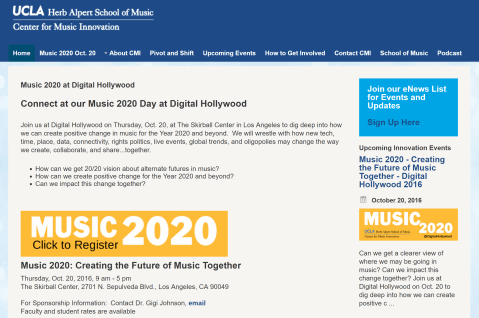
Live in/near Los Angeles? Consider attending the UCLA Center for Music Innovation Music 2020 Day at Digital Hollywood on Oct 20th at Skirball Cultural Center.

I will be moderating the panel “Infrastructure: Building New Pipes, New Rights, and New Micropayment Systems”

Panel Description:
Many companies and innovators are working hard to redo the plumbing in a streaming-driven world. This panel will discuss not only the current efforts and politics, but also where the pressures and frictions are building up that may create new avenues for growth and challenges for artists — and where the money might be made in transforming more than the consumer-facing sides of the music industry.

Moderator: Dae Bogan, Co-Founder and CEO, TuneRegistry

Panelists:
Les Borsai, Co-Founder and President, Songlily
Jeff King, COO, SOCAN Music
Jesse Feister, Director, Client Technology Solutions, Kobalt Music
Michael Shanley, VP, IT Business Development, Music Reports

Dae Bogan To Speak On Content Marketing Panel At FestForums Santa Barbara 2016
FestForum

Live in/near Santa Barbara? If so, consider attending FestForums Santa Barbara 2016 in mid November 2016.

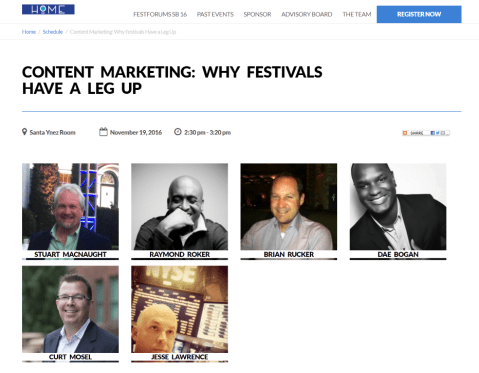
I will be speaking on a panel titled “Content Marketing: Why Festivals Have A Leg Up“
 
Panel Description:
Festivals are in the business of creating valuable experiences and the goal for brands is to use these experiences to connect with their customers. With so much digital content being created, brands are able to connect more intimately than ever, even when consumers are far away from the festival. Let’s explore the brands, the experiences, and how we can use them to the benefit of festivals, sponsors and consumers.
 
Moderator: Stuart McNaught, FestForums
 
Panelists:
Raymond Roker, Goldenvoice
Brian Rucker, Pandora
Dae Music, TuneRegistry
Curt Mosel, ArtsQuest
Jesse Lawrence, Ticket IQ
 
Complete details and schedule at www.festforums.com

[VIDEO] Watch How TuneRegistry Can Help Indie Music Creators Protect Music & Unlock Royalties

Homepage

Are you an indie artist looking to unlock additional income streams from your music?

Are you a band confused about what rights each member owns and how to protect them?

Are you a manager looking to save time and streamline reoccurring music industry administration tasks?

Are you an indie label or publisher looking for a better way to organize your company’s catalog in a collaborative space?

TuneRegistry is a next generation music management platform that enables creators and rights-holders to streamline the administration of their music catalogs.

Check out this tutorial reel to see how TuneRegistry can help you.

Learn more at www.tuneregistry.com.

The Uniquely US Challenge That Indie Artists Face When Asked To License Music To Indie Filmmakers, For Free

film-596009_1920

Over the last few years I’ve been approached by several indie filmmaker friends seeking my help on getting music licensed for their indie film projects. While some have had budgets, most have asked for recommendations on getting music for free. Now, as an advocate for indie music creators and rights owners, I tend to disregard “no compensation” opportunities as taking advantage of artists and/or devaluing the work of music creators (although the folks behind the opportunities are wicked good people).


Several times I’ve had to respectfully tell my indie filmmaker friends that I could not share their “music placement” opportunity, but instead I could direct them to resources to license music for cheap.


I’ve since realized that what I have not done was explain why, specifically in the United States, giving filmmakers music for free is frowned upon. So, in this post I aim to do that.


But first, I will say that I understand and agree that many opportunities for music placed in film — as well as TV shows and commercials — can be a huge break for up-and-coming artists. Productions that are widely released and viewed can result in significant exposure for the music, which can translate into increased radio airplay, digital downloads, and audio and video streams, which dramatically increases the artist’s income potential and exposure. There’s a long history of songs from movie and TV soundtracks going Gold & Platinum and topping the charts.


That being said, small indie film projects are typically not the productions that create these kind of success stories. In fact, I’d argue that over 90% of independently produced projects do little by way of “exposure” for artists (if you’re an independent artist reading this who’ve had your music placed in film, please comment and share your experience).


The reality is many indie film  projects do not have the distribution or exposure to generate the volume of public consumption to translate into significant benefit for the artists who contributed music to the film. This is because only a small percentage (maybe less than 1%) of the people who’ve watched the movie would actually make any effort to track down a song placed in the movie.


Now, let’s talk about how artists get paid for music licensed to films. I am focusing solely on commercially released songs being licensed to a film. I am not going into the details of original songs composed for a film, film scores, or any “commissioned” work for a film. I am strictly talking about a filmmaker asking an artist to use an already recorded and released track.


Ok, so typically, a production company should obtain what’s called a synchronization license from the artist (or label) to use the track in the film.


The term “synchronization” refers to the act of synchronizing a sound recording to a motion visual embedded in a video. A production company should pay two (2) fees for licensing music to film: master use fee and synchronization fee.


The master use fee is a fee paid to the artist (or his/her label if they are signed to a record label) for the use of the sound recording, also known as a “master.” The synchronization fee is a fee paid to the songwriter (or his/her publisher if they are signed to a publishing company) for the use of the song, also referred to as the composition.


The artist/label owns the sound recording/master. The songwriter/publisher owns the song/composition (for example the song “Diamonds” by Rihanna was actually co-written and is co-owned by Sia and her publisher; but the sound recording of “Diamonds” that you hear on the radio is owned by Rihanna’s record label. Both the writer/publisher and the artist/label must get paid for the use of “Diamonds” in a movie; those are two separate copyrights).


Alright that was a crash course on publishing.


In order for a filmmaker to license a piece of commercially released music to your film, you need a synchronization license from the independent artist (I’m going back to talking about independent artists, although I used Rihanna (a “major” artist) in my example above). An independent artist may not have a publisher nor a label, so he/she is the sole owner and should still get paid the synch fee (for the song/composition) AND the master use fee (for the sound recording/master).


Now, so far I’ve talked about what’s known as the up front fees. These are the fees you, filmmaker, would pay to an independent artist to put their music in your movie. But like I said in the beginning, many filmmakers have asked me to help them get music for free. 😦


I wouldn’t mind this too much if we weren’t talking about small projects that will be released (and generate most of its viewership) in the United States.


Why?


Outside of the United States, artists earn public performance income from the movie theaters. That’s right, movie theaters must pay public performance fees to public performance organizations for exhibiting movies. These backend royalties can add up if the movie becomes popular and has many showings across many territories.


However, in the United States movie theaters are exempt from having to pay public performance fees. This means, independent artists (specifically, singer-songwriters) do not earn income from movie theaters when they exhibit movies containing their music.


So, when you do not earn up front fees from synch and master use fees, because the filmmaker “doesn’t have a budget for music” AND you do not earn backend royalties from U.S. movie theaters, because they are exempt from paying what theaters in other countries pay, it is frowned upon to give music for free to U.S. filmmakers making low budget movies. Because these low budget projects may not have the distribution and marketing backing of it’s major and big-independent counterparts, the potential for the movie to generate “non-compensation benefits” for the artist (e.g. radio airplay, downloads, streams, awards, etc.) is significantly low.


Basically, if your indie film is being released in a few United States independent theaters and then on DVD and you want music for free, it will be a challenge. There is no substantial benefit for the artist.


All that being said, there are several examples of small budget projects generating grassroots marketing buzz and cult popularity that does impact the distribution and exposure of the movie, which in turn could generate benefits for artists who’ve given gratis (free) licenses to filmmakers. But this is not the norm. Furthermore, there are scenarios where you can license must free in the interim, but commit to payments based on hitting milestones such as getting distribution, hitting box office sales milestones, hitting DVD rental or sales goals, etc. This is a good way for a filmmaker who doesn’t have a big music budget to potentially negotiate with artists to defer compensation based on the performance of the project.


Thoughts? Questions? Stories to share? Post in the comments.

20 Different Ways to Release an Album: From Beyonce to Frank Ocean to U2 & Beyond

frank-ocean


Having trouble developing a release strategy for your new album? Check out the release strategy of 20 different albums on this article “20 Different Ways to Release an Album: From Beyonce to Frank Ocean to U2 & Beyond” on Billboard: http://www.billboard.com/biz/articles/news/digital-and-mobile/7495436/20-different-ways-to-release-an-album-from-beyonce-to


Also, check out my article “10 Steps to Building a Single Release Campaign” on CD Baby DIY Musician’s Blog: 10 steps to building a single release campaign: https://www.indieonthemove.com/blog/2013/11/10-ways-to-raise-funds-for-your-next-music-project-without-selling-a-single-record


Also, check out my article “10 Ways To Raise Funds For Your Next Music Project (Without Selling A Single Record)” on Indie on the Move website: https://www.indieonthemove.com/blog/2013/11/10-ways-to-raise-funds-for-your-next-music-project-without-selling-a-single-record


And always remember to REGISTER BEFORE YOU RELEASE with TuneRegistry.

FREE WEB CONFERENCE: Artist Launch’s Virtual Music Business Summit

artistlaunch.jpg

FREE WEB CONFERENCE:

Artist Launch’s Virtual Music Business Summit 

August 24th, 2016, Starting at 12pm PST

• Dae Bogan (Co-founder & CEO of TuneRegistry)

• Benji Rogers (Chief Strategy Officer of PledgeMusic)

• Reggie Hawkins (Program Director of Hip Hop Nation on SiriusXM Radio)

• Cynthia Charles (Touring at AEG Live’s Urban Touring Division)

• Cherie Hu (Media & Entertainment Writer for Forbes)

Join the live Q&A on “HOW TO PROTECT AND MARKET YOUR TALENT” with Dae Bogan at 3:30pm – 4:00pm PST

See full schedule: https://karenmariemason.com/
Tune-in here: http://events.instantteleseminar.com/?eventid=88530465