
Ask Me Anything About The Music Business, With Dae Bogan
Ask me your music business question and I’ll attempt to provide you with an answer or direct you to a resource with a better answer or guidance. I cannot provide specific legal advice, but I can discuss general music business practices. Join the conversation on Facebook, Twitter, Linkedin, or DaeBoganMusic.com. Simply drop your question in the comments section wherever you see the above image.
If You’ve Never Received Mechanical Royalties From Google Play Music, This Might Be Why
Is Google Willfully Refusing To Use Its Own Assets To Identify Copyright Owners?
In recent weeks Google and YouTube has come under fire by high-profile music industry professionals in regards to Lyor Cohen’s statements on the royalties it pays to artists. This piece is NOT about that.
At Royalty Claim, we periodically randomly select and investigate records that our researchers and data scientists ingest. Random investigations — sometimes against pre-determined hypotheses and sometimes just to follow down the rabbit hole — has helped us uncover nuances in the music licensing ecosystem that manifest into trends that suggest major systemic issues.
Earlier this month we reported that Google has filed nearly 7 Million Section 115 NOIs on the US Copyright Office for musical works in which it claims to be unable to identify the copyright owner. Then, Lyor Cohen boasted about YouTube’s royalty payouts and its growing ability to match music to videos (Google it, it’s everywhere). And then we remembered that this is only possible due to YouTube Content ID, which is arguably the largest database of copyright information with music codes, audio samples, etc.
So, if the largest submitter of “copyright owner unknown” NOIs is also the owner of the largest private database of copyright owner information, it makes no sense that Google cannot seem to identify copyright owners to pay mechanical royalties for the use of the copyright owner’s songs on Google Play Music.
So, we investigated this.
Do So-called Music Advocacy Groups Avoid Deeper Discussions On Black Box Royalties To Appease Their Major Members?

Over the last few weeks I’ve come to consider the notion that some of the biggest so-called “advocacy” groups for music creators censor their discussions on black box royalties due to the top-heavy makeup of their membership.
I’m Working On A Side Project Addressing ‘Black Box’ Royalties
![[Preview] The State of Unclaimed Royalties and Music Licenses in the United States (7)](https://daeboganmusic.com/wp-content/uploads/2017/08/preview-the-state-of-unclaimed-royalties-and-music-licenses-in-the-united-states-7.jpg?w=479)
Lead Photo by Jonny Clow on Unsplash
SoCal Music Industry Professionals August Meetup With Chips & Salsa Sponsored By Royalty Claim
I am excited to announce the next SoCal Music Industry Professionals (Meetup | Facebook) meetup taking place at my absolute favorite taco joint (which happens to be a beautiful venue for live music on La Brea in Mid-Wilshire District) — Candela La Brea!


I’ve know the owners for almost a decade, having hosted events/parties in this space as a college student/club promoter. The family has completely revamped the space, so I am thrilled to host my music industry colleagues here to network and check it out the space (Red Bull just hosted a sick music event here last night). My buddy Omar, the GM, was kind enough to grant us the full upstairs lounge with a private bar (great margaritas) and a complimentary chips & salsa bar sponsored by Royalty Claim (you can also order food from the full menu…the tacos are AMAZING!).


I hope to see you all Thursday, August 31st at 6pm! Please RSVP (plus 1s and 2s are OK) on Facebook at https://www.facebook.com/events/386559748425153 or on SCMIP Meetup website http://www.meetup.com/scmiponline


Best,
Dae
Watch As Royalty Claim Uncovers Unclaimed Royalties & Music Licenses For Beyoncé, Carl Cox, Afrojack, and Ellie Goulding
Watch us uncover unclaimed royalties & licenses for Beyoncé, Carl Cox, Afrojack, Ellie Goulding, and more using Royalty Claim Platform v1.0 https://youtu.be/J7nIdFdwlzY
[VIDEO] Full Video Of Royalty Claim Pre-launch Webinar
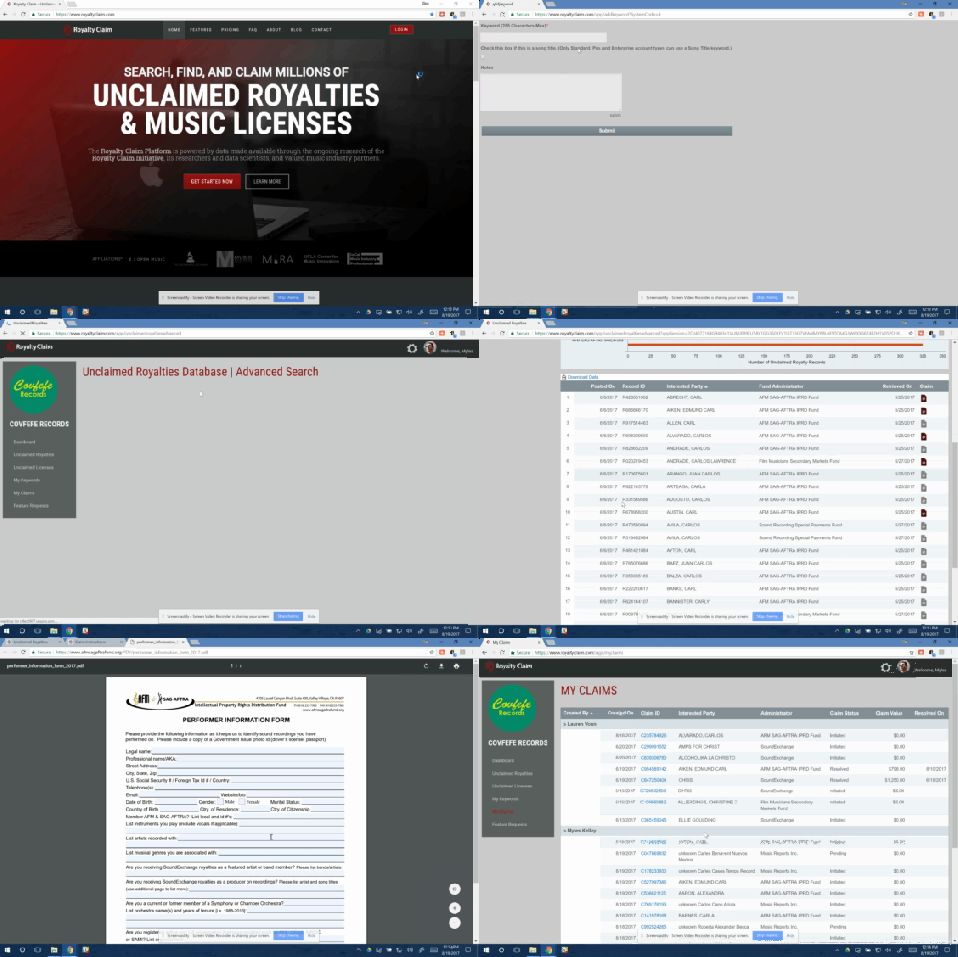
If you missed the Royalty Claim Pre-launch Webinar, watch the full recording here.
Royalty Claim Announces Pre-launch Webinar For This Weekend

Just Announced: Royalty Claim Pre-launch Webinar
Get a sneak peak behind the curtain with Royalty Claim’s Founder & Chief Researcher, Dae Bogan.
Agenda:
- Overview of the Royalty Claim Initiative.
- An encore presentation of our presentation at the Music Industry Research Association Conference.
- Live demo of Royalty Claim Platform v1.0.
- Music industry Q&A.
The webinar will take place on Saturday, August 19th at 10am PDT
(Almost) Everything That You Want To Know About Royalty Claim’s Data

QUESTION: WHERE DOES ROYALTY CLAIM’S DATA COME FROM?
ANSWER: MANY PLACES.
Royalty Claim Initiative researchers and data scientists locate, retrieve, synthesize and ingest an array of published and unpublished data that reference statutory notifications of certain music licenses, unattributed royalties (so-called “Black Box” royalties) and settlements; and income participants (payees) in undistributed royalties that stem from collective bargaining agreements, international reciprocal agreements, statutory royalties, and more. We also analyze data related to music consumption (e.g. downloads, streams, sales), broadcasts, performances, and other types of data to identify trends from which we can interpret insights into the global music licensing ecosystem.
THE FOLLOWING IS JUST A SAMPLE OF THE TYPES OF ROYALTY FUNDS IN WHICH WE ARE INTERESTED:
Royalty Claim’s Full Presentation At The Music Industry Research Association Conference

Royalty Claim attended the Music Industry Research Association‘s first inaugural MIRA Conference at the UCLA Luskin Conference Center this week. Royalty Claim’s Founder and Chief Researcher, Dae Bogan, MIA, had the honor of presenting a preview of our in-progress The State of Unclaimed Royalties and Music Licenses in the United States report before an audience of economists, sociologists, and researchers from universities and institutions from around the world, as well as music industry executives representing firms such as Nielsen, Pandora, Universal Music Group, and Warner Music Entertainment.
For the first time, updated statistics regarding the filing of “address unknown” Section 115 NOIs on the US Copyright Office during the first half of 2017 was revealed. Insights included an overview of the organizations that have utilized the procedure, including Amazon, Google, Spotify, iHeart Communications, and Microsoft. However, those large music users were expected. Interesting inclusions to the list were The Recording Academy and the Christian music service, TheOverflow and interesting omissions from the list are platforms that boast millions of tracks — Apple and Tidal — but may not be reaching every independent rightsowner that may have compositions available on those platforms.

.jpg)
The presentation also discussed the nature and causes of so-called “Black Box royalties”. A black box is an escrow fund in which music royalties are held due to an organization’s inability to attribute the royalties earned to the appropriate payee. Examples were given, including unattributed advances from DSPs to music companies, the US’s limitations on sound recording rights, and other issues.
.jpg)
The presentation concluded with a video demo of the Royalty Claim Platform, which received positive reviews from conference attendees. The full presentation is here.
Eron Bucciarelli (Soundstr), Dae Bogan (TuneRegistry & Royalty Claim), Benji Rogers (DotblockchainMedia & Pledge Music), and Jason Trikakis (HelloSugoi) Submit ‘How Tech Can Save the Music Industry’ Panel for SXSW 2018 – How To Vote Details

I’m excited to join fellow music tech founders Eron Bucciarelli (Soundstr), Benji Rogers (DotblockchainMedia), and Jason Trikakis (HelloSugoi) for a panel submission to SXSW 2018. Please vote and share the submission for “How Tech Can Save the Music Industry” #MusicTransparency
How Tech Can Save the Music Industry
The music industry is in dire need of change not only to thrive, but survive. Streaming, pirating and the secondary ticket market have dealt serious blows to our industry’s major revenue streams, but technology can be our savior. Join experts from the royalty, rights, ticketing and metadata blockchain sectors to learn not only how tech can provide short-term solutions, but also build a more sustainable industry. Join us to learn how tech can save the music industry. #MusicTransparency
QUESTIONS
- What are the current and near-future major issues of the industry that could be disrupted by technology?
- What solutions can tech offer and how can they be practically applied to our everyday lives?
- What is the long-term impact of these tech solutions? What happens without these solutions based on the current landscape of our industry?
SPEAKERS
- Eron Bucciarelli, CEO, Soundstr
- Dae Bogan, CEO, TuneRegistry & Royalty Claim
- Benji Rogers, CEO, Plege Music & dotBlockchain
- Jason Trikakis, CEO, HelloSugoi
CLICK HERE TO VOTE
Free DIY eBook
CONNECT WITH ME


 Dae Bogan Music