
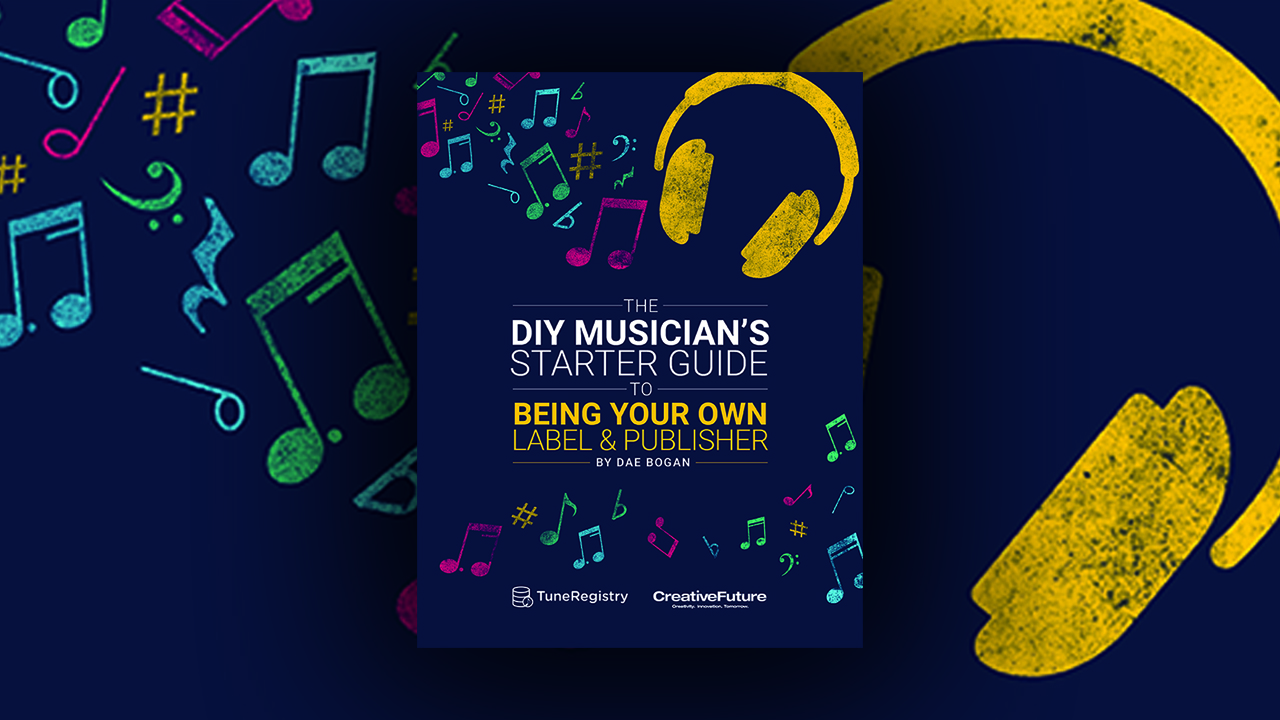
CreativeFuture Releases ‘The DIY Musician’s Starter Guide To Being Your Own Label & Publisher’ Written By Dae Bogan

Over the last 10 years, I’ve had the honor of working with and supporting many DIY musicians in the development, launch and growth of their music careers. As an artist manager, indie label owner, music publisher, music retail executive and music tech entrepreneur I’ve directly contributed to the creation, promotion, release, administration and monetization of hundreds of releases.
It is from these experiences working with DIY musicians (and indies) and through my advanced education having earned a master’s degree in music business that I operate today as an entrepreneur, educator and advocate for DIY musicians.
I try to assist DIY musicians make sense of the music business through articles and insight, workshops, courses, webinars and now a short ebook.
I am excited to present The DIY Musician’s Starter Guide to Being Your Own Label and Publisher
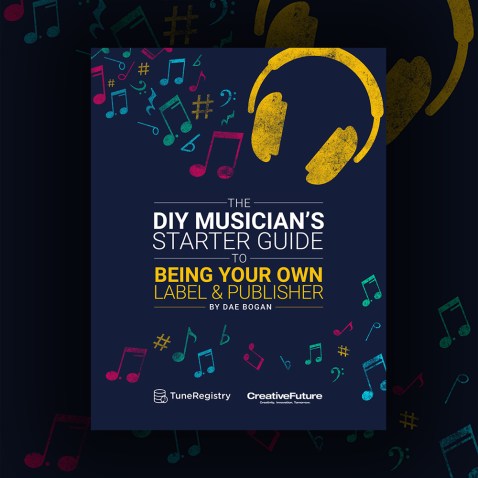
The DIY Musician’s Starter Guide to Being Your Own Label and Publisher was written to (1) help DIY musicians become better advocates for themselves by demystifying some of the confusing concepts behind how the digital music industry operates, (2) to address and offer solutions to many of the challenges that DIY musicians face in their careers, and (3) to educate DIY musicians on the processes with which they must become familiar to increase the possibility of being properly compensated for the
use of their music across the digital music ecosystem.
In this guide, you will learn about the basics of music copyrights and the business implications of the difference between compositions and sound recordings. You will learn what it means to be your own label and publisher and the four different hats you wear in the world of music royalties. You will also gain practical knowledge and steps
for asserting your rights and capturing the royalties that your music earns across the digital music industry.
Gt it FREE here.
The (Not Quite) Definitive Guide To The Exploitation Of Music Royalties

There’s been a lot of talk lately about music royalties; those pesky micro-pennies that add up to something worth fighting over after millions and billions of streams.
With the music industry seeing revenue growth powered by streaming, coupled with shrinking per-stream royalty rates caused by a combination of horrible statutory royalties, unsustainable subscription models, and more content than ever before splitting up the pie, music royalties have never been more scrutinized in modern music history, IMO.
In the United States alone, there are several legislative measures being proposed that directly address music royalties — Fair Play Fair Pay Act (artist royalties), Songwriter Equity Act (songwriter royalties), AMP Act (music producer royalties), CLASSICS Act (legacy artist royalties) — with powerful proponents (music rights organizations, music creators’ rights advocacy groups, and music industry trade associations) and even more power opponents (digital media and Internet company coalitions, broadcaster lobbying organizations, and in some cases, DSPs themselves) on both sides.
Nevertheless, this is an interesting time for music royalties.
Technologists and music licensing experts have come together to create a variety of offerings to music creators and rightsholders to help them exploit their music royalties. Whether you want to find unpaid royalties, get a loan against future royalties, sell your royalties or allow music fans to invest in your music royalties, there’s a platform for that.
Here’s a (not quite) definitive guide of music royalties tools and services (A-Z):
FIND & CLAIM UNPAID MUSIC ROYALTIES
- Paperchain (Revenue Share) – Enriching the music supply chain. Paperchain solves the problem of unpaid royalties in the music industry. Paperchain empowers music copyright owners with products and services to solve the problem of unpaid royalties.
- Royalty Claim (Free/Subscription) – Search, Find, and Claim Millions of Unclaimed Royalties and Music Licenses. The Royalty Claim Platform is powered by data made available through the ongoing research of the Royalty Claim Initiative, its researchers and data scientists, and valued music industry partners.
GET ADVANCES & LOANS AGAINST FUTURE MUSIC ROYALTIES
- Sound Royalties (Flexible Repayments Terms) – Next-generation royalty financing. Retain your music rights. Keep your royalties.
- Lyric Financial (Flexible Repayment Terms) – Advances, Loans, and Financial Solutions for the Music Industry
- Royalty Advance Funding (Interest Loan) – Royalty Advance Funding has funded hundreds of established music royalty earners including songwriters, composers, publishers, producers, and their successors.
SELL, BUY OR INVEST IN MUSIC ROYALTIES
- Royalty Exchange (Ownership & Dividends) – Your online marketplace for buying and selling royalties.
- SongVest (Dividends) – The Stock Market of Music. For the first time ever, both investors and fans can own and get paid by the music that they love.
- Perdiem (Dividends) – Investment platform for creatives. Start your own record label and build your brand in music.
Featured Photo by Fabian Blank on Unsplash
Microsoft Is Shutting Down Groove Music – Here’s Everything You Need To Know About Claiming Mechanical Royalties Before It’s Too Late!

Microsoft is shutting down Groove Music. Here’s everything you need to know about claiming mechanical royalties before it’s too late!
Have You Searched The Royalty Claim Database? What Are You Waiting For?
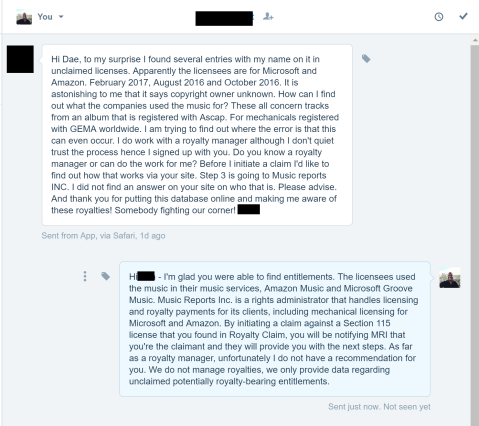
Royalty Claim Announces Unclaimed Neighboring Rights Database – Launches With Nearly 1 Million Records
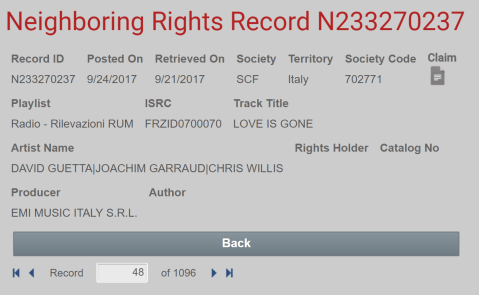
Neighboring rights is becoming a hot ticket music rights issue as download decline (and thus, mechanical royalties) and Internet streaming soars. However, the fact that US music creators and rights owners get the short end of the stick in terms of the global view of neighboring rights protections and financial reward, it is more important than ever of US stakeholders to see where and how their music is performing around the world. Neighboring Rights Agencies have boomed over the last several years to address this issue, but they’re still highly selective and most work with a few dozen performers, if any at all.

Royalty Claim Unleashes Another 22 Million Section 115 NOIs

Royalty Claim Initiative‘s mission is clear:
“To aid in creating transparency in the global music licensing ecosystem.”
We do this by conducting research into the global music licensing ecosystem to understand where and why royalties go uncollected. The Royalty Claim Platform is a FREE online search engine empowering music creators and rights-holders with access to the data about unclaimed royalties and music licenses.
After a rocky launch weekend, we are happy to announce that we’ve just made over 22 Million more Section 115 NOI records searchable. Copyright owners (or their agents) can create a free account, search for free, and initiate claims for free.
Harry Fox Agency, Music Reports Inc, MediaNet and Loudr are among the licensee agents that will receive claim notifications via Royalty Claim for Section 115 NOIs filed on behalf of digital service providers such as Spotify, Google Play Music, Microsoft Groove Music, Pandora, iHeartMedia and Amazon Music.
Join today and search for free at www.royaltyclaim.com
What I Read To Stay Current On Music Industry Affairs — For Better Or Worse

(UPDATED 10/15/17 – Added more outlets to the list)
Music industry professionals — especially consultants who work with a variety of clients across numerous sectors of the music industry — are behooved to stay up-to-date on the latest affairs and current events in the music industry. We do this a number of ways such as catching up with colleagues, attending conferences and networking events, and (the easiest) following and reading music industry trade publications and certain bloggers.
There are many publications and bloggers out there, and they range dramatically in terms of depth and breadth of coverage, level of objectivity, and overall value of insight.
Media analyst Mark Mulligan is known and respected for his in-depth and research-driven approach to offering deep dives into music industry trends via his work at MIDia Research and his blog Music Industry Blog while music attorney Chris Castle offers critical analysis of nuanced legal matters, especially those affecting copyright owners, on his blogs Music x Technology x Policy and Music Tech Solutions.
Then, there are some publications and some bloggers, while they offer interesting insight and news, can come off as “gossipy” from time to time (as one artist manager put it, when I shared this list in the Artist Manager’s Connect Facebook group); while others rant on about nothing of significance (said another).
Moreover, some publications are loaded with advertorial that is sometimes disguised as news (an “advertorial” is the term used to refer to an article that has been paid for (or commissioned in some way) by a brand and written (sometimes by the brand itself) for the purpose of advertising the brand without the content coming off as an advertisement — thus, advertisement + editorial = advertorial). Generally, you can recognize an advertorial and read through the advertisement to extrapolate what’s important to you (if anything). Advertorial falls into the wider spectrum of content marketing (content created by or for a brand to reach and engage target customers; including blogs, videos, advertorials).
Not all content marketing is inherently bad, though. Many articles written by or for brands offer enriching insight for its target audience, like this one that I wrote, which was published on Bandzoogle’s blog and RepostNetwork’s blog. While the article does promote my company TuneRegistry at the very end, the majority of the article details “5 Royalty Streams Every Indie Artist Should Know” and helps DIY musicians and artist managers wrap their heads around these issues.
So, whether you’re a seasoned music industry professional or an up-and-coming DIYer, if you want to stay up-to-date on what’s happening in the music industry, subscribing to a few outlets may be helpful.
Below is a select list of the music industry publications, blogs, and newsletters to which I am subscribed. Where applicable, I included the name of the primary curator/blogger and their personal Twitter handles. Follow them or connect with them up on LinkedIn.
—(A-Z)—
ArisTake (Ari Herstand | @aristake)
ASCAP Daily Brief (Dean Kay)
BillboardBiz
BMI The Weekly
CD Baby’s DIY Musician Blog (Christopher Robley | @chrisrobley)
Dae Bogan Musc (shameless self-promotion — Dae Bogan | @daeboganmusic)
Digital Music News (Paul Resnikoff)
Hypebot (Bruce Houghton)
Leftsetz Letter (Bob Leftsetz | @leftsetz)
Library of Congress Blog
MediaNet Blog
Motive Unknown (Darren Hemmings | @mr_trick)
Music Ally (Wesley A’Harrah | @adreadpirate & Anthony Churchman)
Music Business Worldwide
Music Industry Blog (Mark Mulligan | @mark_mulligan)
Music Tech Solutions (Chris Castle)
Music Think Tank (Bruce Houghton)
Music x Tech x Future (Bas Grasmayer | @basgras)
Music x Technology x Policy (Chris Castle)
SXSW Daily Chord
The Trichordist (David Lowery)
Added on 10/15/2017 from reader submission
- CMU Daily (Complete Music Update)
- ICMP Global Briefing (ICMP)
- Music World News (IMC – International Music Council)
- Music Week Morning Briefing (Music Week)
- Music REDEF (REDEF)
- Platform & Stream
- Synchtank Weekly (Synchtank)
There are several publications not listed here because they do not soley cover the music industry, but are still good sources of information when they periodically publish music industry related pieces (e.g. Wall Street Journal, The Hollywood Reporter, Variety, Forbes, Techcrunch).
QUICK TIP: Subscribing to many blogs and newsletters will result in many emails hitting your inbox. To keep your inbox free for your day-to-day business/personal email, create a new email address just for subscriptions (e.g. daesreadinglist@gmail.com). Then, all of the newsletters and new post announcements will go to that inbox and not clutter your primary inbox. Ok great, you now know how to keep your inbox clutter-free. But, what about keep up-to-date? Well, you can check the inbox once a week, twice a week, or whatever frequency that works for your schedule. I like to scan all emails on Monday. Some newsletters curate other stories, so they link to the same sources. Some publish original content. I like to read the headlines, choose what matters to me, and then read at my leisure.
My list is by no means exhaustive. And since I’ve already heard from some very passionate music industry folks about their support or disdain for some of the publications/blogs/bloggers listed, I’d like hear your thoughts.
Tell me in the comments what you read that isn’t on the list or feel free to share your opinion about any of the listed outlets.
Featured Photo by Muhammad Raufan Yusup on Unsplash
If You’ve Never Received Mechanical Royalties From Google Play Music, This Might Be Why
Is Google Willfully Refusing To Use Its Own Assets To Identify Copyright Owners?
In recent weeks Google and YouTube has come under fire by high-profile music industry professionals in regards to Lyor Cohen’s statements on the royalties it pays to artists. This piece is NOT about that.
At Royalty Claim, we periodically randomly select and investigate records that our researchers and data scientists ingest. Random investigations — sometimes against pre-determined hypotheses and sometimes just to follow down the rabbit hole — has helped us uncover nuances in the music licensing ecosystem that manifest into trends that suggest major systemic issues.
Earlier this month we reported that Google has filed nearly 7 Million Section 115 NOIs on the US Copyright Office for musical works in which it claims to be unable to identify the copyright owner. Then, Lyor Cohen boasted about YouTube’s royalty payouts and its growing ability to match music to videos (Google it, it’s everywhere). And then we remembered that this is only possible due to YouTube Content ID, which is arguably the largest database of copyright information with music codes, audio samples, etc.
So, if the largest submitter of “copyright owner unknown” NOIs is also the owner of the largest private database of copyright owner information, it makes no sense that Google cannot seem to identify copyright owners to pay mechanical royalties for the use of the copyright owner’s songs on Google Play Music.
So, we investigated this.
Do So-called Music Advocacy Groups Avoid Deeper Discussions On Black Box Royalties To Appease Their Major Members?

Over the last few weeks I’ve come to consider the notion that some of the biggest so-called “advocacy” groups for music creators censor their discussions on black box royalties due to the top-heavy makeup of their membership.
I’m Working On A Side Project Addressing ‘Black Box’ Royalties
![[Preview] The State of Unclaimed Royalties and Music Licenses in the United States (7)](https://daeboganmusic.com/wp-content/uploads/2017/08/preview-the-state-of-unclaimed-royalties-and-music-licenses-in-the-united-states-7.jpg?w=479)
Lead Photo by Jonny Clow on Unsplash
Watch As Royalty Claim Uncovers Unclaimed Royalties & Music Licenses For Beyoncé, Carl Cox, Afrojack, and Ellie Goulding
Watch us uncover unclaimed royalties & licenses for Beyoncé, Carl Cox, Afrojack, Ellie Goulding, and more using Royalty Claim Platform v1.0 https://youtu.be/J7nIdFdwlzY
Free DIY eBook
CONNECT WITH ME


