
[VIDEO] Full Video Of Royalty Claim Pre-launch Webinar
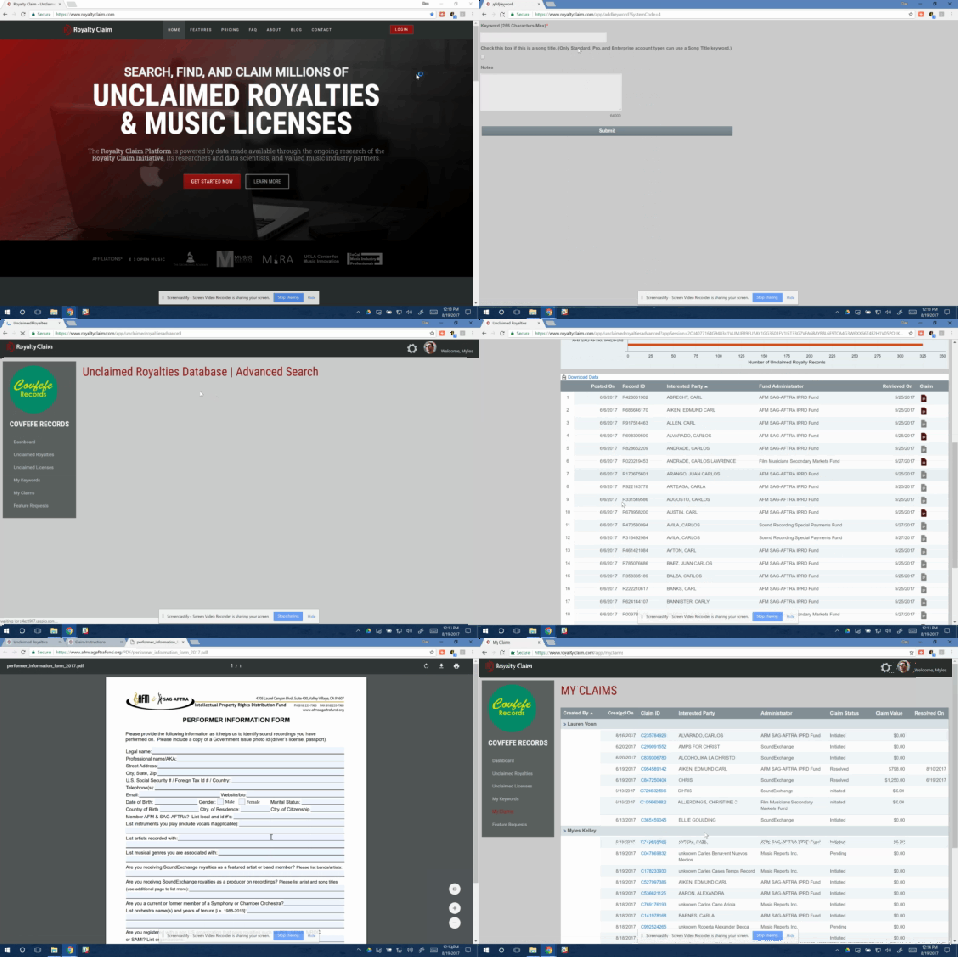
If you missed the Royalty Claim Pre-launch Webinar, watch the full recording here.
(Almost) Everything That You Want To Know About Royalty Claim’s Data

QUESTION: WHERE DOES ROYALTY CLAIM’S DATA COME FROM?
ANSWER: MANY PLACES.
Royalty Claim Initiative researchers and data scientists locate, retrieve, synthesize and ingest an array of published and unpublished data that reference statutory notifications of certain music licenses, unattributed royalties (so-called “Black Box” royalties) and settlements; and income participants (payees) in undistributed royalties that stem from collective bargaining agreements, international reciprocal agreements, statutory royalties, and more. We also analyze data related to music consumption (e.g. downloads, streams, sales), broadcasts, performances, and other types of data to identify trends from which we can interpret insights into the global music licensing ecosystem.
THE FOLLOWING IS JUST A SAMPLE OF THE TYPES OF ROYALTY FUNDS IN WHICH WE ARE INTERESTED:
Royalty Claim’s Full Presentation At The Music Industry Research Association Conference

Royalty Claim attended the Music Industry Research Association‘s first inaugural MIRA Conference at the UCLA Luskin Conference Center this week. Royalty Claim’s Founder and Chief Researcher, Dae Bogan, MIA, had the honor of presenting a preview of our in-progress The State of Unclaimed Royalties and Music Licenses in the United States report before an audience of economists, sociologists, and researchers from universities and institutions from around the world, as well as music industry executives representing firms such as Nielsen, Pandora, Universal Music Group, and Warner Music Entertainment.
For the first time, updated statistics regarding the filing of “address unknown” Section 115 NOIs on the US Copyright Office during the first half of 2017 was revealed. Insights included an overview of the organizations that have utilized the procedure, including Amazon, Google, Spotify, iHeart Communications, and Microsoft. However, those large music users were expected. Interesting inclusions to the list were The Recording Academy and the Christian music service, TheOverflow and interesting omissions from the list are platforms that boast millions of tracks — Apple and Tidal — but may not be reaching every independent rightsowner that may have compositions available on those platforms.

.jpg)
The presentation also discussed the nature and causes of so-called “Black Box royalties”. A black box is an escrow fund in which music royalties are held due to an organization’s inability to attribute the royalties earned to the appropriate payee. Examples were given, including unattributed advances from DSPs to music companies, the US’s limitations on sound recording rights, and other issues.
.jpg)
The presentation concluded with a video demo of the Royalty Claim Platform, which received positive reviews from conference attendees. The full presentation is here.
How To Auction Off Your Future Royalties When You’re A Back-up Singer Or Session Music

Photo by Jason Rosewell on Unsplash
It is very important for background vocalists (and artists who provide background vocals on the side) to understand that they earn money BEYOND the studio session in which they performed. Billboard published an article on how a back-up singer on Wiz Khalifa’s “See You Again” featuring Charlie Puth put up 100% of his U.S. digital performer royalties for auction on Royalty Exchange with bids starting at $30,000. These royalties are collected by SoundExchange and administered by AFM & SAG-AFTRA Intellectual Property Rights Distribution Fund.
This is a great example of how a background vocalist can leverage his/her equity in a hit song to get paid big bucks, today! This also applies to session musicians.
#MusicBusinessMonday: Session Musicians
Royalty Claim has thousands of records of unclaimed royalties due to non-featured performers (session musicians, background vocalists, etc.) from recordings performed on digital radio (e.g. Pandora, Music Choice, iHeartRadio, SiriusXM, and more). Royalty Claim also provides data on ‘address unknown’ NOIs filed under the Section 115 compulsory mechanical license for services such as Amazon, Spotify, Apple, Google, and many others.
Read more about the auctioning your future royalties in the Billboard story here.
Learn more about Royalty Claim at http://www.royaltyclaim.com. Royalty Claim will pre-launch on August 10th. This is for anyone who pre-registered at www.royaltyclaim.com/comingsoon. Those who’ve pre-registered will be able to secure a life-time subscription to Royalty Claim for only $150. Royalty Claim official launch will be September 1st. At that point, anyone can join for free or choose any of the premium plans.
Dear Indie Musician: Do you have a will?
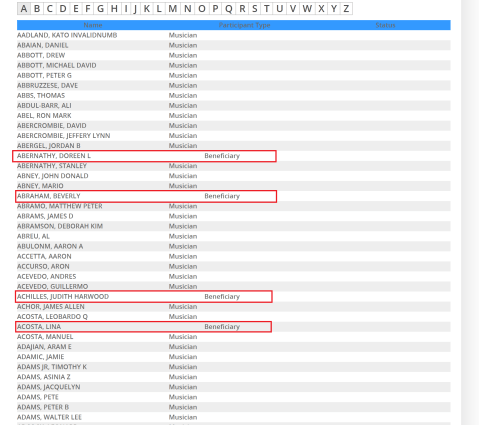
Screenshot of unclaimed royalty checks list at Film Musicians Secondary Market Fund
What musicians should keep in mind is in the event of an untimely passing, your royalty streams are bona fide assets that need to be discussed in a will. Some of the unclaimed royalty information that we have at Royalty Claim is from musicians who’ve passed away, but did not file a beneficiary with the various music rights organizations. So, their music continues to earn revenue, but the organizations do not have beneficiary info to pay it out. Or, musicians who’ve passed away and left no instructions in their will on how their royalties should be allocated, and various claimants have created a dispute.
We should definitely talk more about musician estates (even smaller musicians can have estates). Royalty streams are assets with which musicians can receive loans from companies like Lyric Financial or Sound Royalties, or even sell via platforms like Royalty Exchange. If you’re serious about your music career, be serious about your estate.
Royalty Claim Initiative Unveils RoyaltyClaim.com
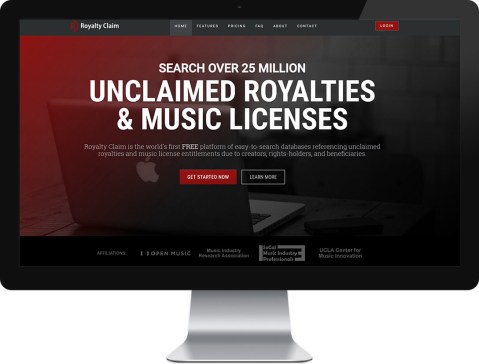
I’m so proud to be able to unveil the info website for Royalty Claim today. I’ve had endless sleepless nights developing and designing the info site, and the actual database platform that’s launching soon.
Check it out, get your questions answered (see FAQ page), and pre-register for the beta. 
The first public demo will be this Thursday at SCMIP x AMC LA Music Industry Meetup | DTLA Arts District.
Is Spotify Rolling Out Sponsored Songs? And Why Does That Reek Of Payola?
In a recent article discussing Spotify’s year-over-year growth, Music Ally suggested that there is “evidence that Spotify may be planning to allow brands to sponsor individual tracks within its service” and shared a Twitter user’s post that appears to show a Sponsored Music / Sponsored Song indicator on the user’s Spotify account.
Not seen this in my Spotify settings before 🤔 pic.twitter.com/hWT58ymj1g
— Talia 🇪🇺 (@talia) June 2, 2017
Music Ally went on to clarify that they “contacted Spotify to ask about sponsored songs, and the [Spotify’s] spokesperson provided this response: ‘We are always testing new ways of putting the right music in front of the right audiences. But we don’t have any more information to share right now.'”
If brands can buy visibility for select songs over others, what is to stop major labels (and major indie labels) from cosying up with any one of their many strategic brand partners to influence the visibility of their songs over others? I suppose they already can and do do this with curated branded playlists.
If this does rollout, how will streaming monitoring services such as Nielsen — which factors streaming data into the ranking algorithm of some of their Billboard charts — take these streams into account? Will the Recording Industry Association of America (RIAA) allow these streams to be factored into Gold and Platinum certification? How will these sponsored streams affect overall royalty calculations and payments to artists and songwriters? And why does this all reek of payola?
Post your thoughts in the comments.
10 Random Thoughts On The Business Of Music Videos

1. If you’re going to monetize your music video (make it available for sale/download), you should consider getting an ISRC for it. Yes, videos can (and should) have an ISRC. This ISRC is separate from the ISRC of the track being performed in the video.
2. You’d be surprised to know this, but music videos still earn significant reach on broadcast and OTT (over the top) platforms. Check out YANGAROO DMDS for pitching to MTV, MTV U, BET, NuVo, CMT, and more. Your video needs to be broadcast quality WITH closed captions.
3. There are many websites where you can monetize and set permissions for your music videos, including social media and discovery sites like DailyMotion. Check out Vydia for managing the distribution of your videos across your socials.
5. Audiam will help you collect composition side “sync royalties” from YouTube. In doing so, they also claim to unlock “performance royalties” paid to you by your PRO.
6. Pitch your music videos for plays in retail stores. Mood Media, PlayNetwork, Inc., Shoplifter In-Store Radio Promotion, and several others can help get your music video playing inside retail shops and malls reaching millions of shoppers. I own Maven Promo, so you can always consider pitching to my small network of 130 retail stores.
7. Sometimes bands can’t afford a full production music video. Lyric videos are great promotional tools as an alternative to nothing at all. I actually place lyric videos on my network often. Here are some great resources to have lyric videos made.
8. If your song is explicit, make sure that you have a clean cut version of the music video. Don’t wait until you land an opportunity for placement or a feature to get it done. Your editor may not be available to cut the clean version in a timely manner. I deal with this every month.
9. The three copyrights associated with a music video: 1.) the copyright in the composition (requires a grant of synchronization right), 2.) the copyright in the sound recording (requires a master use right), and 3.) the copyright in the motion picture itself. If your artist doesn’t own and control all three copyrights, make sure to have paperwork drawn up with whomever owns and controls a particular copyright granting the artist the rights, before distributing.
10. I don’t have a 10th thought, but it would be weird to end at 9.
I’m Working On A Side Project Addressing ‘Black Box’ Royalties

As of this writing, there are currently 116,133 verifiable* payments owed to music creators and rights-holders that are sitting in unclaimed/undistributed royalties escrow accounts (referred to as “Black Box” funds**) in the United States.
The actual number of individual payments owed is likely closer to or exceeds 1 Million, however the actual number is unknown because the administrator(s) of some of the biggest Black Box funds have not made public their list of payees to whom they owe royalties.
Unfortunately, due to the statute of limitations on these funds many of these payments expire. Every month payees unknowingly forfeit their rights to these payments and the interest in the royalties revert back to the administrator. This happens because the payee does not contact the administrator of the fund to claim their royalties. Granted, most payees are unaware that these payments are waiting for them because the administrator is unable to reach the payee for various reasons.
It has been estimated that the global “Black Box” royalties could be in the billions of dollars owed to music creators and rights-holders.
Imagine working somewhere and then you do not receive a paycheck because the HR department does not have your new address. Not a perfect analogy, but not receiving monies that you’ve earned as a result of your hard work seems unfair.
THIS IS A HUGE PROBLEM
So, I am happy to announce that I am working on a side project called Royalty Claim. Royalty Claim will attempt to work with as many of these administrators to aggregate their databases of millions of records of unclaimed/undistributed royalties and make that information available to the public. There are other services and insight that we will offer through Royalty Claim to help educate music creators and rights-holders on Black Box funds and how to limit/prevent their earnings from falling victim to the broken global music licensing ecosystem (such as taking control of your music catalog with TuneRegistry).
Want to get updates on the Royalty Claim project and be the first to know when we have something to reveal? Sign-up for our email list at www.RoyaltyClaim.com.
Also, follow @RoyaltyClaim on Twitter.
* These 116,133 payments are specifically verifiable because the list of payee names can be gathered from several databases.
** I am currently aware of over 30 funds and sub funds being managed in the United States. However, there are definitely many more that are “private”.
Spotify Moves Spotify Ad Studio Into Beta – Opens Up To Indie Artists & Managers

I’ve been hearing that Spotify is rolling out their BETA for their new Spotify Ad Studio, which they are comparing to Google Adwords and Facebook. Some artist managers I’ve spoken with are already in the beta and using it to run ad campaigns on Spotify.
One manager posted in a group that I’m in:
Everyone go to adstudio.spotify.com and check it out for yourselves. Apparently I already have access. The targeting doesn’t get as fine as Facebook, for example, and there’s a $250 minimum spend which gets about 10,000 airings at $0.025 each. There’s also a $5,000 maximum, I presume per campaign, and above that you’re getting into their Spotify For Brands territory which has a $25,000 campaign minimum spend.
They also specify that they don’t currently support driving traffic to songs or playlists. Their ad objectives are ‘Announce an event,’ ‘Raise brand awareness,’ ‘Drive people to my website,’ and ‘Other.’
If you’re interested in advertising content, they encourage you to email adstudio@spotify.com
Want to learn more, here’s a Google Doc with FAQs:
Free DIY eBook
CONNECT WITH ME


