
How To Get A Facebook, Instagram and Oculus Direct License For DIY Musicians & Indie Publishers

Facebook has been undoubtedly one of the music industry’s biggest missed opportunity for monetization in recent years. With billions of users consuming millions of hours of video on Facebook and Instagram, which embodies sound recordings and compositions, the thought of Facebook rolling out monetization to independent songwriters and publishers makes us giddy!
Well, we are happy to report that that day has finally arrived! Read the story.
HAAWK Expands Offerings; Acquires TuneRegistry And RoyaltyClaim

I am thrilled to continue the journey of empowering DIY musicians and independent rights-holders as part of the HAAWK family.
HAAWK has acquired TuneRegistry and RoyaltyClaim. Read the story on Billboard this morning.
Ask Me Anything About The Music Business, With Dae Bogan
Ask me your music business question and I’ll attempt to provide you with an answer or direct you to a resource with a better answer or guidance. I cannot provide specific legal advice, but I can discuss general music business practices. Join the conversation on Facebook, Twitter, Linkedin, or DaeBoganMusic.com. Simply drop your question in the comments section wherever you see the above image.
500 Spotify Playlists That You Can Pitch To Right Now
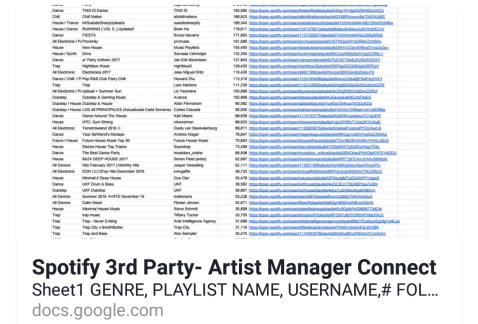
Several members of the Artist Managers Connect Facebook group (a global networking group of artist managers and other music industry professionals such as service providers, music tech founders, and label/publishing reps) curated a list of third-party Spotify playlists.
This amazing resource is a Google Sheet posted by AMC member Jorge Mejias with a caption:
Since I truly hate the fact that there are “PR” companies offering “Spotify Playlist Pitching” for upwards of $1K+ making false promises they know and then saying something around the lines of “it’s just how the industry is” or “Spotify playlisting is tough” or whatever-
Here is a google sheet w/ info on some of the most popular third party Spotify playlists that most of these companies are pitching to because-
1) this information is all public so I don’t feel bad giving it out & saving people some research
2) what you get out of it = how much time you dedicate to it
3) getting scammed in 2017 / not helping prevent it when you can is silly
Contact info is all out there so stop making excuses. Also the follower count on these are outdated.
*Edit* – also this is a thank you to everyone from AMC who has helped me out thus far. you rock~
*Edit2* – also please refrain from publicly posting any contact info- thank youuu!
*Edit3* – this post by no means aims to discredit companies who do properly provide pitching services. Dan put it best by saying “Would like to caveat that some of us work records at Spotify and Apple Music very transparently and based on years of repertoire and success for our artists within the platform’s respective ecosystems. ”
*Edit4* – thank you Dustin for contributing his spreadsheet
The list requires you to do a little bit of work to reach out to the curator, but the awesome thing about the list is that they’ve already done the work to identify the curator’s Spotify username and have tracked followers and genre to help you sort and prioritize.
List: https://docs.google.com/spreadsheets/d/1-jf6HkRHay43pv8f6X_VneDPuEY405YV3Ool8GVdZjs/htmlview
Go forth and pitch your music!
Let me know if you land a placement.
5 Music Business Tasks You Can Do Before The End Of 2017

2017 is coming to an end. Here’s a quick rough rundown of some things you can (and some that you must) accomplish before the end of the year:
1. GET YOUR GROOVE MUSIC MECHANICAL ROYALTIES BEFORE ITS FORFEITED. Microsoft is shutting down Groove Music on December 31, 2017. Legally speaking, they are not required to pay mechanical royalties to songwriters and publishers who have not registered their copyrights with the United States Copyright Office. Therefore, in theory, on January 1st, 2018 Microsoft could expunge any unclaimed mechanical royalties. Royalty Claim shows you how to find your songs and begin the process of unlocking any accrued mechanical royalties.
2. GET DISCOUNTED CONFERENCE PASSES FOR 2018. If you’re thinking about going to music industry conferences in 2018, you should know that many of them offer early-bird discounts now. These savings really add up when you attend multiple conferences in one year. SXSW is currently offering lower rates that end on set dates. The next rate increase will be on Nov 17th. NAB is offering a variety of packages at more than 50% off through Nov 24th (including a FREE pass for the Exhibit floor). There are more offers out there such as Music Biz Expo with discounted rates through March and ASCAP’s “I Create Music” Expo with discounted rates through the end of the year.
3. RELEASE A HOLIDAY COVER SONG LEGALLY AND SUBMIT TO BLOGS FOR END OF YEAR EXPOSURE. It’s not too late to record and release a holiday song this season and leverage the exposure from blogs and background music services. I breakdown how to do this in my piece “5 Tips For Making, Marketing And Monetizing Holiday Music This Season”.
4. GET OR RENEW YOUR GOOGLE PLAY MUSIC MECHANICAL LICENSE. If you distribute music to Google Play Music, you may be earning mechanical royalties that you have not collected. Mechanical royalties are different from your master use royalties (paid to labels, distributors, and aggregators) and performance royalties (paid to performing rights organizations (PROs) such as ASCAP, BMI, SESAC, and GMR in the United States). Mechanical royalties are royalties paid for the distribution of the underlying musical work embodied in a sound recording — that is, the “song.” Mechanical royalties are owed to songwriters and publishers and is not paid to labels, distributors, aggregators, or PROs. To enter into a direct agreement with Google for your Google Play Music mechanical royalties, you can do one of two things: (1) Sign a direct deal with Google Play Music, whereby you will be responsible for data ingestion as well as ongoing account management. Please reach out to indiepublisher@google.com should you like more information about the direct license; or (2) Opt in via the Harry Fox Agency, whereby they will manage your content on your behalf. You can do so by logging into your HFA account at harryfox.com and click the “Authorizaions” link located in the “Licensing” box. If you do not have an HFA Online account, you can fill out a Request for Administrator Account form at https://secure.harryfox.com/public/forms/online-account/form.jsp. You do not need to be a member of HFA to pursue this option. You can easily streamline and expedite the delivery of your song registrations to Harry Fox Agency (and Music Reports Inc., Loudr, ASCAP, BMI, SESAC, SoundExchange, and many others) using the affordable music rights and metadata management platform TuneRegistry. TuneRegistry was built to empower the independent music company and DIY musicians who self-publish.
5. CLAIM / VERIFY YOUR ARTIST PAGES & SOCIAL MEDIA. Go into 2018 with a tight marketing infrastructure by making sure that you control all of your presence across the top DSPs and social platforms. Symphonic Distribution breaksdown how to claim your label/artist page on DSPs and music marketing agency View Manic can help eligible artists verify their profiles on Facebook, Twitter, YouTube, and Instagram.
***BONUS ITEM – DUE IN EARLY 2018***
6. PREPARE AND SEND FORM 1099s. Did you hire a publicist or digital marketing consultant to work your campaign this year? Did you book a photographer for a photo shoot? Hire a graphic designer to overhaul your website? Got a new music video from a production company or indie video director? If you hired freelancers or independent contractors this year, make sure to prepare and send them a Form 1099. This form is required (few exceptions) to be sent to non-employees when you’ve paid them $600 or more for services remitted. The information for the form is gathered from payments you’ve made and the contractor’s information, which you should also collect on a Form W-9. Contractors must receive the 1099 by January 31st, 2018. Read more about 1099s here and W-9s here. In the past, I’ve used Track1099 to easily generator and file 1099s. Check them out or others on the market.
Featured photo by aiden marples on Unsplash
[Podcast] Dae Bogan On “The Business Of Data” Panel At SF MusicTech Summit 2017

Listen here.
SF MusicTech Summit
October 17, 2017
www.sfmusictech.com
PANEL DISCUSSION: This Business of Data
MODERATOR: Cherie Hu, Forbes / Billboard
SPEAKERS:
Scott Ryan, Gracenote
www.gracenote.com
Michael Jeffrey, TiVo
www.tivo.com
Dae Bogan, TuneRegistry
www.tuneregistry.com
Kristin Westcott Grant, Westcott Multimedia
www.westcottmultimedia.com
***********
Recorded by Media One AV
www.mediaoneaudio.com
Listen on SoundCloud here.
[Podcast] Dae Bogan On “Entertainment Business Podcast” With Graham Rowe

I had the pleasure of being a guest on Graham Rowe’s Entertainment Business Podcast. In this episode, I talk a bit about my background and my journey in the music industry as well as offer some strategy and insight into DIY music careers. Have a listen on iTunes here.
Google To Enable DIY Musicians To Capture Their Mechanical Royalties
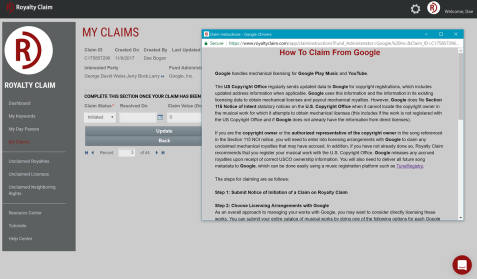
Today, I’m happy to say that after weeks of discussions, Google has come onboard to
Royalty Claim to make it possible for DIY music creators to get DIRECT LICENSING DEALS with Google Play Music and YouTube.Read more in Royalty Claim’s Facebook post.
Ask Me Anything About The Music Business, With Dae Bogan
Ask me your music business question and I’ll attempt to provide you with an answer or direct you to a resource with a better answer or guidance. I cannot provide specific legal advice, but I can discuss general music business practices. Join the conversation on Facebook, Twitter, Linkedin, or DaeBoganMusic.com. Simply drop your question in the comments section wherever you see the above image.
[Podcast] Copyright Clearance Center Adds Recording Of “View From The Top: The Future Of Machine-To-Machine Rights Management” Panel Discussion From RightsTech Summit 2017 To Its Beyond The Book Podcast

“View From The Top: The Future Of Machine-To-Machine Rights Management” panel at RightsTech Summit in New York

Left to Right: Dae Bogan (CEO, TuneRegistry), Benji Rogers (CEO, dotBlockchain Music), Michael S. Simon (President of Rumblefish & CEO of Harry Fox Agency), Michael Shanley (Vice President of IT Business Development, Music Reports)
Machine-to-machine communication is the ideal scenario if we want to enable on a global scale, with as little friction as possible and at a reasonable cost, the licensing of works and the payment of royalties to rightsholders. That at least is the stated premise for a recent discussion at the annual RightsTech Summit conference.
But how far have we come? How close are we to achieving a digitized business environment for rights and royalties that is as fully realized as we see today in media distribution and consumption? Until code entirely does away with contracts will human beings will continue to add a value that no machine ever can?
“I think all of this starts with a human being. No matter what technology we apply to these systems, if a person doesn’t know how to interact or create the data that they need to disseminate, it’s just not going to get there,” said Michael Shanley of Music Reports. Technology evolves all the time, and I think we’re getting to great places in technology. But education and information is, I think, paramount.”
Panelists for the session moderated by CCC’s Chris Kenneally included Dae Bogan co-founder & CEO of TuneRegistry, a music and rights metadata management platform; Benji Rogers, a British-born, New York-based entrepreneur, who co-founded the Dot Blockchain Music Project, an attempt to create a de-centralized global registry of music rights using blockchain technology; Michael S. Simon, President of Rumblefish, a world leader in music micro-licensing and YouTube monetization and also CEO of the Harry Fox Agency LLC, the nation’s leading provider of rights management, licensing and royalty services for the music industry; and Michael Shanley, Vice President of IT Business Development at Music Reports, developers of proprietary databases and software applications that facilitate music rights administration.
Listen here.

Free DIY eBook
CONNECT WITH ME


