
Dae Bogan To Host Round-Table On Music Rights For Film & TV Composers At 2016 Production Music Conference

Do you create music for film & TV? Want to learn more about your rights as a composer of production music? Join me next week as TuneRegistry hosts a round-table at the 2016 PMA Production Music Conference on Tuesday, 10/18 – 9:00 – 10:00am. The conference is almost sold out, so grab your tickets now.http://pmc.pmamusic.com/
[FREE] Join Southern California Music Industry Professionals

Music Industry Professionals: As some of you know, I am the organizer of Southern California Music Industry Professionals, a professional networking group with over 1,600 members (our member base is mostly online at www.meetup.com/scmiponline, but I recently created a Facebook group).
I am happy to announce that I am organizing our 3rd meetup this year and you’re invited!
Our next SCMIP mixer will be held on Thursday, October 27th, from 5pm to 8pm at the Rosenthal – The Malibu Estate Wines off of PCH in Malibu.
Come mix and mingle with professionals across all sectors of the music industry from recorded music and publishing to live music, touring, and music supervision.
I will have a guest speaker (TBA) to discuss music publishing.
OPEN MIC CALL: I am pleased to announce that we will have limited slots for open mic performances. If you are interested, please contact me to audition your music. This is a wine bar in Malibu, so the music selection will be appropriate for the environment. The venue has a backline, so you may not need to bring much equipment (if anything).
I hope you can make it. Please SHARE with other music industry professionals and make sure they join www.meetup.com/SCMIPonline.
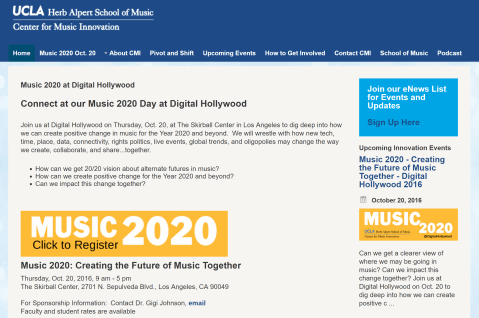
Dae Bogan To Moderate Panel On Music Rights And Micropayment Systems At UCLA Center For Music Innovation’s Music 2020 Day Event
Dae Bogan To Speak On Content Marketing Panel At FestForums Santa Barbara 2016
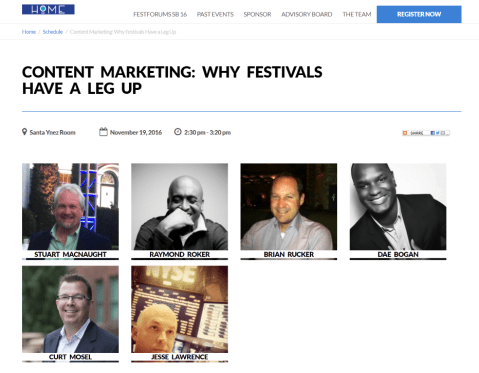
Live in/near Santa Barbara? If so, consider attending FestForums Santa Barbara 2016 in mid November 2016.
Festivals are in the business of creating valuable experiences and the goal for brands is to use these experiences to connect with their customers. With so much digital content being created, brands are able to connect more intimately than ever, even when consumers are far away from the festival. Let’s explore the brands, the experiences, and how we can use them to the benefit of festivals, sponsors and consumers.
[VIDEO] Watch How TuneRegistry Can Help Indie Music Creators Protect Music & Unlock Royalties

Are you an indie artist looking to unlock additional income streams from your music?
Are you a band confused about what rights each member owns and how to protect them?
Are you a manager looking to save time and streamline reoccurring music industry administration tasks?
Are you an indie label or publisher looking for a better way to organize your company’s catalog in a collaborative space?
TuneRegistry is a next generation music management platform that enables creators and rights-holders to streamline the administration of their music catalogs.
Learn more at www.tuneregistry.com.
The Uniquely US Challenge That Indie Artists Face When Asked To License Music To Indie Filmmakers, For Free

20 Different Ways to Release an Album: From Beyonce to Frank Ocean to U2 & Beyond

FREE WEB CONFERENCE: Artist Launch’s Virtual Music Business Summit

FREE WEB CONFERENCE:
Artist Launch’s Virtual Music Business Summit
August 24th, 2016, Starting at 12pm PST
• Dae Bogan (Co-founder & CEO of TuneRegistry)
• Benji Rogers (Chief Strategy Officer of PledgeMusic)
• Reggie Hawkins (Program Director of Hip Hop Nation on SiriusXM Radio)
• Cynthia Charles (Touring at AEG Live’s Urban Touring Division)
• Cherie Hu (Media & Entertainment Writer for Forbes)
Join the live Q&A on “HOW TO PROTECT AND MARKET YOUR TALENT” with Dae Bogan at 3:30pm – 4:00pm PST
See full schedule: https://karenmariemason.com/
Tune-in here: http://events.instantteleseminar.com/?eventid=88530465
On Helping African And Caribbean Artists
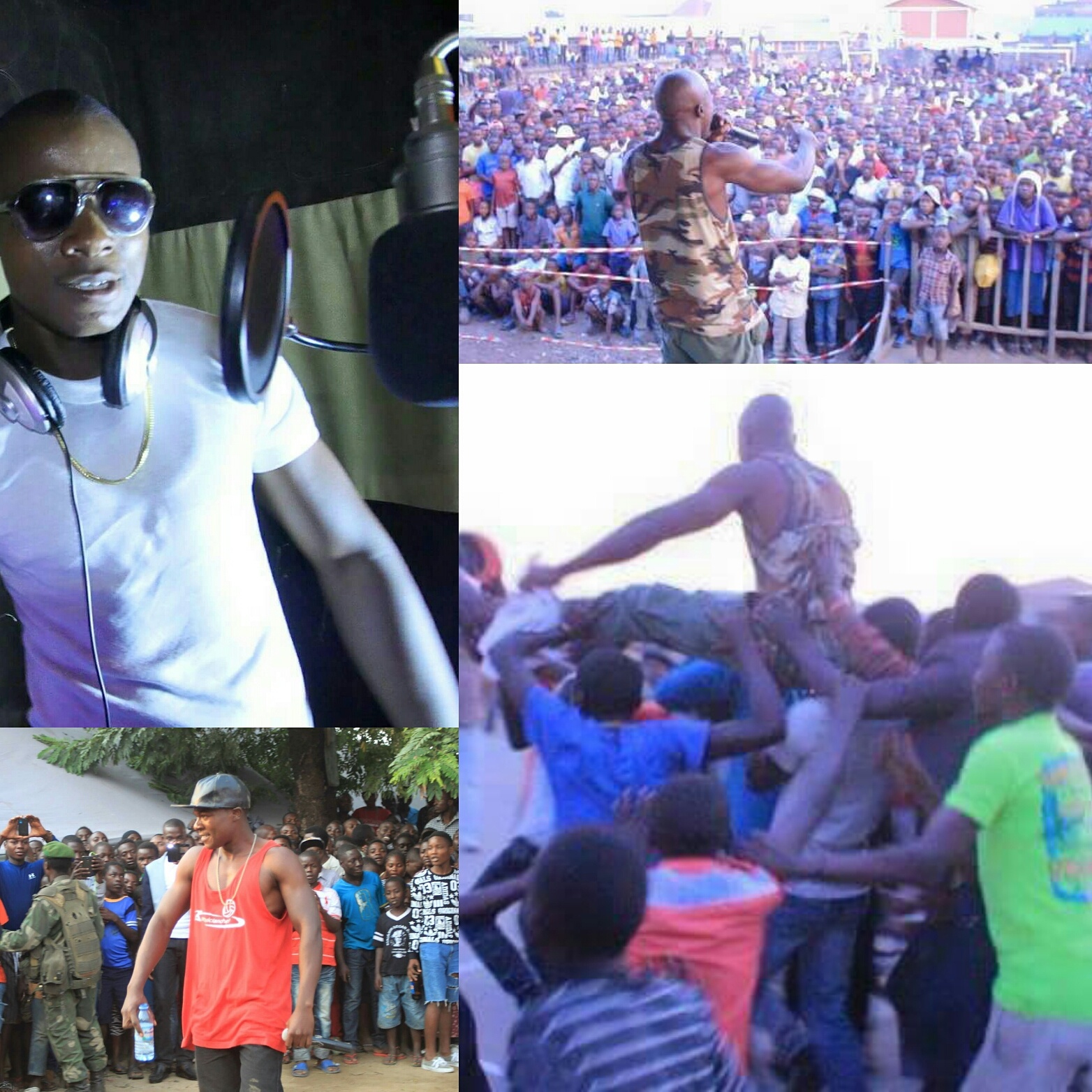
A collage of Blackman, a rapper from Congo to whom I provided career advice. Photos from his Facebook fan page.
Thanks to my buddy Mark Adato, and his work with the organization Africa New Day, I got to help two African independent artists from Congo with career advice. This year, through my mentorship work at SXSW and through AND, I’ve been honored to give career advice to artists in the Caribbean and Africa.
Independent artists in the United States take for granted our relatively easy and abundant access to information and resources related to the music business. Many of the artists in Africa and Carribean do not even know how to get their music on iTunes. They want desperately to share their music. I’m proud that I’ve been able to help a few get started on the right path.
I’ve even used my in-store music video network, which plays in all Shiekh Shoes stores across the United States, to showcase artists from Africa and the Caribbean to my 3 million viewers.
Connecting the diaspora through music, demonstrating our similarities through musical storytelling, and showing that entertainment defies boarders has been a humbling experience.
If you are reading this and you are an artist from Africa, reach out to Africori, which describes itself as a Pan-African music company for artists and labels. Their website is http://africori.com. They may be able to help with getting music distributed. Also, learn about copyrighting your music and collecting music royalties in your territory. You can find more information by talking to Music In Africa foundation. Their website is http://musicinafrica.net.
DOJ 100% Licensing Rule: An UnFair Tax on Hip Hop and Works With Samples?
I often use Hip-Hop and Pop songs in my classes and workshops when discussing rights, income participation, publishing splits, and royalties because these two genres tend to have the most writers per song on average. With the recent DOJ ruling to enforce 100% licensing, songwriters have been trying to understand its impact on their careers. In his blog, TheTrichordist.com, David Lowery presents a compelling argument that the 100% licensing ruling is a “tax” on Hip-Hop music creators and rights-holders. He uses a DJ Khaled song as an example to demonstrate how the 100% licensing rule could impose unfair cost, administrative, and time prohibitive requirements on writers and publishers.

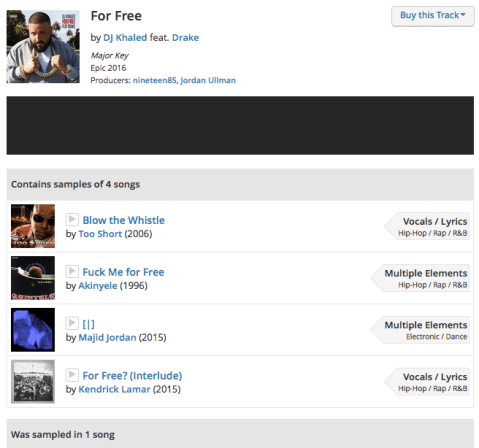
Let’s look at the implications of the DOJ 100% rule for the writers of the 5th most popular Hip Hop Song in the US this week.
These are the four samples in For Free, by DJ Khaled featuring Drake. Each of those sampled songs also has multiple writers. Consequently the list of writers for the composite work is quite long. In this case there are 13 Songwriters, 4 BMI publishers and at least 3 non BMI publishers. 6 writers use ASCAP to license performing rights. 6 writers use BMI and one writer is Canadian so they use SOCAN. As is always the case with works composed of samples, these writers have a co-writer agreement to spell out ownership percentages and then an agreement that specifies each party will license and collect it’s own fractional share. “You do your business and collect your money, I do…
View original post 272 more words
Free DIY eBook
CONNECT WITH ME


