
Infinite Licensing in AI Music

For a few years now, in private conversations with various technologists, music rightsholders and fellow data nerds, I’ve been using, and trying to coin, the term “infinite licensing” to describe the concept of real-time AI-powered dynamic licensing of rights in both generative-AI and single-source derivative AI music applications.
No, I am not talking about smart contracts, which are finite preset rules hardcoded in a file that is then minted to a blockchain, but rather the convergence of AI (conceptual/subjective/ecosystem) and blockchain (context/ownership) within the permission layer of applications that can generate an infinite ♾️ combination of licensing deal terms.
Infinite licensing would behave sort of like an oracle within applications to dynamically value and clear rights in machine-to-machine, business-to-business, and consumer-to-machine applications, going beyond the scope of human objectivity, individual experience in negotiation and valuation, and workload capacity in the licensing process.
It removes limiting royalty formulas and most favored nations models and replaces them with highly customized and more commercially accurate representations of value at a given point in time.
I imagine a future where an AI system built on an LLM that has learned from previous licensing deals (and the outcomes and missed opportunities of such deals), ingested airplay and streaming stats, interpreted correlations and trends, while calculating the lost value of undervalued deals, analyzed historical sync data, quantifies hype, ingested sales data, and consumer behavior and sentiment data, etc. would dynamically determine rates and terms for gen-AI and single-source derivative AI music outputs.
Infinite licensing, unlike smart contracts, could factor in variations in types of use, the real commercial value of the source music involved, the perceived cultural value of music creators involved, the market value of the opportunity, and much more.
The blockchain aspect, which has been in development across a variety of projects and startups for over 10 years now, would provide the architecture for transparent and immutable rights management while remuneration could be supported by cryptocurrency.
In 2019, when I presented my lecture “Music 2020: The Next Era of Innovation in the Music Industry” at the California Institute of The Arts and again at Music Biz Conference, I argued that artificial intelligence, blockchain, and cryptocurrency would be among the technologies that will transform the music industry in the 2020’s.
We’re halfway through the 2020’s and I think someone will figure out infinite licensing before 2030.
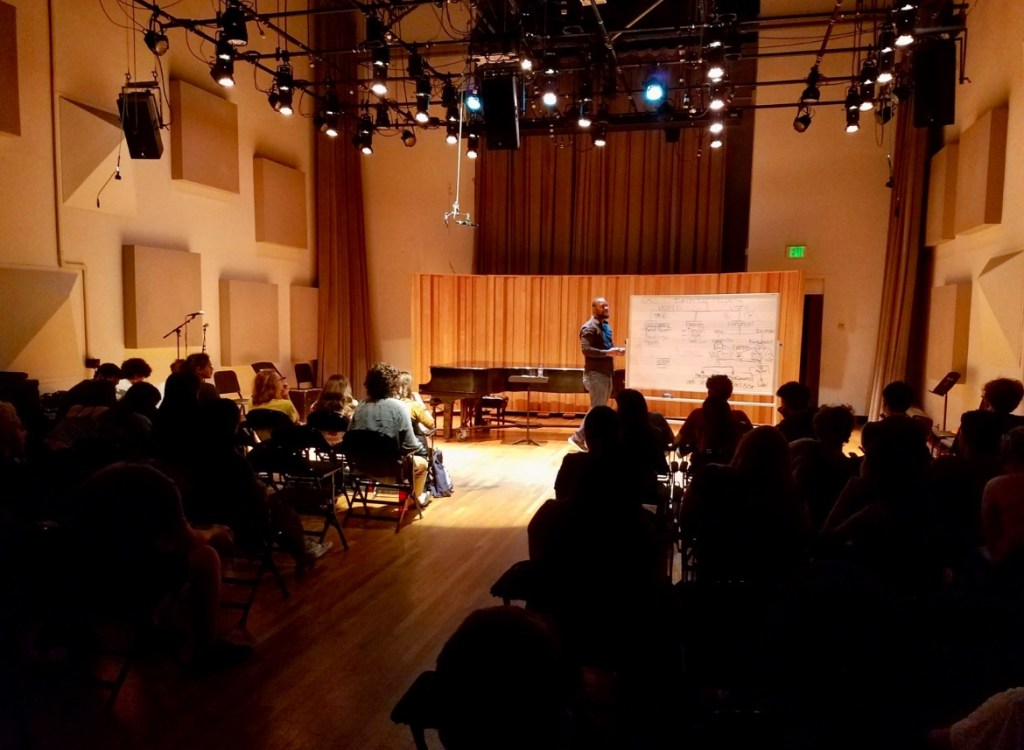
Dae Bogan’s Music Industry Entrepreneurship Winter 2023 Class At UCLA Wraps With Student Startup Presentations

An artificial intelligence music production platform. A global music mentorship and collaboration social media platform. An app to track your favorite artist shows and connect to attend with other solo concert-goers. A digital music service for independent music where artists can engage with their listeners. And a marketplace where musical artists can find visual artists to design album artwork.
Those were the startup ideas that my students pitched during their final presentations tonight in my Music Industry Entrepreneurship class at UCLA Herb Alpert School of Music.
They put in 10 weeks of market research and strategic business planning to conceptualize 5 highly feasible startup ideas while learning from my lectures and guest speakers including Jeff Ponchick (formerly of Repost by SoundCloud), Vickie Nauman (CrossBorderWorks), Shara Senderoff (Futureverse / Raised In Space), Josh Simons (Vampr), Darryl Reid (E-Mixed), and Kristin Graziani (Stem).
An intense 10-weeks series of 4-hour masterclasses (one per week) has come to an end. I am proud to know that another batch of tomorrow’s music industry game-changers are armed with the skillsets and entrepreneurial mindset to contribute to the continued evolution of the music industry.
One such example is my former student (2019) David Hartley, Founder & CEO of SoundSmith. David utilized my office hours to explore an idea at the intersection of music and influencers and express his interest in diving into entrepreneurship. After excelling in my music industry entrepreneurship class and graduating in 2020, he began to work on his idea with his friend/co-founder. Eventually, they were accepted into both the Startmate business accelerator and the Melbourne Accelerator Program. Recently, David was named a The Music Network 30 Under 30.
Dae Bogan To Moderate Panel On Los Angeles Music Startup Scene With Capitol360, Techstars Music, Expert DOJO, The Rattle LA, And Startup UCLA / Blackstone Launch Pad At UCLA’s Amplifying Music In Our Los Angeles Conference On| May 15th, 2019
Amplifying Music in Our Los Angeles
A Conference Amplifying and Connecting the Music Scenes of Los Angeles
Host: Center for Music Innovation at UCLA Herb Alpert School of Music
Location: Charles E. Young Research Library Auditorium, UCLA North Campus
Time: 9 am – 4:30 pm
Date: Wednesday, May 15, 2019
Cost: Free for Registered Attendees
How can we support Los Angeles’ music scene(s) and work together to continue to create something robust, diverse, and dynamic in this changing era?
This day-long conference expands the conversation of how Los Angeles can grow and connect/collaborate around its diverse music scenes. If other cities are challenged by gentrification in having vibrant live music scenes, (a) why is Los Angeles seeming to be growing, despite these difficulties and (b) how we we enhance and amplify this growth?
Background
This Conference is the second in a series of events that UCLA Center for Music Innovation is holding with this Future of Music in LA focus across 2019 across LA, so we welcome you to be involved in those programs as well.
On February 6th, the City of Los Angeles Department of Cultural Affairs held a half-day Symposium as part of its February COMPOSE LA series of events. With partners that included UCLA’s Center for Music Innovation, they brought together different voices across Los Angeles and music to talk about the future of Music in Los Angeles.
Los Angeles is a complex environment. From panels and provocations, we came up with many things that weren’t right within the overall ecosystems in terms of policy, permitting, and procedures. We also explored our very vibrant environment that seems to be growing — despite the systemic challenges.
The Invitation
We invite the community gather again on May 15th at UCLA to both expand the conversation and to add new voices into the mix. We’re going to include people joining us from video conference from other cities and locations. We’re going to include new parties — and parties with different perspectives. And we’re going to include roundtable conversations, where the conversation will come out into and with the audience.
We invite you to join us for this community event at the Charles Young Research Library at the UCLA campus. The event will be free, along with the support from our community and marketing sponsors.
The Schedule
Sessions and the full schedule will be posted mid-April.
FREE REGISTRATION (INCLUDING ONLINE STREAMING OF CONFERENCE)
Here Are 10 Ways That The Mechanical Licensing Collective (The MLC) Can Set The Bar As A Collective Management Organization In The 21st Century

Title 1 of the MMA, also called Music Modernization Act, sets out provisions and guidance for the formation of a collective mechanical licensing body to be called the Mechanical Licensing Collective (The MLC). The MLC will administer a safe harbor blanket license for the streaming of musical works, collect licensee fees from licensees, prepare and remit statements of earnings to songwriters and music publishers, and make royalty payments to the same.
The MLC will join the ranks of SoundExchange, ASCAP, BMI, and SESAC in the sense that it will become a powerful representative of the collective rights of thousands of music creators and rights-holders in the United States. However, unlike its counterparts, The MLC will be born in the 21st century. And as a 21st century collective licensing organization, The MLC has the unique opportunity to implement, at inception, 21st century business practices utilizing 21st century best practices and technologies.
Music 2020: The Next Era of Innovation in the Music Industry

Wednesday night, at California State University – Northridge (CSUN), I conducted my latest workshop, “Music 2020: The Next Era of Innovation in the Music Industry,” in Professor Andrew L. Surmani’s class for his M.A., Music Industry Administration students.
In this workshop, we explore the art and process of ideation; discuss the differences between invention, disruption, and innovation; and profile a number of developing innovations within the music industry including augmented reality (AR), virtual reality (VR), mixed reality (MR), artificial intelligence (AI), machine learning (ML), blockchain and crypotcurrency. The presentation ends with a design thinking exercise where students break out into groups to work through the fundamental design thinking process of developing a minimum viable product to solve a vetted problem in the music industry.
The students seemed to like the workshop:
Dae, you were fantastic and the CSUN MIA students thoroughly enjoyed your very organized, insightful and forward thinking presentation. That was evident in the line of students waiting to talk to you at the break. Thank you again for coming to talk to our graduate music industry students.
– Andrew Surmani, Associate Professor of Music Industry Studies, California State University – Northridge
I’m looking forward to conducting this workshop next week at the College of the Canyons.
How Blockchain And Cryptocurrency Can Speed Up Spotify International Publishing Royalty Payments To US Songwriters

There’s been a lot of talk about applications of blockchain technology and cryptocurrency payments in the music industry. In fact, there isn’t a single major music industry conference that doesn’t dedicate some programming to related topics. There are several projects and startups currently underway to address licensing, discovery, attribution, remuneration and more with blockchain, smart contracts, and cryptocurrency.
For those of us who aren’t blockchain developers, simply keeping up with the many applications of blockchain in the music industry is the closest we’ll get actually knowing how this all (could) works.
I’ve been thinking about how blockchain and cryptocurrency could speed up the process of paying U.S. songwriters, who wait upwards of 1.5 years to get paid for the use of their songs on Spotify outside the U.S.
The current state of the flow of international publishing income to U.S. Independent Songwriters who own their publishing and use traditional publishing administrators to collect in the U.S. is quite depressing.
As an example, Tommy released a song on Spotify in January 2018. In the United Kingdom, the song earned $100 “publisher share” Spotify UK digital public performance royalties.
Here’s the breakdown:
START: $100 “publisher share” of Spotify UK digital performance royalties in January 2018.
1. PRS collects Tommy’s publishing income in the UK ($100) in January 2018.
2. PRS retains 10% admin fee and remits the balance ($90) to ASCAP in October 2018.
3. ASCAP retains 12% admin fee and remits the balance ($79.20) to the Publishing Administrator in February 2019.
4. Publishing Administrator retains 20% admin fee and pays Tommy ($63.36) in July 2019.
END: Tommy is paid $63.36 for his Spotify UK “publisher share” income (earned $100) after waiting 1.5 years and experiencing a reduction of 37% of his royalties. Imagine $1,000 reduced to $633.60 or $10,000 reduced to $6,336.00.
Had Spotify used blockchain technology to dynamically identify Tommy as the rightsholder in his song and paid him instantly at the close of the month with cryptocurrency, Tommy would have already spent his $100 on studio time!
Free DIY eBook
CONNECT WITH ME


 Dae Bogan Music