
Royalty Claim Unleashes Another 22 Million Section 115 NOIs

Royalty Claim Initiative‘s mission is clear:
“To aid in creating transparency in the global music licensing ecosystem.”
We do this by conducting research into the global music licensing ecosystem to understand where and why royalties go uncollected. The Royalty Claim Platform is a FREE online search engine empowering music creators and rights-holders with access to the data about unclaimed royalties and music licenses.
After a rocky launch weekend, we are happy to announce that we’ve just made over 22 Million more Section 115 NOI records searchable. Copyright owners (or their agents) can create a free account, search for free, and initiate claims for free.
Harry Fox Agency, Music Reports Inc, MediaNet and Loudr are among the licensee agents that will receive claim notifications via Royalty Claim for Section 115 NOIs filed on behalf of digital service providers such as Spotify, Google Play Music, Microsoft Groove Music, Pandora, iHeartMedia and Amazon Music.
Join today and search for free at www.royaltyclaim.com
What I Read To Stay Current On Music Industry Affairs — For Better Or Worse

(UPDATED 10/15/17 – Added more outlets to the list)
Music industry professionals — especially consultants who work with a variety of clients across numerous sectors of the music industry — are behooved to stay up-to-date on the latest affairs and current events in the music industry. We do this a number of ways such as catching up with colleagues, attending conferences and networking events, and (the easiest) following and reading music industry trade publications and certain bloggers.
There are many publications and bloggers out there, and they range dramatically in terms of depth and breadth of coverage, level of objectivity, and overall value of insight.
Media analyst Mark Mulligan is known and respected for his in-depth and research-driven approach to offering deep dives into music industry trends via his work at MIDia Research and his blog Music Industry Blog while music attorney Chris Castle offers critical analysis of nuanced legal matters, especially those affecting copyright owners, on his blogs Music x Technology x Policy and Music Tech Solutions.
Then, there are some publications and some bloggers, while they offer interesting insight and news, can come off as “gossipy” from time to time (as one artist manager put it, when I shared this list in the Artist Manager’s Connect Facebook group); while others rant on about nothing of significance (said another).
Moreover, some publications are loaded with advertorial that is sometimes disguised as news (an “advertorial” is the term used to refer to an article that has been paid for (or commissioned in some way) by a brand and written (sometimes by the brand itself) for the purpose of advertising the brand without the content coming off as an advertisement — thus, advertisement + editorial = advertorial). Generally, you can recognize an advertorial and read through the advertisement to extrapolate what’s important to you (if anything). Advertorial falls into the wider spectrum of content marketing (content created by or for a brand to reach and engage target customers; including blogs, videos, advertorials).
Not all content marketing is inherently bad, though. Many articles written by or for brands offer enriching insight for its target audience, like this one that I wrote, which was published on Bandzoogle’s blog and RepostNetwork’s blog. While the article does promote my company TuneRegistry at the very end, the majority of the article details “5 Royalty Streams Every Indie Artist Should Know” and helps DIY musicians and artist managers wrap their heads around these issues.
So, whether you’re a seasoned music industry professional or an up-and-coming DIYer, if you want to stay up-to-date on what’s happening in the music industry, subscribing to a few outlets may be helpful.
Below is a select list of the music industry publications, blogs, and newsletters to which I am subscribed. Where applicable, I included the name of the primary curator/blogger and their personal Twitter handles. Follow them or connect with them up on LinkedIn.
—(A-Z)—
ArisTake (Ari Herstand | @aristake)
ASCAP Daily Brief (Dean Kay)
BillboardBiz
BMI The Weekly
CD Baby’s DIY Musician Blog (Christopher Robley | @chrisrobley)
Dae Bogan Musc (shameless self-promotion — Dae Bogan | @daeboganmusic)
Digital Music News (Paul Resnikoff)
Hypebot (Bruce Houghton)
Leftsetz Letter (Bob Leftsetz | @leftsetz)
Library of Congress Blog
MediaNet Blog
Motive Unknown (Darren Hemmings | @mr_trick)
Music Ally (Wesley A’Harrah | @adreadpirate & Anthony Churchman)
Music Business Worldwide
Music Industry Blog (Mark Mulligan | @mark_mulligan)
Music Tech Solutions (Chris Castle)
Music Think Tank (Bruce Houghton)
Music x Tech x Future (Bas Grasmayer | @basgras)
Music x Technology x Policy (Chris Castle)
SXSW Daily Chord
The Trichordist (David Lowery)
Added on 10/15/2017 from reader submission
- CMU Daily (Complete Music Update)
- ICMP Global Briefing (ICMP)
- Music World News (IMC – International Music Council)
- Music Week Morning Briefing (Music Week)
- Music REDEF (REDEF)
- Platform & Stream
- Synchtank Weekly (Synchtank)
There are several publications not listed here because they do not soley cover the music industry, but are still good sources of information when they periodically publish music industry related pieces (e.g. Wall Street Journal, The Hollywood Reporter, Variety, Forbes, Techcrunch).
QUICK TIP: Subscribing to many blogs and newsletters will result in many emails hitting your inbox. To keep your inbox free for your day-to-day business/personal email, create a new email address just for subscriptions (e.g. daesreadinglist@gmail.com). Then, all of the newsletters and new post announcements will go to that inbox and not clutter your primary inbox. Ok great, you now know how to keep your inbox clutter-free. But, what about keep up-to-date? Well, you can check the inbox once a week, twice a week, or whatever frequency that works for your schedule. I like to scan all emails on Monday. Some newsletters curate other stories, so they link to the same sources. Some publish original content. I like to read the headlines, choose what matters to me, and then read at my leisure.
My list is by no means exhaustive. And since I’ve already heard from some very passionate music industry folks about their support or disdain for some of the publications/blogs/bloggers listed, I’d like hear your thoughts.
Tell me in the comments what you read that isn’t on the list or feel free to share your opinion about any of the listed outlets.
Featured Photo by Muhammad Raufan Yusup on Unsplash
If You’ve Never Received Mechanical Royalties From Google Play Music, This Might Be Why
Is Google Willfully Refusing To Use Its Own Assets To Identify Copyright Owners?
In recent weeks Google and YouTube has come under fire by high-profile music industry professionals in regards to Lyor Cohen’s statements on the royalties it pays to artists. This piece is NOT about that.
At Royalty Claim, we periodically randomly select and investigate records that our researchers and data scientists ingest. Random investigations — sometimes against pre-determined hypotheses and sometimes just to follow down the rabbit hole — has helped us uncover nuances in the music licensing ecosystem that manifest into trends that suggest major systemic issues.
Earlier this month we reported that Google has filed nearly 7 Million Section 115 NOIs on the US Copyright Office for musical works in which it claims to be unable to identify the copyright owner. Then, Lyor Cohen boasted about YouTube’s royalty payouts and its growing ability to match music to videos (Google it, it’s everywhere). And then we remembered that this is only possible due to YouTube Content ID, which is arguably the largest database of copyright information with music codes, audio samples, etc.
So, if the largest submitter of “copyright owner unknown” NOIs is also the owner of the largest private database of copyright owner information, it makes no sense that Google cannot seem to identify copyright owners to pay mechanical royalties for the use of the copyright owner’s songs on Google Play Music.
So, we investigated this.
Do So-called Music Advocacy Groups Avoid Deeper Discussions On Black Box Royalties To Appease Their Major Members?

Over the last few weeks I’ve come to consider the notion that some of the biggest so-called “advocacy” groups for music creators censor their discussions on black box royalties due to the top-heavy makeup of their membership.
I’m Working On A Side Project Addressing ‘Black Box’ Royalties
![[Preview] The State of Unclaimed Royalties and Music Licenses in the United States (7)](https://daeboganmusic.com/wp-content/uploads/2017/08/preview-the-state-of-unclaimed-royalties-and-music-licenses-in-the-united-states-7.jpg?w=479)
Lead Photo by Jonny Clow on Unsplash
Watch As Royalty Claim Uncovers Unclaimed Royalties & Music Licenses For Beyoncé, Carl Cox, Afrojack, and Ellie Goulding
Watch us uncover unclaimed royalties & licenses for Beyoncé, Carl Cox, Afrojack, Ellie Goulding, and more using Royalty Claim Platform v1.0 https://youtu.be/J7nIdFdwlzY
[VIDEO] Full Video Of Royalty Claim Pre-launch Webinar
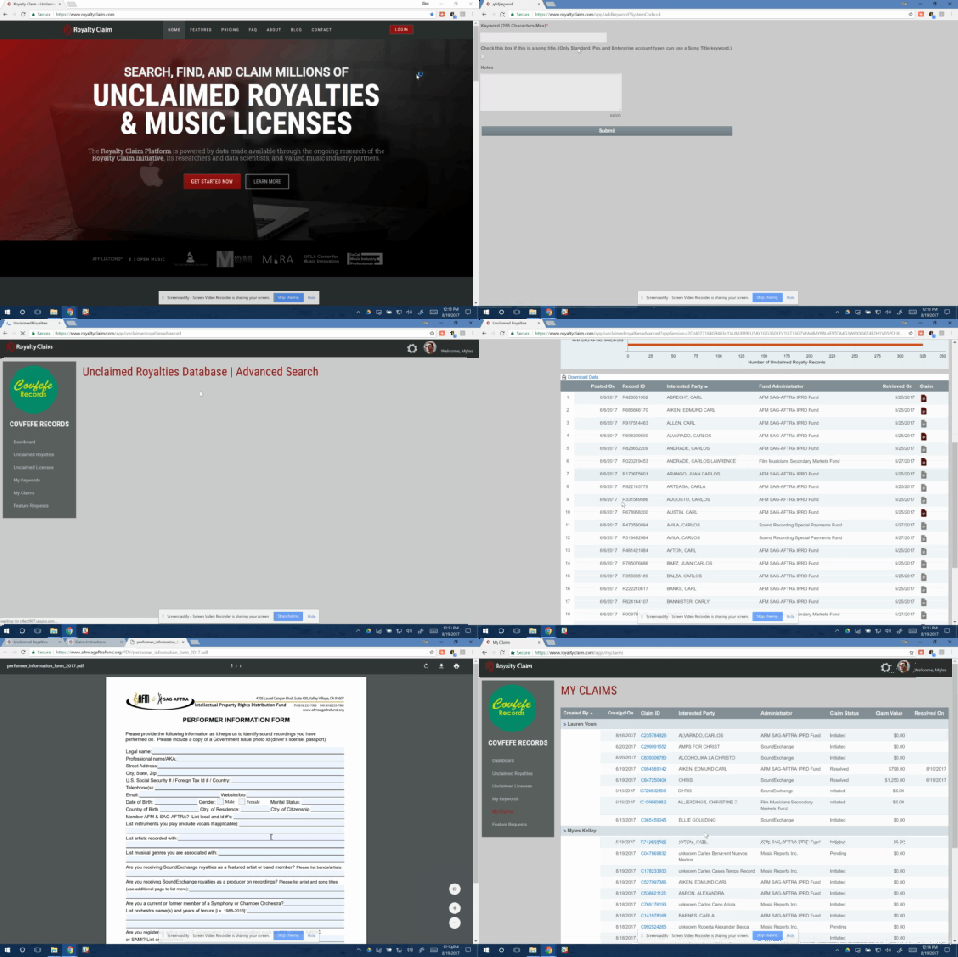
If you missed the Royalty Claim Pre-launch Webinar, watch the full recording here.
(Almost) Everything That You Want To Know About Royalty Claim’s Data

QUESTION: WHERE DOES ROYALTY CLAIM’S DATA COME FROM?
ANSWER: MANY PLACES.
Royalty Claim Initiative researchers and data scientists locate, retrieve, synthesize and ingest an array of published and unpublished data that reference statutory notifications of certain music licenses, unattributed royalties (so-called “Black Box” royalties) and settlements; and income participants (payees) in undistributed royalties that stem from collective bargaining agreements, international reciprocal agreements, statutory royalties, and more. We also analyze data related to music consumption (e.g. downloads, streams, sales), broadcasts, performances, and other types of data to identify trends from which we can interpret insights into the global music licensing ecosystem.
THE FOLLOWING IS JUST A SAMPLE OF THE TYPES OF ROYALTY FUNDS IN WHICH WE ARE INTERESTED:
Royalty Claim’s Full Presentation At The Music Industry Research Association Conference

Royalty Claim attended the Music Industry Research Association‘s first inaugural MIRA Conference at the UCLA Luskin Conference Center this week. Royalty Claim’s Founder and Chief Researcher, Dae Bogan, MIA, had the honor of presenting a preview of our in-progress The State of Unclaimed Royalties and Music Licenses in the United States report before an audience of economists, sociologists, and researchers from universities and institutions from around the world, as well as music industry executives representing firms such as Nielsen, Pandora, Universal Music Group, and Warner Music Entertainment.
For the first time, updated statistics regarding the filing of “address unknown” Section 115 NOIs on the US Copyright Office during the first half of 2017 was revealed. Insights included an overview of the organizations that have utilized the procedure, including Amazon, Google, Spotify, iHeart Communications, and Microsoft. However, those large music users were expected. Interesting inclusions to the list were The Recording Academy and the Christian music service, TheOverflow and interesting omissions from the list are platforms that boast millions of tracks — Apple and Tidal — but may not be reaching every independent rightsowner that may have compositions available on those platforms.

.jpg)
The presentation also discussed the nature and causes of so-called “Black Box royalties”. A black box is an escrow fund in which music royalties are held due to an organization’s inability to attribute the royalties earned to the appropriate payee. Examples were given, including unattributed advances from DSPs to music companies, the US’s limitations on sound recording rights, and other issues.
.jpg)
The presentation concluded with a video demo of the Royalty Claim Platform, which received positive reviews from conference attendees. The full presentation is here.
How To Auction Off Your Future Royalties When You’re A Back-up Singer Or Session Music

Photo by Jason Rosewell on Unsplash
It is very important for background vocalists (and artists who provide background vocals on the side) to understand that they earn money BEYOND the studio session in which they performed. Billboard published an article on how a back-up singer on Wiz Khalifa’s “See You Again” featuring Charlie Puth put up 100% of his U.S. digital performer royalties for auction on Royalty Exchange with bids starting at $30,000. These royalties are collected by SoundExchange and administered by AFM & SAG-AFTRA Intellectual Property Rights Distribution Fund.
This is a great example of how a background vocalist can leverage his/her equity in a hit song to get paid big bucks, today! This also applies to session musicians.
#MusicBusinessMonday: Session Musicians
Royalty Claim has thousands of records of unclaimed royalties due to non-featured performers (session musicians, background vocalists, etc.) from recordings performed on digital radio (e.g. Pandora, Music Choice, iHeartRadio, SiriusXM, and more). Royalty Claim also provides data on ‘address unknown’ NOIs filed under the Section 115 compulsory mechanical license for services such as Amazon, Spotify, Apple, Google, and many others.
Read more about the auctioning your future royalties in the Billboard story here.
Learn more about Royalty Claim at http://www.royaltyclaim.com. Royalty Claim will pre-launch on August 10th. This is for anyone who pre-registered at www.royaltyclaim.com/comingsoon. Those who’ve pre-registered will be able to secure a life-time subscription to Royalty Claim for only $150. Royalty Claim official launch will be September 1st. At that point, anyone can join for free or choose any of the premium plans.
Dear Indie Musician: Do you have a will?
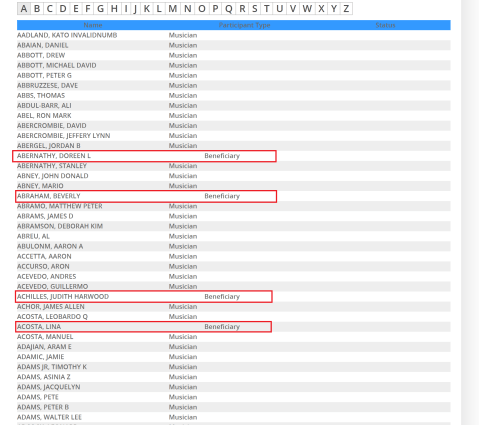
Screenshot of unclaimed royalty checks list at Film Musicians Secondary Market Fund
What musicians should keep in mind is in the event of an untimely passing, your royalty streams are bona fide assets that need to be discussed in a will. Some of the unclaimed royalty information that we have at Royalty Claim is from musicians who’ve passed away, but did not file a beneficiary with the various music rights organizations. So, their music continues to earn revenue, but the organizations do not have beneficiary info to pay it out. Or, musicians who’ve passed away and left no instructions in their will on how their royalties should be allocated, and various claimants have created a dispute.
We should definitely talk more about musician estates (even smaller musicians can have estates). Royalty streams are assets with which musicians can receive loans from companies like Lyric Financial or Sound Royalties, or even sell via platforms like Royalty Exchange. If you’re serious about your music career, be serious about your estate.
Free DIY eBook
CONNECT WITH ME


 Dae Bogan Music