
House of Blues Music Forward Foundation’s Bringing Down the House Seeks Young Emerging Artists

Hello 2019! A Few Updates & Announcements from Dae Bogan
I hope you had a wonderful holiday break. I enjoyed time with family and friends for two weeks, but now I am back full swing!
I wanted to share a few exciting updates and make several announcements regarding my various projects and involvements:
1. TuneRegistry announces new clients Nettwerk Music Group and Jammber. Last year was a pivotal moment for TuneRegistry as we went through the legal battle to re-acquiring our business. We succeeded. In Q4, we launched our enterprise edition and have been working hard to on board new clients such as Repost Network, Vydia, and Create Music Group. Today we announced the addition of Nettwerk Music Group and Jammber (among many others). We are expanding the platform to offer new services in Q1 2019. Here’s the official press release.

2. The website for my consulting firm is now live. Through Rights Department, I provide consulting, coaching, and advisory services to founders of music, tech, and digital media companies. I also provide career coaching and advice to music entrepreneurs (DIY musicians, artist managers, indie label owners, music publishers, etc.). Visit www.RightsDepartment.com for details.
3. I return this week to UCLA Herb Alpert School of Music. I am so excited to return to UCLA to teach “Music Industry Entrepreneurship and Innovation.” The course has grown in popularity within the department, so I believe it will be offered in the Spring as well. This class is very special to me because I get to help bright young future entrepreneurs and business leaders realize their potential as entrepreneurs.

4. My speaking engagements are starting to solidify. I will be speaking at the Digital Entertainment World on Feb. 4th, Balanced Breakfast Music Summit on Feb. 9th, and SXSW on Mar. 14th. More on speaking engagements can be found here.
6. Webinar for A2IM Members. I will be conducting a webinar on neighboring rights royalties for A2IM members on February 6th at 1pm EST. More details to come on this.
5. SoCal Music Industry Professionals Music Industry Happy Hour 13th Edition. I will be hosting the next meetup in February on the 20th or 27th. Stay tuned at www.meetup.com/scmiponline or www.facebook.com/groups/scmiponline.
Thank you for following my blog. I am looking forward to a busy 2019. I’ll be sure to keep this community updated from time-to-time.
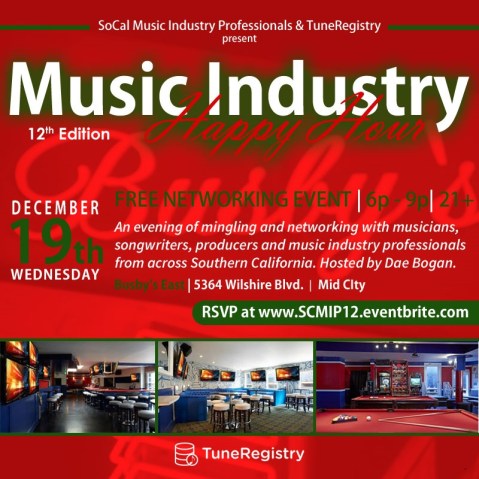
You’re Invited To The SoCal Music Industry Professionals’ End Of Year Music Industry Happy Hour – Wed. Dec. 19th
Another Online Music Industry Entrepreneurship Course?

I’ve been considering developing a series of online courses around entrepreneurship and innovation within the music industry, including and expanding on what I’ve taught in music industry and marketing undergraduate programs at UCLA Herb Alpert School of Music and Emerson College, in the music business graduate program at California State University, Northridge, in the business module of the advanced audio engineering program at SAE Institute Los Angeles, and in my workshops at USC Marshall School of Business, Los Angeles Recording School and College of the Canyons, but I’m starting to reconsider this.
I’ve seen dozens of online courses developed by so-called marketing, business, and entrepreneurship experts that promise to take your business from stagnant to 7 figures in just a few weeks. Often times these experts only verifiable accomplishments tend to be their ability to get others to sign-up for their online courses. Or, at best, they’ve had one lucky break and somehow parlayed that into a facade of serial success, from which real strategy and knowledge can be shared.
We’ve all heard the saying that “those who can’t do teach.” I do not agree with this ugly notion as a generalization, but I do believe that it is actually quite easy to take bits and pieces of advice, common sense, and lessons from others’ case studies and weave these concepts into curriculum padded with superficial “proven strategies” and outdated yet widely adopted business modeling techniques, which the instructor has never put into practice himself, and charge naive entrepreneurs hundreds of dollars to access this material as a life-changing course.
And we wonder why there is such a high rate of failure amongst students who’ve completed these courses.
I enjoy teaching. And I am honored to have been acknowledged in Billboard “15 Top Music Business Schools of 2017” and have been reviewed highly among the students in the programs in which I currently teach.
But even more thrilling, I enjoy doing.
I enjoy transforming business ideas into investible businesses within the music industry; especially when those ideas create real value for its target customers — music creators, music industry professionals, and music fans. And I enjoy helping entrepreneurs do this for themselves.
I don’t know if it makes sense for me to create a standalone online course.
I believe entrepreneurs who seek help seek mentorship and an open channel of communication. I provide this in the classroom where the ability to ask a question can unlock meaningful insight for an entrepreneur struggling with a decision or a challenge. Nuance matters. Nuance is what makes the difference between reading a lecture and experiencing a lecture. I also provide this through consulting and mentorship.
Over the last 7 years, I’ve had the pleasure of being a consultant, advisor, or mentor to nearly 50 founders of music, tech and digital media start-ups, including current clients Baserock (achieved over 300% Kickstarter launch goal), Weeshing (has earned over $10M in revenue), RoadNation (has helped indie artists raise tens of thousands of dollars to fund touring) and mydiveo (acquired for over $7.4M after my consultation to develop a go-to-market strategy and intellectual property compliance strategy).
I’ve provided mentorship and coaching through programs such as SXSW Music, Capitol360 gBeta MusicTech Accelerator, recommendations for founders to attend Project Music Nashville and Techstars Music Los Angeles, and will be continuing this work in 2019 at The Rattle Los Angeles and 2112 Chicago.
Over the last 2 years, I’ve contributed to the acquisition of or investment in 5 music tech startups including 3 companies that I founded.
I don’t know if any of this work could have been achieved by uploading 10 course videos and some downloadable worksheets. If so, I highly doubt the success rate would be very high. I do believe there is some perfect balance and that is what I am setting out to achieve in 2019.
In the meantime, if you’re an entrepreneur struggling to get your music industry businesss idea off the ground, reach out to me for a free consultation to see how me and my team can help.
http://www.rightsdepartment.com


Dae Bogan To Provide Mentorship To Music Makers And Tech Founders At The Rattle Los Angeles
RattleCCPitch2018 from The Rattle on Vimeo.
Apple To Recruit College Students For Apple Music From UCLA Herb Alpert School of Music

I am pleased to announce that Apple has selected my Billboard-recognized class, Music Industry Entrepreneurship and Innovation, at UCLA Herb Alpert School of Music as a preferred source to recruit aspiring music industry professionals into its college internship programs at Apple Music.
Upon successful completion of an internship and graduation from UCLA, recent grads may become eligible for full-time employment at Apple music divisions.
An Apple Worldwide Recruiting representative will visit my class in January 2019 to promote their internship program to my students and answer any questions that students might have.
I am pleased with Apple’s decision to partner with universities and educators that deliver best-in-class education and experiences to students who may become tomorrow’s music industry leaders.
In reviewing my class students have shown great appreciation for the course and the speaker series that I curate throughout the quarter:
Hi Dae, Just wanted to thank you for an awesome class. This was one of the few classes at UCLA where I felt I was taught skills, not just about the subject matter but in how to go about achieving my career goals, that were applicable to my endeavors and will be used for the rest of my life. I got more out of it than I had with any other course here and I would highly recommend your class to to anyone interested in a music industry career.
– Student testimonial, Winter Quarter 2018
Without a doubt one of the most useful classes I have taken in my undergraduate career at UCLA. Professor Bogan has so much real world knowledge and knows how to convey that knowledge in a classroom setting immensely well. All the course material was invaluable to my progression and aspirations of being in the music industry. Every lecture was extremely well-prepared, with amazing guest speakers and information that I will be using for the rest of my life. Professor Bogan did a phenomenal job and I will be recommending this class to all my friends interested in music or starting their own company. Can’t say enough good things about this class.
– Student testimonal, Winter Quarter 2018
In addition to the relationship with Apple, I am excited to announce that I’ve established a relationship with music tech start-up accelerator Techstars Music that allows me to recommend student and alumni owned start-ups for consideration to receive seed investment and to participate in its accelerator program.
I look forward to continuing to add value to my course to offer students one of the best experiences in their academic careers at UCLA.
Music Licensing Collective: Call for Nominations

Dae Bogan Returns To UCLA Herb Alpert School Of Music To Teach Billboard-recognized Course
I am happy to announce that my UCLA top rated and Billboard recognized course on music entrepreneurship will return to UCLA Herb Alpert School of Music next quarter, Winter 2019.
Course Title: MSC IND 188: Music Industry Entrepreneurship and Innovation
Course Description: From digital-first record labels and music messaging apps to AR/VR (augmented reality / virtual reality) music experiences and blockchain-based music startups, entrepreneurs have been disrupting and innovating across the music industry since the launch of Napster in the early 2000’s.
In this course, you will learn and apply principles of entrepreneurship and fundamental business strategies to the music industry. We will analyze case studies and current events and participate in critical discussions around music industry entrepreneurship.
Course work will consist of developing business plans, workgroup labs, and building out infrastructure for start-ups that focus on technology and innovation in the music industry; all culminating in the pitch of a fictitious music industry company at the end of the quarter. You will also take away cautionary tales and lessons for success from founder stories presented by guest speakers of music industry start-ups and executives from established music industry companies.
Personal Note: I developed “Music Industry Entrepreneurship and Innovation” as a forward-thinking course which reflects the kind of entrepreneurial exploration we will do around new business models and emerging technologies (e.g. artificial intelligence in music composition, blockchain in music rights administration, cryptocurrency as royalty payments, augmented reality and mixed reality in music education, virtual reality in music experiences such as concerts, etc.). I’m looking forward to taking this journey with you starting January 2019.
Student testimonials:
Without a doubt one of the most useful classes I have taken in my undergraduate career at UCLA. Professor Bogan has so much real world knowledge and knows how to convey that knowledge in a classroom setting immensely well. All the course material was invaluable to my progression and aspirations of being in the music industry. Every lecture was extremely well-prepared, with amazing guest speakers and information that I will be using for the rest of my life. Professor Bogan did a phenomenal job and I will be recommending this class to all my friends interested in music or starting their own company. Can’t say enough good things about this class. – Anonymous, Student Course Evaluation
Very strong thought person allows him to be a very quality, natural teacher and mentor. Very cool to learn from a self made millionaire. Very humble and engaging. Understands the value on unorthodox education. – Anonymous, Student Course Evaluation
Hello Dae,
Hope your week has been going well! I just wanted to thank you for an amazing quarter. I really learned a lot from you and would love to keep in touch in the future. The information I gained from your class will help me in developing my professional career in the music industry and I just wanted to let you know how much of an impact you’ve had on me. Thank you!
Best,
R.
Hello Professor,
Thank you so much for all the knowledge you have provided this year, I have profoundly enjoyed your class.-M.
Hi Dae,
Thank you for everything this quarter.
Not only have I learned so much about the music industry and entrepreneurship skills from your class, but you also taught me how to value my time and sense of self highly. With these valuable tools and mindsets, I have started to believe in myself so much more and I have also set higher standards for my life with purpose, thanks to you.
I appreciate the active investment you put in our actual learning through outside resources and guests. This class was a special experience, which has honestly been very hard to find in many of my professors these four years.
[Omitted]
I wish you enormous success in your future! I hope to be there one day as well 🙂
Best Regards,
E.
Dear Professor Bogan,
Hope this email finds you well! [Omitted]
I was truly inspired by your entrepreneurship and knowledge. It is great to see someone that looks like me be passionate, knowledgeable, and successful in the music industry. I also am grateful for all of the tools you gave us to create our own businesses. The things we learned are truly priceless and will help us structure our ideas and concepts for a lifetime. Moreover, thank you for the diverse array of music industry professionals you brought into the class, because of the depth of your network, you connected us with someone from just about every aspect of the industry, which gave me personal accounts of what is needed to get into this industry. I can tell that you carefully craft every aspect of your class, and I truly appreciate the effort and dedication to student learning.
[Omitted]
Not a goodbye, but definitely see you later! Thanks for a great quarter!
Best,
S.
Hi Dae,
Just wanted to thank you for an awesome class. This was one of the few classes at UCLA where I felt I was taught skills, not just about the subject matter but in how to go about achieving my career goals, that were applicable to my endeavors and will be used for the rest of my life.
I got more out of it than I had with any other course here and I would highly recommend your class to to anyone interested in a music industry career.See you around hopefully,
A.
A Curated List Of My Thoughts On The Music Modernization Act (And Related Topics)

I am a very vocal music creators’ rights advocate and copyright purist. Often, I have the opportunity to share my *opinions* on topics within and circling the music industry that impact the ways in which music creators — especially DIY musicians — navigate and thrive in the United States.
Over the last ten months I have been especially vocal about the Music Modernization Act. I’ve been quoted in Billboard, Rolling Stone, Pitchfork and Digital Media News. I’ve been invited to panel discussions at music industry conferences and keynotes at universities. And I have written several think pieces (and rants) on the bill, which is now law, and related issues.
Still, I am asked what my thoughts are on the MMA.
I’ll summarize my thoughts by saying that I believe the intent of the MMA is good and admirable on its surface — that is, to improve the way rightsholders are accounted to and paid for the use of their music. I believe there is some good stuff in the MMA; particularly, the entirety of Title 2 (The CLASSICS Act) and Title 3 (The AMP Act). However, I feel that there is still work to be done. I also feel that some compromises, at the expense of DIY music creators, were made too easily (this is partially based on private discussions that I’ve had with individuals with privileged knowledge of the negotiations and dealings that took place during the drafting and subsequent amending of the MMA). That being said, I also believe that the soon to be formed Mechanical Licensing Collective has the opportunity to prove to songwriters that this law was truly about them.
Only time will tell.
Here’s a 2018 curated list of my “thoughts” on the Music Modernization Act (and related topics):
- (Oct 16, 2018) Here Are 10 Ways That The Music Licensing Collective (MLC) Can Set The Bar As A Collective Licensing Organization In The 21st Century – https://bit.ly/2RW9kW2
- (Sep 14th, 2018 in Pitchfork) Why So Many Hip-Hop Producers Are Putting Business Before Beats – https://bit.ly/2PEsi1x
- (Aug 19th, 2018) Another Music Modernization Act Opinion Piece – https://bit.ly/2NLp9LC
- (Aug 15th, 2018 in Rolling Stone) Why More Pop Songwriters Are Stepping Into the Spotlight – https://bit.ly/2ClAuAc
- (Jul 24th, 2018) Songwriters Are Owed Nearly $2B In Unclaimed Royalties!!! — Maybe More — I’ve Been Saying This For Some Time Now (Against Pushback), But Finally The Press Has Confirmed It – https://bit.ly/2CMR6Sp
- (May 15th, 2018 in Billboard) Black Box Royalties Myths, Common Misconceptions Debunked at Music Biz 2018 – https://bit.ly/2q4dhLD
- (May 7th, 2018 in Digital Music News) Is the Music Modernization Act Enabling ‘Legal Theft’ Against Smaller Artists? – https://bit.ly/2IugrCS
- (Apr 25th, 2018) 5 Ways The Music Modernization Act Could Be Fairer To ALL Music Creators – https://bit.ly/2Jzn1tb
- (Apr 20th, 2018) I Was Interviewed By The Congressional Budget Office Regarding The Music Modernization Act, And Now I’m Even More Concerned For DIY Musicians – https://bit.ly/2AdwpN0
- (Jan 17th, 2018) – My Thoughts On The MMA In Light Of The CRB Mechanical License Rate Decision – https://bit.ly/2P6bT98
Where do you stand on the MMA?
Here Are 10 Ways That The Mechanical Licensing Collective (The MLC) Can Set The Bar As A Collective Management Organization In The 21st Century

Title 1 of the MMA, also called Music Modernization Act, sets out provisions and guidance for the formation of a collective mechanical licensing body to be called the Mechanical Licensing Collective (The MLC). The MLC will administer a safe harbor blanket license for the streaming of musical works, collect licensee fees from licensees, prepare and remit statements of earnings to songwriters and music publishers, and make royalty payments to the same.
The MLC will join the ranks of SoundExchange, ASCAP, BMI, and SESAC in the sense that it will become a powerful representative of the collective rights of thousands of music creators and rights-holders in the United States. However, unlike its counterparts, The MLC will be born in the 21st century. And as a 21st century collective licensing organization, The MLC has the unique opportunity to implement, at inception, 21st century business practices utilizing 21st century best practices and technologies.
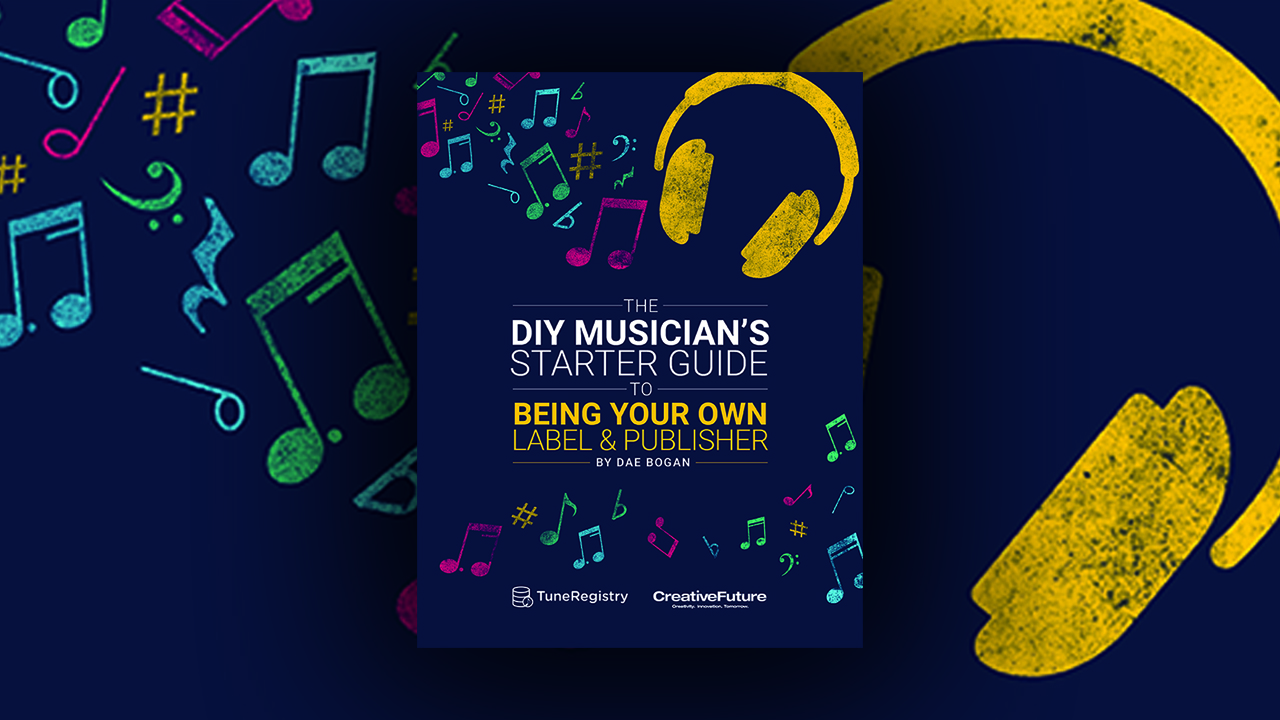
Free DIY eBook
CONNECT WITH ME


