
Infinite Licensing in AI Music

For a few years now, in private conversations with various technologists, music rightsholders and fellow data nerds, I’ve been using, and trying to coin, the term “infinite licensing” to describe the concept of real-time AI-powered dynamic licensing of rights in both generative-AI and single-source derivative AI music applications.
No, I am not talking about smart contracts, which are finite preset rules hardcoded in a file that is then minted to a blockchain, but rather the convergence of AI (conceptual/subjective/ecosystem) and blockchain (context/ownership) within the permission layer of applications that can generate an infinite ♾️ combination of licensing deal terms.
Infinite licensing would behave sort of like an oracle within applications to dynamically value and clear rights in machine-to-machine, business-to-business, and consumer-to-machine applications, going beyond the scope of human objectivity, individual experience in negotiation and valuation, and workload capacity in the licensing process.
It removes limiting royalty formulas and most favored nations models and replaces them with highly customized and more commercially accurate representations of value at a given point in time.
I imagine a future where an AI system built on an LLM that has learned from previous licensing deals (and the outcomes and missed opportunities of such deals), ingested airplay and streaming stats, interpreted correlations and trends, while calculating the lost value of undervalued deals, analyzed historical sync data, quantifies hype, ingested sales data, and consumer behavior and sentiment data, etc. would dynamically determine rates and terms for gen-AI and single-source derivative AI music outputs.
Infinite licensing, unlike smart contracts, could factor in variations in types of use, the real commercial value of the source music involved, the perceived cultural value of music creators involved, the market value of the opportunity, and much more.
The blockchain aspect, which has been in development across a variety of projects and startups for over 10 years now, would provide the architecture for transparent and immutable rights management while remuneration could be supported by cryptocurrency.
In 2019, when I presented my lecture “Music 2020: The Next Era of Innovation in the Music Industry” at the California Institute of The Arts and again at Music Biz Conference, I argued that artificial intelligence, blockchain, and cryptocurrency would be among the technologies that will transform the music industry in the 2020’s.
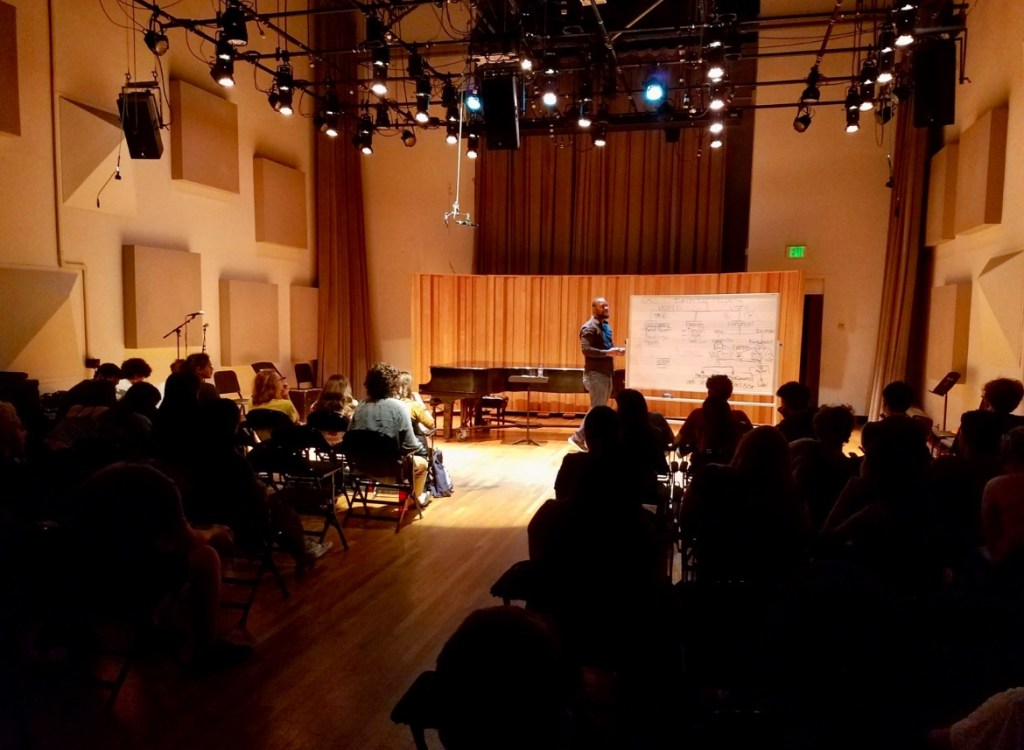
We’re halfway through the 2020’s and I think someone will figure out infinite licensing before 2030.
The Permission Layer for AI Music: Consent, Attribution, and Getting Artists Paid
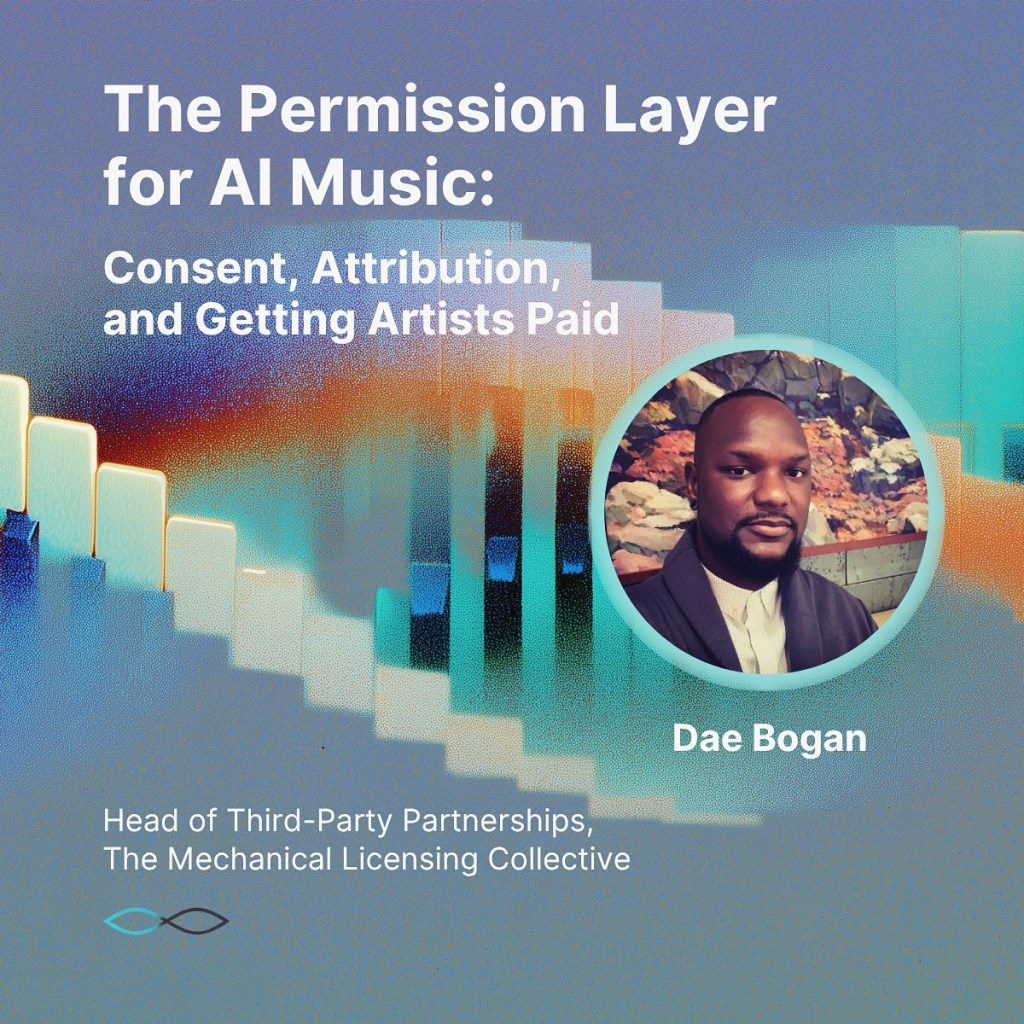
The Permission Layer for AI Music: Consent, Attribution, and Getting Artists Paid
🗓️ Wednesday, November 12, 2025
⏰ 9am PT • 11am CT • 12pm ET
How do you scale artist consent across millions of AI-generated tracks? What infrastructure makes attribution and payment actually possible?
AI music is charting on Billboard, signing major label deals, and reshaping production workflows. This panel brings together the architects building the permission layer to explore the frameworks being built right now—from control and consent to metadata and royalty tracking—that will determine how AI music enters advertising, brand campaigns, and commercial licensing.
Essential for brand marketers, creative directors, music supervisors, artists, business affairs teams, and anyone navigating music licensing in the AI era.
Host/Moderator: Abbi Press, Global Lead Business Affairs Manager, Creative at Uber | Founder of The Double Helix
Speakers:
- Daouda Leonard, Co-Founder & CEO, CreateSafe
- Dae Bogan, Head of Third-Party Partnerships, The Mechanical Licensing Collective
- Marc Rucker, Associate Director of Artist & Industry Relations, SoundExchange
- Tushar Apte, Music Producer/Songwriter/Composer, Warner Chappell Music
Register: https://luma.com/500w2bvc

On AI in the Music Industry
I have been writing and talking about the use of AI in the music industry since I developed and taught the course “Music Tech Innovation: Launching New Ventures” at UCLA Herb Alpert School of Music in 2016 when I was an Innovation Fellow at the UCLA Center for Music Innovation.
At the time, there were dozens of startups in accelerators and incubators across the US and around the world building AI tools and ML projects to address various aspects of music creation and data analytics.
I had been running my consultancy agency, Rights Department, where I helped founders navigate the intellectual property implications of their startups as well as develop go-to-market strategies. I was also a mentor to startups through a few accelerator programs and an advisor to a roster of music tech and digital media startups through my ENT Ventures, LLC advisory brand. Later, I would feature some of these companies, including those involved in cryptocurrency, augmented reality, NFTs, and blockchain in my lecture that I gave at universities and the Music Biz Conference titled “Music 2020: The Next Era of Innovation in the Music Industry” (https://daeboganmusic.com/2018/10/12/music-2020-the-next-era-of-innovation-in-the-music-industry/)
In early 2019, I wrote a note titled “Are Founders Of AI Music Services Being Disingenuous When They Tell Human Music Creators Not To Worry Or Are They Just Clueless?” where I asked:
“Recently, we’ve seen AVIA become the first AI to be recognized as a composer represented by the French performing rights society SACEM (I have bigger concern over the implication of recognizing AI as a composer and what that could mean to the legal definition of an author under copyright law) and Endel recently became the first AI to land a major label record deal with Warner Music Group.
If AVIA is a composer and Endel is a recording artist, and they can produce massive volumes of content (WMG is releasing 20 albums by Endel this year alone), what does this mean for the quality and pace of human-created music?” (https://daeboganmusic.com/2019/03/22/are-founders-of-ai-music-services-being-disingenuous-when-they-tell-human-music-creators-not-to-worry-or-are-they-just-clueless/)
This past week, ASCAP, BMI, and SOCAN — the largest public performance organizations in North America that represent millions of music creators — put out a joint statement announcing the acceptance of registrations of partially AI-generated songs and thus clarifying that partially AI-generated songs are eligible to receive public performance royalty payments. (https://www.musicbusinessworldwide.com/ascap-bmi-and-socan-will-now-accept-registrations-of-partially-ai-generated-musical-works/)
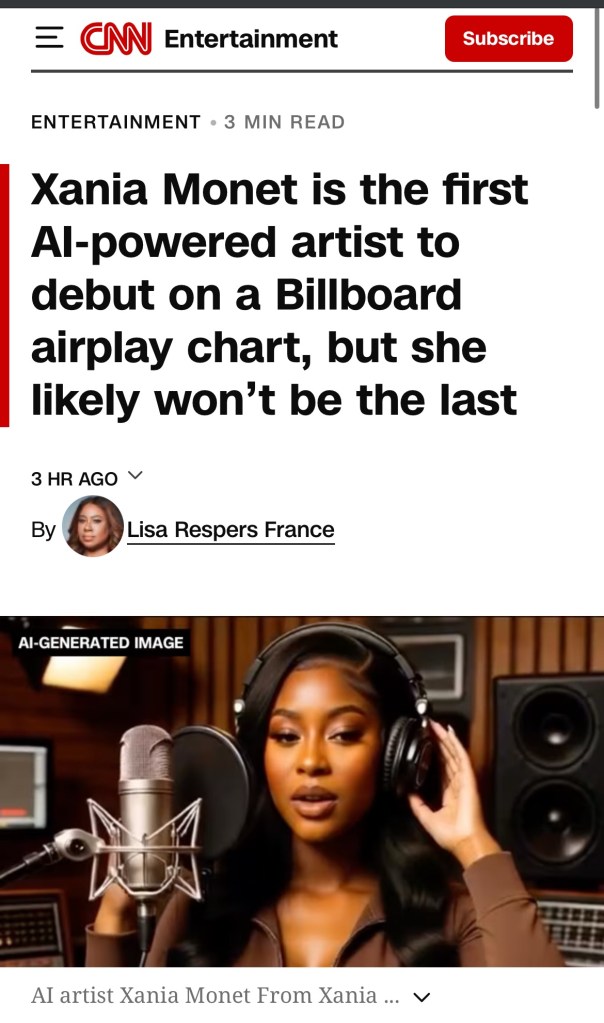
So, the news that AI singer Xania Monet being charted for radio airplay on Billboard means that the songwriter will be able to receive public performance royalties for those plays, in addition to the royalties for the streams on digital music services. (https://www.cnn.com/2025/11/01/entertainment/xania-monet-billboard-ai)
So, that brings me back to the question I asked in 2018: “Are Founders Of AI Music Services Being Disingenuous When They Tell Human Music Creators Not To Worry Or Are They Just Clueless?”
In September this year, I spoke on a panel about AI in the music industry at the Bogotá Music Market in Bogotá, Colombia. I argued that music creators and consumers will have to reconcile our tolerance for creativity and authenticity in the AI-music era and promoted the responsible use of AI as a tool, an innovation in the evolution of the arts no different, fundamentally, from innovations of decades past (enter the printing press, the electronic guitar and synthesizers). (https://www.instagram.com/p/DOgkjVUDT1A)
Some artists will leverage AI as a tool (there are many use cases other than generative AI vocals). Some will resist and possibly fall short. But what is clear to me is that the evolution, which begun as scrappy projects by founders and small teams in the 2010s is now being accelerated by multi-billion dollar investments, regulatory overhauls, and innovative creators who enjoy and do not fear new tools.
And what about consumers? How do consumers feel?
On Preparing for an AI Future
“A child born today will never be smarted than artificial intelligence (AI).” – Sam Altman, CEO of OpenAI and ChatGPT
A child born today will grow up surrounded by AI powered experiences. In fact, by the time a child born today reaches adulthood, he will likely take the existence of AI for granted; as normal and expected. Take for example electricity and plumbing, vehicles and aircraft, medicine and psychiatry (as opposed to witchcraft). The age of enlightenment and the industrial revolution changed the human experience and human expectations.
Time morphed magnificent inventions and discoveries into basic necessities and human rights. AI, too, will make discoveries and change how we do things, but at a faster speed of technological evolution than humanity has ever experienced before. The rate of change in 10 years will be equivalent to the rate of change of 100 years in the past. This means that the learning curve will be sharp and people will be left behind.
By the time a middle school student today graduates college, half of college-educated white collar skilled jobs may be replaced by AI software and blue collar skilled jobs will be replaced or reduced by AI robots.
Music 2020: The Next Era of Innovation in the Music Industry
Knowledge will boast ego more than it creates a competitive advantage. That is, with all the world’s knowledge about any given topic accurately and immediately available and accessible to anyone at anytime, the need for subject matter experts in some fields will greatly decline. Objective fields such as finance, mathematics, history, language, some sciences, contract law, and others are susceptible to delution by AI replacement faster than subjective fields requiring human discernment, emotion, and context. Although, the creative class—a subjective field—is an exception.
So, the question is: How are you preparing your child for an AI future and how do today’s adults maintain relevance as the nature of work and human interaction evolves?
I attended a luncheon and networking event in Medellin yesterday with AI developers and entrepreneurs from around the world. What many employees may not know is that CEOs are already thinking about what aspects of their business can be made more efficient by AI. In other words, who can be replaced by AI.
In 2018, I made predictions on how the music industry would evolve in the 2020’s. Nearly every prediction that I made has come to fruition, including the rise of AI in the music industry.
Have you begun thinking about your industry?
IG: https://www.instagram.com/reel/DJsZjuYyr5k/?igsh=MXJzbTB0MmJwYm0yZA==
Are The People Who Are Creating AI Replacing Themselves With AI?
Microsoft just laid off 6,000 employees, including hundreds of software engineers and their Director of Artificial Intelligence. Microsoft also recently announced it will be investing further into AI development, which to me does not translate into an investment in humans.
This got me thinking.
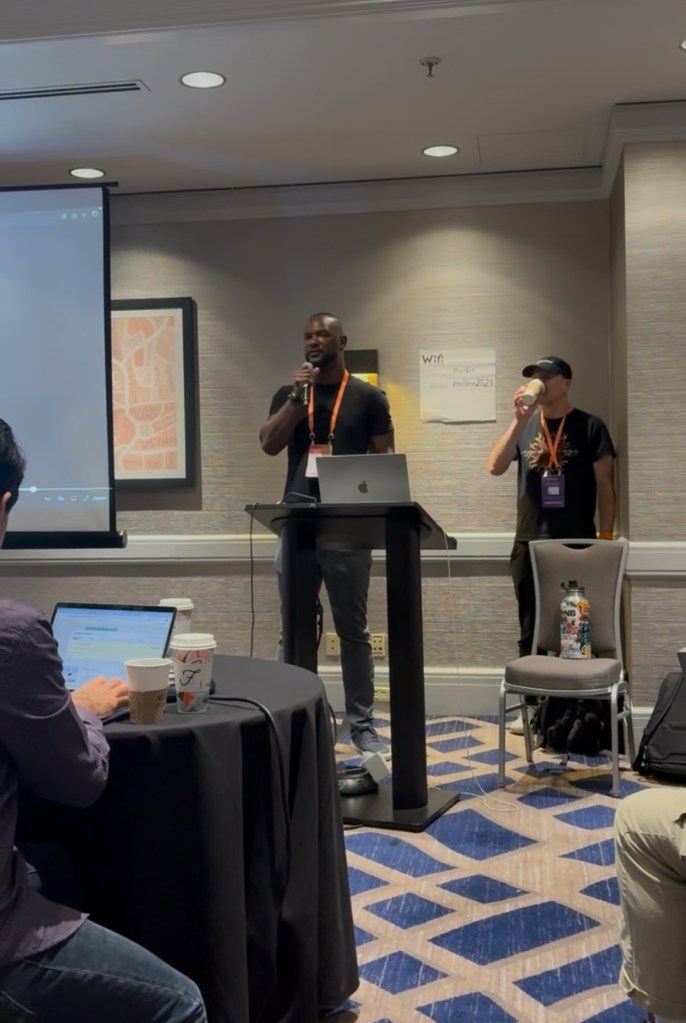
Last week, I mentored a hackathon in Atlanta. A hackathon is a fast-paced software development event where individuals and teams participate to build a web or mobile app to win a prize. Our company, among others, offered our API and data for use by the participants to build a web app based on music business use cases.
There were over 20 participants. Most of them were seasoned software developers, but a few had little to no experience.
Many of the participants engaged in vibe coding, which is a process by which AI writes the code, for the web app they submitted to be judged. They gave the AI prompts related to the use case that they were solutioning and the AI wrote the code.
There were three winners. The 2nd place winner were two individuals who are not software developers at all and cannot write code — a music business educator/lawyer and a product designer. They used AI to design a prototype based on the lawyer’s prompts surrounding sample licensing analysis.
The room was full of software developers, but many of them used AI to write most of the code to build their web apps. Effectively, AI built the apps.
Microsoft is laying off software developers to invest more into AI itself developing AI software to further improve AI development of AI software.
Are the people who are creating AI replacing themselves…with AI?
Dae Bogan to Join Panel On The Future of Music Publishing & AI at Canadian Music Week 2024

I’m coming to Toronto 🇨🇦 for Canadian Music Week June 2-5!!
I am looking forward to speaking on the panel “Harmony & Code: The Future of Music Publishing in the AI Era” on June 3rd at 12 PM. Tap in if you’ll be there!
Harmony & Code: The Future of Music Publishing in the AI Era
Join us for a compelling panel discussion where we explore the transformative impact of technology on the music publishing industry. This session will explore critical questions at the intersection of tech and music: What implications does AI have for the roles of music publishers and artists alike? What tools do artists need to thrive in this new landscape? We’ll examine the future of copyright laws, ponder the necessity of new rights, and debate how technology can coexist with music without exploiting creators. Don’t miss this essential conversation on the evolution of music rights in the digital age, designed for publishers, tech companies, and artists ready to navigate these changes.
Moderated By: Cole Davis Founder & CEO Switchchord
- Chris Dampier, Head of North America – Sentric Music
- Dae Bogan, Head of Third-Party Partnerships – The Mechanical Licensing Collective
- Paul Shaver, President – CMRRA (Canadian Musical Reproduction Rights Agency Ltd) and SX Works
- Virginie Berger, Chief Business Development and Rights Officer – Matchtune
Learn more at https://cmw.net/
Are Founders Of AI Music Services Being Disingenuous When They Tell Human Music Creators Not To Worry Or Are They Just Clueless?

If AVIA is a composer and Endel is a recording artist, and they can produce massive volumes of content (WMG is releasing 20 albums by Endel this year alone), what does this mean for the quality and pace of human-created music?
Free DIY eBook
CONNECT WITH ME


 Dae Bogan Music