
Dae Bogan to Join Panel On The Future of Music Publishing & AI at Canadian Music Week 2024

I’m coming to Toronto 🇨🇦 for Canadian Music Week June 2-5!!
I am looking forward to speaking on the panel “Harmony & Code: The Future of Music Publishing in the AI Era” on June 3rd at 12 PM. Tap in if you’ll be there!
Harmony & Code: The Future of Music Publishing in the AI Era
Join us for a compelling panel discussion where we explore the transformative impact of technology on the music publishing industry. This session will explore critical questions at the intersection of tech and music: What implications does AI have for the roles of music publishers and artists alike? What tools do artists need to thrive in this new landscape? We’ll examine the future of copyright laws, ponder the necessity of new rights, and debate how technology can coexist with music without exploiting creators. Don’t miss this essential conversation on the evolution of music rights in the digital age, designed for publishers, tech companies, and artists ready to navigate these changes.
Moderated By: Cole Davis Founder & CEO Switchchord
- Chris Dampier, Head of North America – Sentric Music
- Dae Bogan, Head of Third-Party Partnerships – The Mechanical Licensing Collective
- Paul Shaver, President – CMRRA (Canadian Musical Reproduction Rights Agency Ltd) and SX Works
- Virginie Berger, Chief Business Development and Rights Officer – Matchtune
Learn more at https://cmw.net/
Dae Bogan to Conduct Workshop ‘From Beat to Bank: Dissecting the Flow of Digital Music Royalties in Rap and Hip-Hop’

I am thrilled to announce the first of a series of in-person music rights and royalties workshops that I will be conducting in Nashville, Miami, and New York this year:
From Beat to Bank: Dissecting the Flow of Digital Music Royalties in Rap and Hip-Hop
🗓️ June 22nd • 4pm-6pm
📍 The Mechanical Licensing Collective in Nashville, TN
🎫 Free with Registration
Description:
“From Beat to Bank: Dissecting the Flow of Digital Music Royalties in Rap and Hip-Hop” is an interactive workshop specifically designed for aspiring Hip-Hop and R&B music creators.
Presented by The MLC and Nashville is Not Just Country Music and led by Dae Bogan, Head of Third-Party Partnerships at The MLC, the workshop will take creators through a crash course demystifying the intricate world of music rights, income entitlements, publishing administration and the distribution of U.S. digital music royalties.
Through a series of individual and group simulations, participants will delve into various facets of the industry including contribution and credit tracking, negotiation of splits, the impact of samples on copyrights and royalties, work registrations and the process of claiming royalty shares.
Participants will gain a deeper understanding and appreciation of how song and recording contributions translate into royalty payments from The MLC and other organizations.
The workshop will take place at The MLC’s office in Nashville on June 22 from 4 p.m. to 6 p.m. CT. Tune in by registering at https://www.eventbrite.com/e/the-mlc-ninjcm-present-from-beat-to-bank-workshop-tickets-637622174087
On the Impact of False Copyright Infringement Claims on Independent Artists and Other Digital Creators
Over the past 10 years, among other pursuits and adventures, I’ve advised independent artists and artist managers on copyright issues surrounding the exploitation of their music in the Internet Age. I’ve also advised entrepreneurs on the intellectual property compliance implications of their music app and digital media startups.
One interesting unintended consequence that has emerged out of the creation of copyright policing systems by Internet and digital music services is the abuse of these systems by bad actors whose only goal is to curb the success of a particular piece of content (music or video) or the creator of such content.
Services such as Youtube and Spotify have implemented takedown processes to comply with the Digital Millennium Copyright Act of 1998 and limit their liability while maintaining a safe harbor from damages that may arise out of copyright infringement lawsuits. However, bad actors can use these same tools that are meant to help rightsholders protect their rights to instead attack creators in what appears to be economic warfare against artists: false infringement claims and errorneous takedowns.
Takedowns can derail creators during viral momentums, which can be detrimental; especially for independent artists. I’ve advised several clients who’ve been the victim of such an abuse of the system.
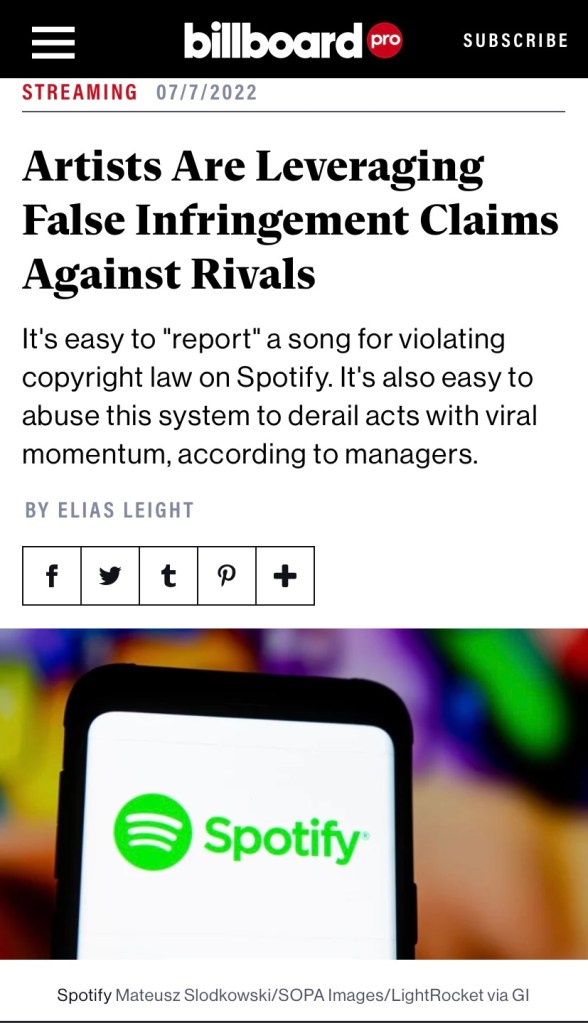
Today, Billboard published an article, written by reporter Elias Leight who investigated the use of false infringement claims as a tactic to curb the success of rivals. I was interviewed for the article and provided some of the contextual and technological backdrop for the investigation:
Article Excerpt:
Like other prominent platforms, Spotify responds to infringement claims seriously by removing allegedly infringing songs, and you can report a song without breaking a sweat. Platforms honor an infringement claim whether the intentions behind it are legitimate or not.
“Anywhere there’s content and there’s some system with a trust mechanism to flag violations, there’s an opportunity for abuse and mis-use,” says Dae Bogan, head of third-party partnerships at the Mechanical Licensing Collective. “Bad actors are gonna do what they’re gonna do.”
Article: https://www.billboard.com/pro/spotify-false-infringement-claims/
[Video] Symphonic Distribution x The MLC Live Q&A with Dae Bogan

Did you know that there is over 424 million in unmatched royalties that The MLC is looking to pay out? Join Randall Foster & Dae Bogan as they dive deep into the world of publishing.
Watch: https://youtu.be/EhxljeejSqI
[Video] Recording of Panel ‘How Credits Improve Contributor Identification and Payment’ from DDEX Virtual Creator Credit Summit 2020
Here is the recording of the panel on which I spoke at the DDEX Virtual Creator Credit Summit 2020.
How Credits Improve Contributor Identification and Payment

During The Coronavirus Pandemic, Dae Bogan Has Helped DIY Musicians Unlock Tens of Thousands Of Dollars In Unclaimed Music Royalties – Here’s How
For over twelve years I have helped thousands of DIY musicians administer and monetize their copyrights to be properly accounted to and paid for the use of their musical works and sound recordings in the United States and abroad. To date, I’ve helped self-published songwriters and self-released artists collect millions of dollars in royalties that would have otherwise gone unclaimed and eventually forfeited and/or redistributed due to a confusing web of regulations and company policies surrounding the fragmented music licensing ecosystem.
I’ve also helped background vocalists, session musicians, and music producers understand how their contributions, while often detached from copyright ownership, generates entitlements that yield royalties that often go unclaimed for many years. I am passionate about the issue of remuneration for music creators and have published research, built technology platforms, and have spoken at the Library of Congress on the topic.

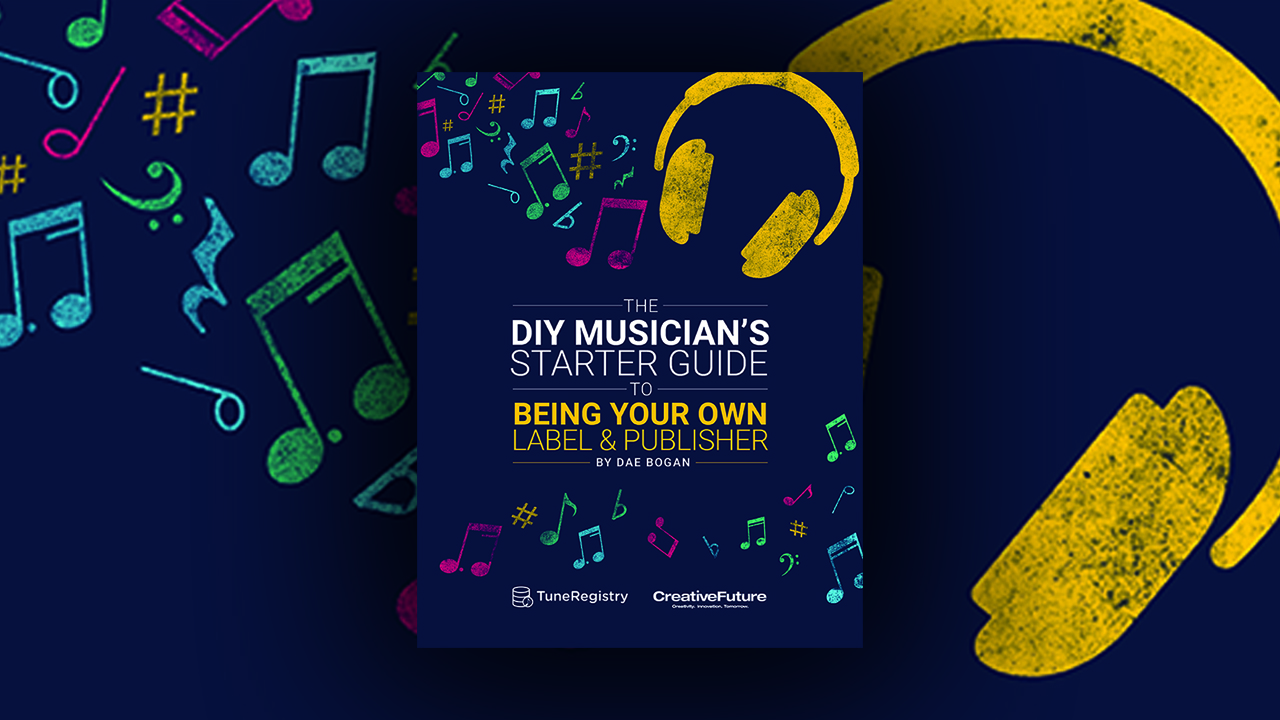
A few years ago I wrote the free ebook “The DIY Musician’s Starter Guide To Being Your Own Label And Publisher” for the non-profit creator advocacy group CreativeFuture as a checklist for DIY musicians who own their publishing and/or masters. The ebook has helped many DIY musicians to get setup with US music rights organizations to collect their royalties. I’ve also written dozens of articles on specific issues surrounding royalty collection that have been published on my blog DaeBoganMusic.com and other websites.

All of this to say that for over a decade I have been championing, educating, advocating for, and empowering DIY musicians and yet I still feel that so many of them are underserved and missing out on their own earnings.
Right now tens of thousands of artists, songwriters, composers, lyricists, session musicians, background vocalists, and music producers have been hit hard by the closure of live music venues and slow down of music production during the coronavirus pandemic. Many have struggled to get financial assistance due to the gig economy nature of much of the work in the music industry. But the sad part is many DIY musicians may have money due to them from their music and contributions over the last 5 to 7 years!
Since the pandemic began, I’ve helped several DIY musicians uncover royalties that have been sitting in unclaimed royalties databases or so-called “black boxes” (Tip: Search “black box” in my search field above to find articles I’ve written on the topic) to the tune of tens of thousands of dollars (Note: I did this work prior to joining The MLC in May 2020 and I am not currently accepting clients due to the fact that I am 100% committed to my work at The MLC, but please continue reading to learn how to do this yourself).
Searching for unclaimed royalties is part of the royalty forensics process. Understanding what entitlements a musician has based on their contribution(s) to any given work, what royalties are due based on type of use and territory, and where the royalties flow to be accounted to and paid out can be a challenge. I did this work for my clients, but I also have a workshop on the topic (Tweet me @daeboganmusic to request FREE access to the workshop).
For example, my cousin, independent singer-songwriter Durand Bernarr had around $8k in unclaimed royalties for his contribution as a background vocalist on the song “Girl” by The Internet sitting unclaimed at just one organization in the United States. Although these royalties were due to him in 2018, the AFM & SAG-AFTRA Intellectual Property Rights Distribution Fund did not know who Durand Bernarr was or how to reach him. I helped Durand uncover these royalties during the coronavirus pandemic and the payment couldn’t have come at a more needed time.

Unclaimed royalties is a common problem for new and up-and-coming music creators (but it also affects emerging and established music creators) and it stems from poor metadata and production credits creation and distribution (this is why I founded TuneRegistry and RoyaltyClaim (I no longer own these companies)). It also stems from DIY musicians not being properly setup and registered everywhere (I cover this in my free ebook).
I now work at The Mechanical Licensing Collective (The MLC) as its Head of Third-Party Partnerships where I am building relationships between The MLC and a variety of organizations and companies to help self-administered songwriters and music publishers interface with us to unlock and collect digital audio mechanical royalties from the use to their songs in the United States by digital service providers such as Spotify, Apple, Amazon, Google, Pandora, Deezer, Tidal, SoundCloud and more.
Now is the time for DIY musicians to take the time to hunt down unclaimed royalties that may go back as far as 7 years. Check out my free ebook as a starting point!
Pro Tip: If you find unclaimed royalties in one place, there may be more and other places. Check with the organization where you find your royalties if those royalties are for the US only or the world. If for the US only, you may have counterpart unclaimed royalties for the same set of rights and types of usage in other countries!
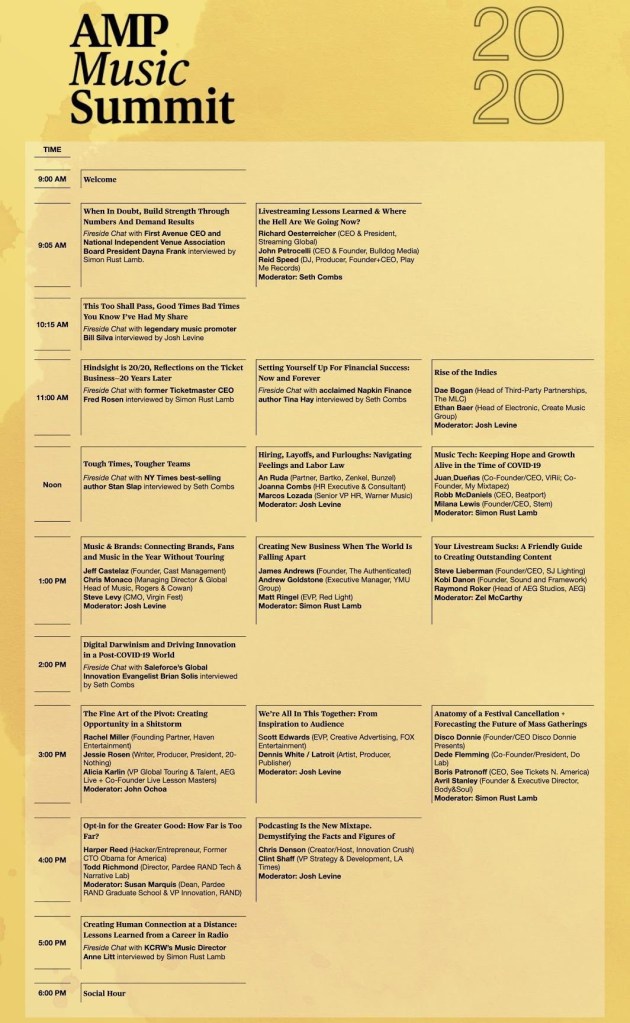
Full line-up for the free AMP Music Summit Today
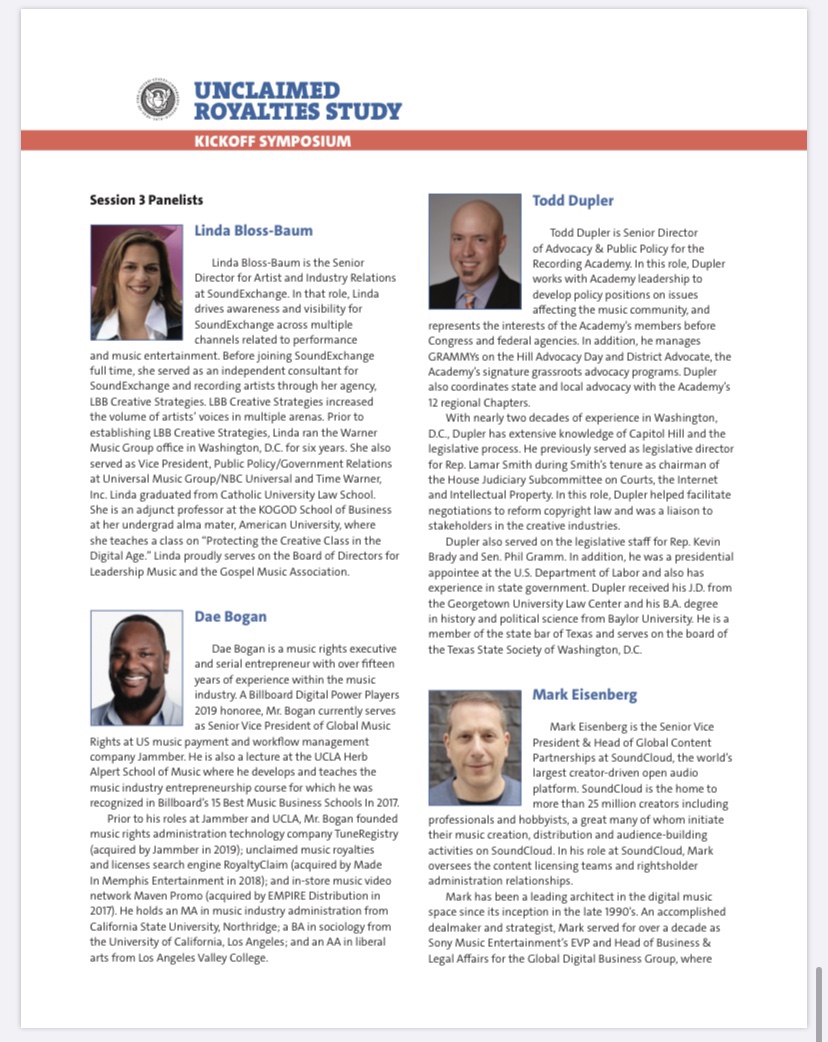
Off To Washington D.C. For Unclaimed Royalties Study Symposium

I’m looking forward to joining music industry colleagues in Washington, D.C. tomorrow to discuss issues related to the implementation of the Music Modernization Act at the Library of Congress.


Free DIY eBook
CONNECT WITH ME


 Dae Bogan Music