
Dae Bogan Talks TikTok Metadata and Song Titles with Rolling Stone
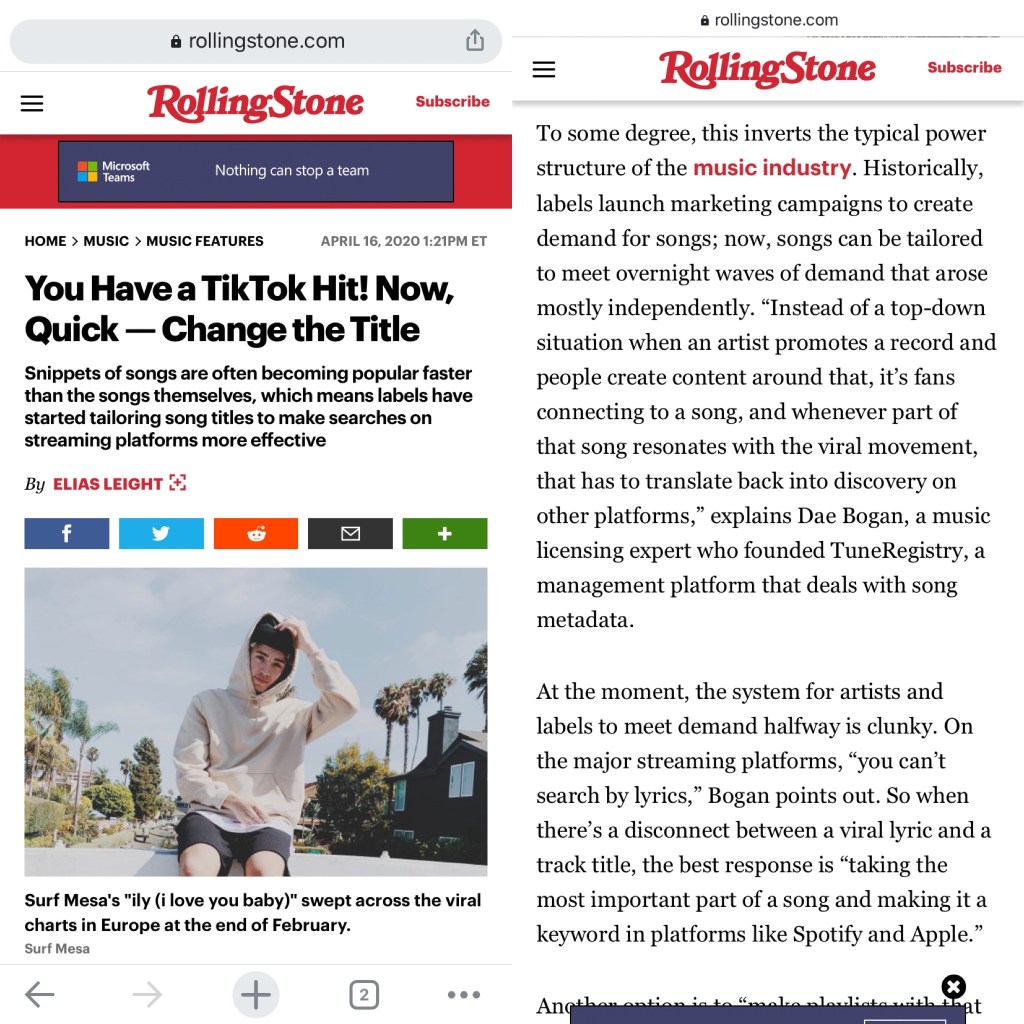
Check it out.
https://www.rollingstone.com/music/music-features/tik-tok-hits-changing-titles-983383/
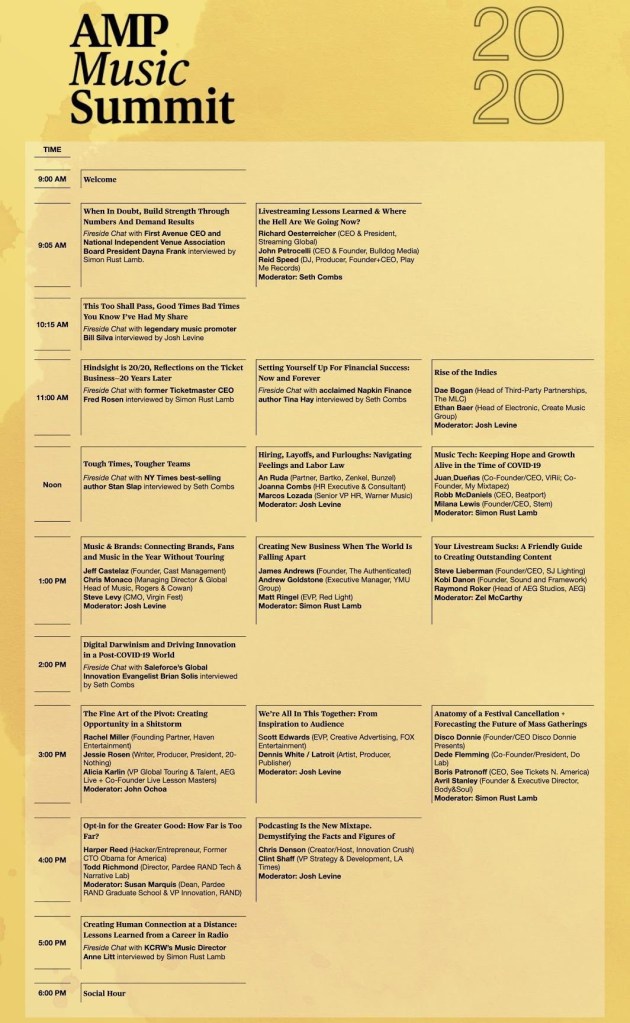
Full line-up for the free AMP Music Summit Today
On Digital Radio Royalties: What Are They And How To Look For Unclaimed Royalties
(This was originally post on my Facebook page, so my apologies if the hyperlinks directs you to Facebook pages of the mentioned companies).
On Digital Radio Royalties
DIY Musicians – If/when you get a recording placed on non-interactive Internet, satellite, or cable radio (e.g. Pandora, SiriusXM, Music Choice) it earns multiple royalty streams. It is important to understand how to collect them all. I will get granular below to break this down.
Let’s use for example the recording “6 Inch (feat. The Weeknd)” by Beyonce. When this recording is played on Pandora (or iHeartRadio, 8Tracks, TuneIn or any of the other 2,500+ properly licensed webcasters serving the United States), here are the royalty streams:
1. Master Royalties for Featured Performers – Royalties paid to SoundExchange for the featured performers, which are the “named” artists on the track. For “6 Inch,” the featured performers are Beyoncé (main artist) and The Weeknd (guest artist). They each must have an account at SoundExchange to collect these royalties. Here is the unclaimed royalties list for featured performers: https://www.soundexchange.com/…/does-sou…/search-for-artist/
2. Master Royalties for Master Copyright Owner (Label) – Royalties paid to SoundExchange for the copyright owner, which is the label. For “6 Inch,” the label is Columbia Records. The label must have an account at SoundExchange to collect these royalties. (A Few Notes: (1) Major labels have direct deals with most music services, so it is likely that Columbia is paid directly by Pandora. (2) Unsigned artists can collect this income if you properly create your free account with SoundExchange as the copyright owner. This means, you cannot only sign up as the Artist. You are the label!). Here is the unclaimed royalties list for copyright owners: https://www.soundexchange.com/…/do…/search-for-rights-owner/
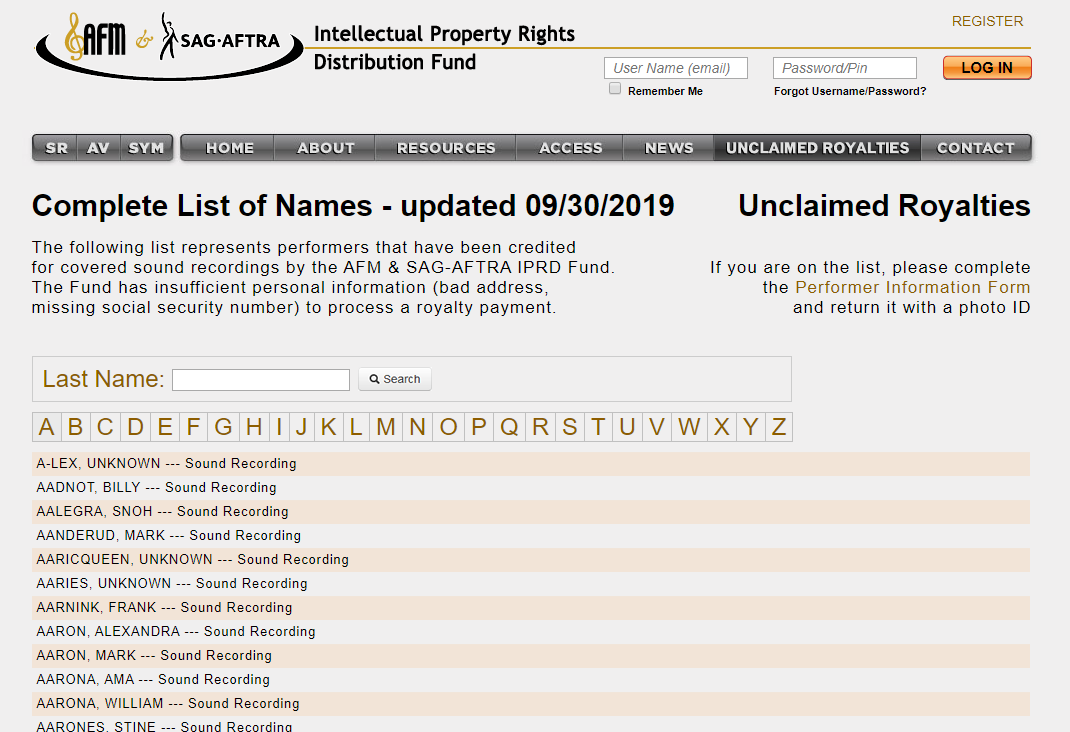
3. Master Royalties for Non-featured Performers – Royalties paid to AFM & SAG-AFTRA Intellectual Property Rights Distribution Fund (“the Fund”) for the background vocalists and session musicians who performed on the recording. For “6 Inch,” the non-featured performers include Ahmad Balshe (background vocalist) and Derek Dixie (session musician) among others. (Note: 5% of the royalties paid to SoundExchange is passed to the Fund. The Fund conducts research to identify the non-featured performers. They use published credits, such as those published on AllMusic.com (Ex: https://www.allmusic.com/album/lemonade-mw0002940342/credits), Discogs, and other resources to identify the vocalists and musicians on a recording. Keep in mind that if the producer of the track contributed background vocals or live instrumentation, it is important to credit him/her separately as such in addition to his/her producer credit, so that they can access this income stream. At TuneRegistry, we deliver credits to TiVo, which makes metadata available to AllMusic, among other services. If the Fund does not have the non-featured performer on their list, you can check and submit. See “6 Inch” only shows two (2) non-featured performers, but there may be more who just do not know: https://www.afmsagaftrafund.org/covered-rec-artist_SR_Maste…). Here is the unclaimed royalties list for non-featured performers: https://www.afmsagaftrafund.org/unclaimed-royalties.php and here is the list of recordings that the Fund has credits for here: https://www.afmsagaftrafund.org/covered-rec-title_sr_master…
4. Publishing Royalties for Composers/Writers – Royalties paid to performing rights organizations (PROs) such as American Society of Composers, Authors & Publishers (ASCAP), Broadcast Music, Inc. (BMI), and SESAC in the United States for the composers and writers, which is Jordan Asher, Burt Bacharach, Ahmad Balshe, Hal David, Ben Diehl, Beyoncé Knowles, Noah Lennox, Terius Nash, David Portner, Danny Schofield, Abel Tesfaye, and Brian Weitz. Because “6 Inch” uses samples, there are more composers/writers credited on the recording. You can view the full publishing credits for “6 Inch” at ASCAP here: https://www.ascap.com/repertory#ace/search/workID/890413300 (Note: US PROs, like most PROs/CMOs around the world, do not have a public list of unclaimed royalties. It is important to register your song before the release or as soon as possible after release to limit the possibility of having your royalties fall into the “black box,” which is an industry term of unclaimed or unmatched royalties. Also note that if you collaborate with someone who has not affiliated with a PRO, that can slow down the registration process.)
5. Publishing Royalties for Composition Copyright Owner (Publisher) – Royalties paid to PROs for the copyright owner in the compositions. This is the publisher or a self-published songwriter’s own publishing entity. For “6 Inch,” the publishers are 2082 Music Publishing, BMG, Domino Publishing, KMR Music Royalties, New Hidden Valley Music Co, Oakland 13 Music, Sal And Co LP, Songs of FujiMusic, Universal Music Corportation, WB Music Corporation. Because “6 Inch” uses samples, there are more publishers credited on the recording. You can view the full publishing credits for “6 Inch” at ASCAP here: https://www.ascap.com/repertory#ace/search/workID/890413300 (Note: In the US, if you are a self-published writer, you do not need to have a publishing account at BMI in order to unlock your publishing income. You will need a writer AND publisher account at ASCAP. So, if you do not have a publisher account at ASCAP and you are self-published, you literally leave 50% of your income on the table because ASCAP will not pay out the so-called “publisher’s share” to writers (unless they’ve changed this policy).)
In conclusion, if you get a recording on a digital radio platform and it takes off, make sure you have your business in order. We help with all of the above at TuneRegistry. This is what I am doing every day — helping thousands of independent music creators properly register their music so that they are 1.) identified, 2.) accounted to, and 3.) PAID.
Check out my free ebook “The DIY Musician’s Starter Guide To Being Your Own Label & Publisher” available for download at www.daeboganmusic.com (subscribe to my blog) and catch me speaking Oct 12th at A3C Conference in Atlanta or Oct 30th at Music Tectonics Conference in Los Angeles.
CC: Dae Bogan Music
Metadata And Money: On Background Vocalists and Session Musicians

Most independent artists do not know that 5% of their digital radio master royalties earned in the United States from the likes of Pandora, SiriusXM, Music Choice, iHeartRadio, Slacker, TuneIn, Last.fm, etc. are automatically allocated to a pool that is to be paid out to background vocalists and session musicians.
This money is allocated, *even if there are no background vocalists and sessions musicians on the record,* and are paid out in the United States by AFM & SAG-AFTRA Intellectual Property Rights Distribution Fund (aka “The Fund”).
Knowing this now, what should you do?
- Invite musician friends to perform background vocals or an instrument on your record.
- Invite the producer of the record to add background vocals or live instrumentation to their production (then, the producer would be able to qualify for these royalties; which is separate from his/her other producer royalties).
It is important to know that if you have background vocalists or session musicians on your record you MUST PUBLISH THE TRACK CREDITS! The Fund does track credit research to identify the individuals entitled to these royalties. THERE IS NO REGISTRATION PROCESS. They look for credits at places like AllMusic.com, Discogs, MusicBrainz, etc.
Don’t let your royalties go undistributed.
Get 👏 it 👏 done.
TuneRegistry, we deliver track credits to TiVo, which supplies data to AllMusic.com. We also deliver metadata and audio fingerprints to Gracenote, Audible Magic, Medianet, ACRCloud, Quantone, Exactuals – RAI, and Crunch Digital. These services power search and discovery features in hundreds of music apps, websites, audio devices, and smart speakers around the world.
Dae Bogan To Moderate Panel On Los Angeles Music Startup Scene With Capitol360, Techstars Music, Expert DOJO, The Rattle LA, And Startup UCLA / Blackstone Launch Pad At UCLA’s Amplifying Music In Our Los Angeles Conference On| May 15th, 2019
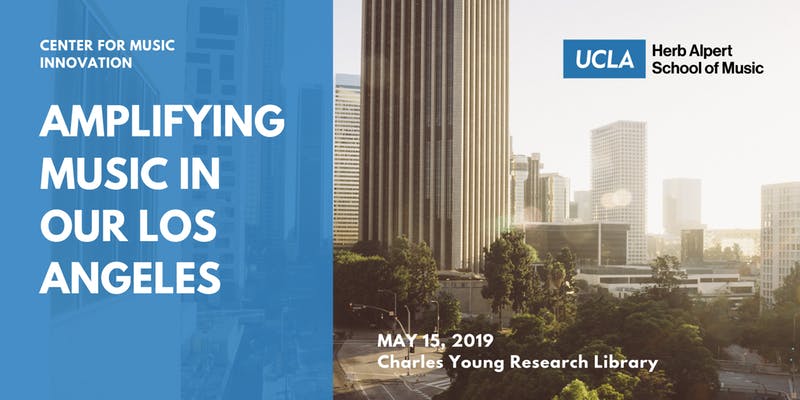
Amplifying Music in Our Los Angeles
A Conference Amplifying and Connecting the Music Scenes of Los Angeles
Host: Center for Music Innovation at UCLA Herb Alpert School of Music
Location: Charles E. Young Research Library Auditorium, UCLA North Campus
Time: 9 am – 4:30 pm
Date: Wednesday, May 15, 2019
Cost: Free for Registered Attendees
How can we support Los Angeles’ music scene(s) and work together to continue to create something robust, diverse, and dynamic in this changing era?
This day-long conference expands the conversation of how Los Angeles can grow and connect/collaborate around its diverse music scenes. If other cities are challenged by gentrification in having vibrant live music scenes, (a) why is Los Angeles seeming to be growing, despite these difficulties and (b) how we we enhance and amplify this growth?
Background
This Conference is the second in a series of events that UCLA Center for Music Innovation is holding with this Future of Music in LA focus across 2019 across LA, so we welcome you to be involved in those programs as well.
On February 6th, the City of Los Angeles Department of Cultural Affairs held a half-day Symposium as part of its February COMPOSE LA series of events. With partners that included UCLA’s Center for Music Innovation, they brought together different voices across Los Angeles and music to talk about the future of Music in Los Angeles.
Los Angeles is a complex environment. From panels and provocations, we came up with many things that weren’t right within the overall ecosystems in terms of policy, permitting, and procedures. We also explored our very vibrant environment that seems to be growing — despite the systemic challenges.
The Invitation
We invite the community gather again on May 15th at UCLA to both expand the conversation and to add new voices into the mix. We’re going to include people joining us from video conference from other cities and locations. We’re going to include new parties — and parties with different perspectives. And we’re going to include roundtable conversations, where the conversation will come out into and with the audience.
We invite you to join us for this community event at the Charles Young Research Library at the UCLA campus. The event will be free, along with the support from our community and marketing sponsors.
The Schedule
Sessions and the full schedule will be posted mid-April.
FREE REGISTRATION (INCLUDING ONLINE STREAMING OF CONFERENCE)
2021 Prediction: The United States Music Publishing Market Continues To Grow And Fragment, Creating More Silos For Unpaid “Black Box” Royalties — DIY Musicians Hit The Hardest
As the U.S. music publishing industry grows (in terms of revenue, volume of copyrights, and number of income participants), the rights administration and licensing sector becomes ever-more fragmented; giving way to cracks in its foundation through which royalties fall into the so-called “black box” — the industry name for the unmatched and unpaid royalties earned against unidentified works or unidentified or unreachable income participants that accrue in escrow only to be later forfeited and disbursed to entities to which the funds do not belong; primarily major music conglomerates and those acquiring catalogs of copyrights to expand their market share position.
Black Box Royalties Myths, Common Misconceptions Debunked at Music Biz 2018
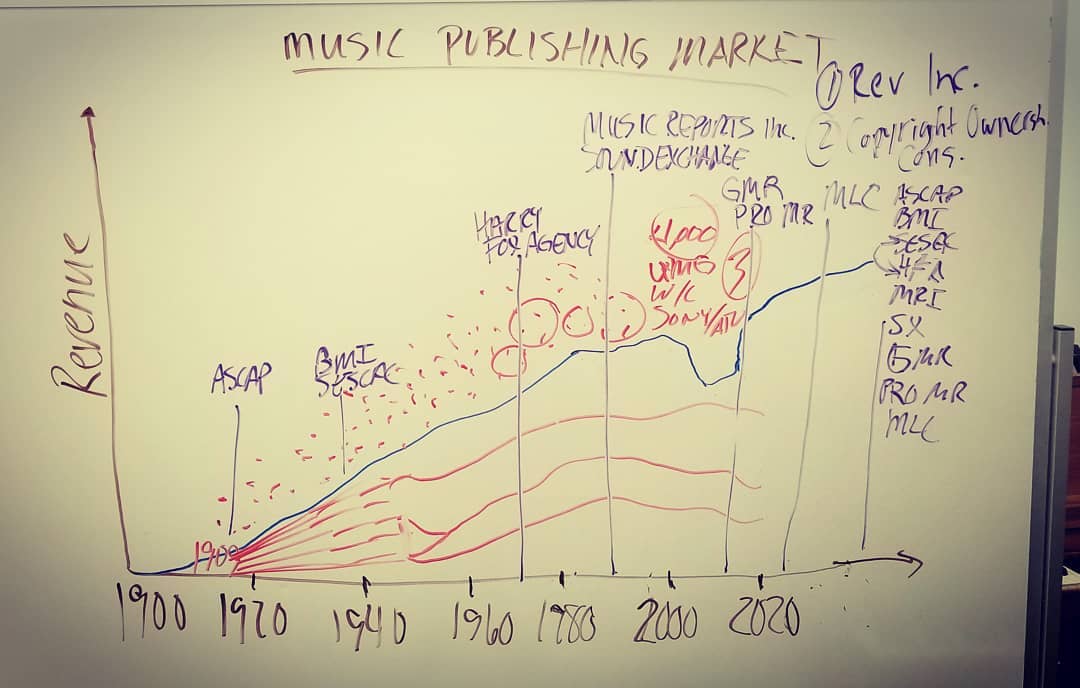
A picture of a white board illustrating the growth and fragmentation of the US Music Publishing Market, specifically the music licensing and royalty ecosystem, drawn during Dae Bogan’s lecture in his class, “Music Industry Entrepreneurship and Innovation” at the UCLA Herb Alpert School of Music, Winter Quarter 2019
In 1909, when the first federal copyright law that protected music creators and rights-holders was enacted, there were no massive music rights organizations as we’ve come to know them today. Although unions had existed — the American Federation of Musicians was founded 13 years earlier in 1896, but focused more on work conditions than collective bargaining, as it does today — ASCAP was formed in 1914 to license the performing rights of composers, authors, and publishers.
Fast forward to 2021 when the newly formed Mechanical Licensing Collective will issue its first blanket digital streaming mechanical license to the likes of Spotify, Google, and Apple. There will be over a dozen music rights and royalty collection organizations issuing thousands of licenses, administering millions of pieces of copyrights, and processing billions of micro-penny transactions.
The music licensing and royalty ecosystem in 1909: Individual music composers, aristocrats who financed or commissioned works, and sheet music publishers.
The music licensing and royalty ecosystem in 2021: Traditional non-profit and private music rights organizations (ASCAP, BMI, SESAC, Global Music Rights, PRO Music Rights, SoundExchange, Mechanical Licensing Collective), royalty funds (AFM & SAG-AFTRA Intellectual Property Rights Distribution Fund, Alliance for Artists and Record Companies, Film Musician’s Secondary Market Fund, Sound Recording Special Payments Fund), unions engaged in collective bargaining (SAG-AFTRA, American Federation of Musicians), licensing clearing houses and agents (e.g. Music Reports, Harry Fox Agency).
If I wrote a popular commercial song that is exploited to the fullest extent — released on a commercial recording; performed live in concert; licensed for use in film or television; placed in a commercial; earns viral success on user generated content platforms and social music apps; covered many times; embodied in a music video; lyrics printed and sold on merchandise; used for a live broadcast sporting event; added to Spotify and Apple playlists where it takes off; picked up on terrestrial, Internet, satellite, and cable radio; etc. — I would need to ensure that my work is registered at all of the places where the royalties earned from the uses I’ve described are paid; the music licensing and royalty ecosystem. If I do not, then my royalties will leak into the black box.
The black box is estimated at over $2 billion — and growing — of which much of it is due to independent music creators, small music rights-holders, and the estates of deceased authors and performers who do not have the access, power, know-how or market share to navigate the web of black boxes; for which there are many.
When entities charged with maintaining these black boxes distribute the funds in market share distributions, the major labels and publishers win and the independent and DIY creators lose. It is unfair and unethical. But what are we going to do about it?
Some artists, knowing that they do not know exactly how this all works, have found creative business ways to “make up” for potential lost royalties. But for the rest — the majority — of DIY musicians, they’re generally left out of the discussion and left to fend for themselves, even when they think they’re doing everything right.
As the industry charges forward with new energy fueled by the growth of music streaming, we have to consider how the continued fragmentation of the music licensing ecosystem affects the most vulnerable — DIY musicians. Major labels have direct deals with DSPs and digital services that pay them advances and account to and pay them royalties. DIY musicians rely on music rights organizations, who are often disproportionately influenced by the majors, to handle these things for them.
I founded TuneRegistry to help DIY musicians be their own advocate, to demystify the music licensing and royalty ecosystem by aggregating the fragmented world of rights administration into one economical platform. To this end, our team has helped hundreds of small to medium-sized music rights-holders and DIY musicians unlock thousands of dollars in new found royalties and to register their works to ensure that they are identified and accounted to in the future. Not all music rights organization have joined our network, but we will continue to advocate and fight for the rights and entitlements of DIY music creators as long as we can.
Are Founders Of AI Music Services Being Disingenuous When They Tell Human Music Creators Not To Worry Or Are They Just Clueless?

If AVIA is a composer and Endel is a recording artist, and they can produce massive volumes of content (WMG is releasing 20 albums by Endel this year alone), what does this mean for the quality and pace of human-created music?
[Podcast] Dae Bogan Appears On Music Tectonics To Talk About Los Angeles’ Music Tech Scene

I was recently invited by host Dmitri Vietze to appear on his new podcast Music Tectonics for the episode “The Shifting LA Music Tech Scene.” It was a fun discussion about the various ecosystems and hubs of innovation, creation and thought-leadership that is taking place in Los Angeles right now.
The Music Tectonics podcast goes beneath the surface of the music industry to explore how technology is changing the way business gets done. The podcast includes news roundups, interviews, and more.
Listen to the episode here or on Spotify, Stitcher, or Google.
Another Online Music Industry Entrepreneurship Course?

I’ve been considering developing a series of online courses around entrepreneurship and innovation within the music industry, including and expanding on what I’ve taught in music industry and marketing undergraduate programs at UCLA Herb Alpert School of Music and Emerson College, in the music business graduate program at California State University, Northridge, in the business module of the advanced audio engineering program at SAE Institute Los Angeles, and in my workshops at USC Marshall School of Business, Los Angeles Recording School and College of the Canyons, but I’m starting to reconsider this.
I’ve seen dozens of online courses developed by so-called marketing, business, and entrepreneurship experts that promise to take your business from stagnant to 7 figures in just a few weeks. Often times these experts only verifiable accomplishments tend to be their ability to get others to sign-up for their online courses. Or, at best, they’ve had one lucky break and somehow parlayed that into a facade of serial success, from which real strategy and knowledge can be shared.
We’ve all heard the saying that “those who can’t do teach.” I do not agree with this ugly notion as a generalization, but I do believe that it is actually quite easy to take bits and pieces of advice, common sense, and lessons from others’ case studies and weave these concepts into curriculum padded with superficial “proven strategies” and outdated yet widely adopted business modeling techniques, which the instructor has never put into practice himself, and charge naive entrepreneurs hundreds of dollars to access this material as a life-changing course.
And we wonder why there is such a high rate of failure amongst students who’ve completed these courses.
I enjoy teaching. And I am honored to have been acknowledged in Billboard “15 Top Music Business Schools of 2017” and have been reviewed highly among the students in the programs in which I currently teach.
But even more thrilling, I enjoy doing.
I enjoy transforming business ideas into investible businesses within the music industry; especially when those ideas create real value for its target customers — music creators, music industry professionals, and music fans. And I enjoy helping entrepreneurs do this for themselves.
I don’t know if it makes sense for me to create a standalone online course.
I believe entrepreneurs who seek help seek mentorship and an open channel of communication. I provide this in the classroom where the ability to ask a question can unlock meaningful insight for an entrepreneur struggling with a decision or a challenge. Nuance matters. Nuance is what makes the difference between reading a lecture and experiencing a lecture. I also provide this through consulting and mentorship.
Over the last 7 years, I’ve had the pleasure of being a consultant, advisor, or mentor to nearly 50 founders of music, tech and digital media start-ups, including current clients Baserock (achieved over 300% Kickstarter launch goal), Weeshing (has earned over $10M in revenue), RoadNation (has helped indie artists raise tens of thousands of dollars to fund touring) and mydiveo (acquired for over $7.4M after my consultation to develop a go-to-market strategy and intellectual property compliance strategy).
I’ve provided mentorship and coaching through programs such as SXSW Music, Capitol360 gBeta MusicTech Accelerator, recommendations for founders to attend Project Music Nashville and Techstars Music Los Angeles, and will be continuing this work in 2019 at The Rattle Los Angeles and 2112 Chicago.
Over the last 2 years, I’ve contributed to the acquisition of or investment in 5 music tech startups including 3 companies that I founded.
I don’t know if any of this work could have been achieved by uploading 10 course videos and some downloadable worksheets. If so, I highly doubt the success rate would be very high. I do believe there is some perfect balance and that is what I am setting out to achieve in 2019.
In the meantime, if you’re an entrepreneur struggling to get your music industry businesss idea off the ground, reach out to me for a free consultation to see how me and my team can help.
http://www.rightsdepartment.com
How Blockchain And Cryptocurrency Can Speed Up Spotify International Publishing Royalty Payments To US Songwriters

There’s been a lot of talk about applications of blockchain technology and cryptocurrency payments in the music industry. In fact, there isn’t a single major music industry conference that doesn’t dedicate some programming to related topics. There are several projects and startups currently underway to address licensing, discovery, attribution, remuneration and more with blockchain, smart contracts, and cryptocurrency.
For those of us who aren’t blockchain developers, simply keeping up with the many applications of blockchain in the music industry is the closest we’ll get actually knowing how this all (could) works.
I’ve been thinking about how blockchain and cryptocurrency could speed up the process of paying U.S. songwriters, who wait upwards of 1.5 years to get paid for the use of their songs on Spotify outside the U.S.
The current state of the flow of international publishing income to U.S. Independent Songwriters who own their publishing and use traditional publishing administrators to collect in the U.S. is quite depressing.
As an example, Tommy released a song on Spotify in January 2018. In the United Kingdom, the song earned $100 “publisher share” Spotify UK digital public performance royalties.
Here’s the breakdown:
START: $100 “publisher share” of Spotify UK digital performance royalties in January 2018.
1. PRS collects Tommy’s publishing income in the UK ($100) in January 2018.
2. PRS retains 10% admin fee and remits the balance ($90) to ASCAP in October 2018.
3. ASCAP retains 12% admin fee and remits the balance ($79.20) to the Publishing Administrator in February 2019.
4. Publishing Administrator retains 20% admin fee and pays Tommy ($63.36) in July 2019.
END: Tommy is paid $63.36 for his Spotify UK “publisher share” income (earned $100) after waiting 1.5 years and experiencing a reduction of 37% of his royalties. Imagine $1,000 reduced to $633.60 or $10,000 reduced to $6,336.00.
Had Spotify used blockchain technology to dynamically identify Tommy as the rightsholder in his song and paid him instantly at the close of the month with cryptocurrency, Tommy would have already spent his $100 on studio time!
Free DIY eBook
CONNECT WITH ME


 Dae Bogan Music