
10 Income Streams For A Music Producer
A breakdown of income you could earn by producing one hit (or at least, viral) record.
Production Icome
1. Production fee for your creative input in producing the track.
2. Recording Engineer fee for performing recording engineer duties in the studio.
3. Mixing Engineer fee for mixing the track.
4. Mastering Engineer fee for mastering the track.
(1-4 could be embodied all in one fee, or you could line item it in your contract and/or invoice.)
Master Income
5. Income share in the master sales, downloads, streams, often referred to as “points on the record.”
6. If you add background vocals and/or live instrumentation to the production, while you may not earn a session musician fee, you are still entitled to receive all or a portion of the non-featured performer share of statutory master royalties for US non-interactive streams, or so-called “digital radio royalties.” To get this, make sure that you are credited not only as a Producer but also as a background vocalist or musician for whatever instrument you played. These royalties in the US are paid out by the AFM & SAG-AFTRA Intellectual Property Rights Distribution Fund. These funds do not reduce the featured artist’s neighboring rights (US = digital radio) income. It is completely separate from the featured performer share of income and non-negotiable by that featured performer. If you don’t claim it, you still earn it but you leave it on the table!
7. Thanks to the passing of the Music Modernization Act, which became law on October 11th, 2018, and the inclusion of the Allocation for Music Producers Act (AMP Act), studio professionals such as producers and engineers have a legal and permanent right to directly collect non-interactive, digital royalties agreed through a letter of direction with the featured artist from SoundExchange. Join the Creative Affiliates Program at SoundExchange and submit your letters of direction.
8. A producer’s share of international neighboring rights royalties in several territories where recordings that you produce are performed on broadcast radio and TV.
Publishing Income
9. If you composed the melody or co-authored the lyrics, you should be considered a Writer on the musical work and be entitled to receive writer-share of publishing income (performance royalties, mechanical royalties, synchronization royalties).
10. If you composed the melody or co-authored the lyrics, as a Writer on the musical work, you are entitled to receive or assign the publisher-share of publishing income (performance royalties, mechanical royalties, synchronization royalties).
In conclusion, if you’re a music producer, make sure that you understand all of the income streams associated with the work that you put in on a recording AND your legal entitlements under copyright law and music publishing industry customs. Also, join the Recording Academy / GRAMMYs Producers & Engineers Wing.
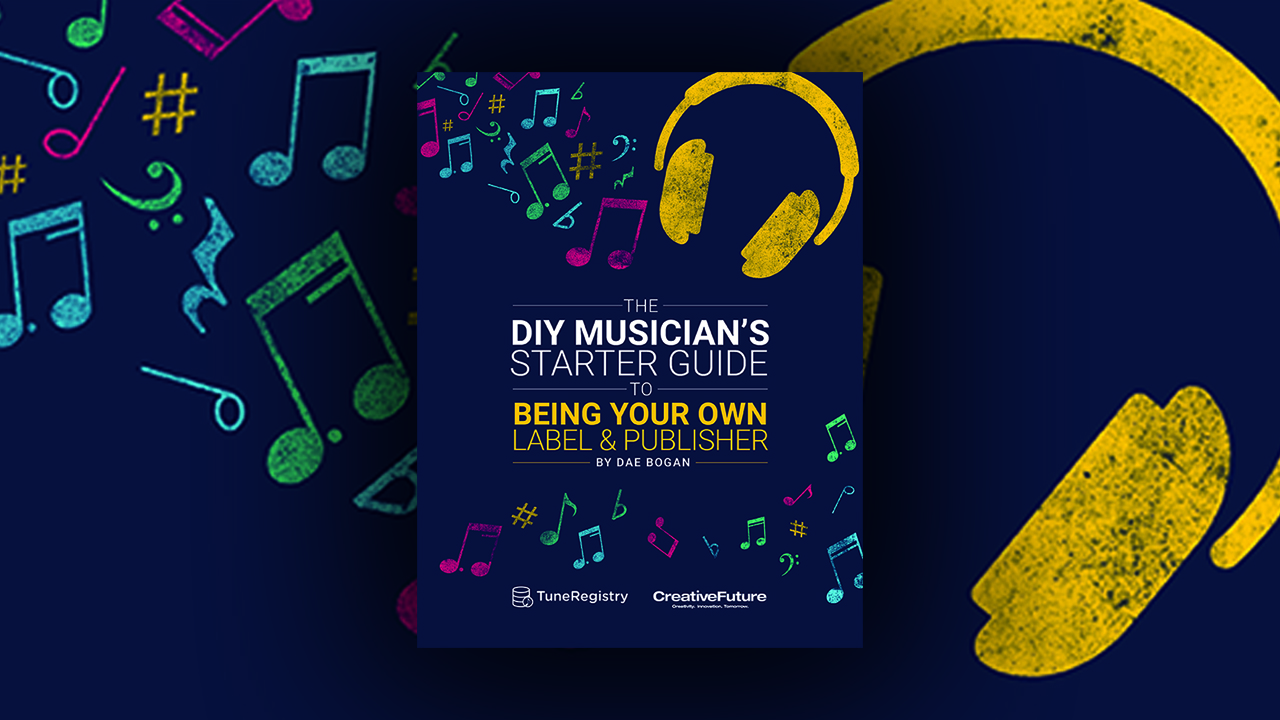
Want to learn more? Download my FREE ebook “The DIY Musician’s Starter Guide To Being Your Own Label And Publisher.”

2021 Prediction: The United States Music Publishing Market Continues To Grow And Fragment, Creating More Silos For Unpaid “Black Box” Royalties — DIY Musicians Hit The Hardest
As the U.S. music publishing industry grows (in terms of revenue, volume of copyrights, and number of income participants), the rights administration and licensing sector becomes ever-more fragmented; giving way to cracks in its foundation through which royalties fall into the so-called “black box” — the industry name for the unmatched and unpaid royalties earned against unidentified works or unidentified or unreachable income participants that accrue in escrow only to be later forfeited and disbursed to entities to which the funds do not belong; primarily major music conglomerates and those acquiring catalogs of copyrights to expand their market share position.
Black Box Royalties Myths, Common Misconceptions Debunked at Music Biz 2018
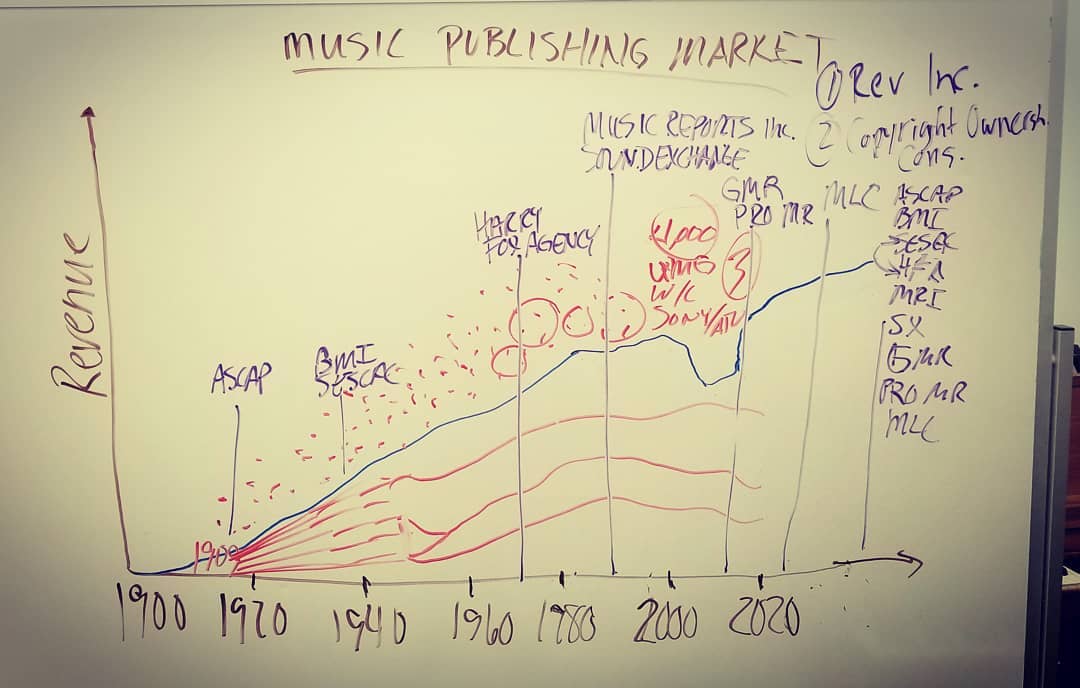
A picture of a white board illustrating the growth and fragmentation of the US Music Publishing Market, specifically the music licensing and royalty ecosystem, drawn during Dae Bogan’s lecture in his class, “Music Industry Entrepreneurship and Innovation” at the UCLA Herb Alpert School of Music, Winter Quarter 2019
In 1909, when the first federal copyright law that protected music creators and rights-holders was enacted, there were no massive music rights organizations as we’ve come to know them today. Although unions had existed — the American Federation of Musicians was founded 13 years earlier in 1896, but focused more on work conditions than collective bargaining, as it does today — ASCAP was formed in 1914 to license the performing rights of composers, authors, and publishers.
Fast forward to 2021 when the newly formed Mechanical Licensing Collective will issue its first blanket digital streaming mechanical license to the likes of Spotify, Google, and Apple. There will be over a dozen music rights and royalty collection organizations issuing thousands of licenses, administering millions of pieces of copyrights, and processing billions of micro-penny transactions.
The music licensing and royalty ecosystem in 1909: Individual music composers, aristocrats who financed or commissioned works, and sheet music publishers.
The music licensing and royalty ecosystem in 2021: Traditional non-profit and private music rights organizations (ASCAP, BMI, SESAC, Global Music Rights, PRO Music Rights, SoundExchange, Mechanical Licensing Collective), royalty funds (AFM & SAG-AFTRA Intellectual Property Rights Distribution Fund, Alliance for Artists and Record Companies, Film Musician’s Secondary Market Fund, Sound Recording Special Payments Fund), unions engaged in collective bargaining (SAG-AFTRA, American Federation of Musicians), licensing clearing houses and agents (e.g. Music Reports, Harry Fox Agency).
If I wrote a popular commercial song that is exploited to the fullest extent — released on a commercial recording; performed live in concert; licensed for use in film or television; placed in a commercial; earns viral success on user generated content platforms and social music apps; covered many times; embodied in a music video; lyrics printed and sold on merchandise; used for a live broadcast sporting event; added to Spotify and Apple playlists where it takes off; picked up on terrestrial, Internet, satellite, and cable radio; etc. — I would need to ensure that my work is registered at all of the places where the royalties earned from the uses I’ve described are paid; the music licensing and royalty ecosystem. If I do not, then my royalties will leak into the black box.
The black box is estimated at over $2 billion — and growing — of which much of it is due to independent music creators, small music rights-holders, and the estates of deceased authors and performers who do not have the access, power, know-how or market share to navigate the web of black boxes; for which there are many.
When entities charged with maintaining these black boxes distribute the funds in market share distributions, the major labels and publishers win and the independent and DIY creators lose. It is unfair and unethical. But what are we going to do about it?
Some artists, knowing that they do not know exactly how this all works, have found creative business ways to “make up” for potential lost royalties. But for the rest — the majority — of DIY musicians, they’re generally left out of the discussion and left to fend for themselves, even when they think they’re doing everything right.
As the industry charges forward with new energy fueled by the growth of music streaming, we have to consider how the continued fragmentation of the music licensing ecosystem affects the most vulnerable — DIY musicians. Major labels have direct deals with DSPs and digital services that pay them advances and account to and pay them royalties. DIY musicians rely on music rights organizations, who are often disproportionately influenced by the majors, to handle these things for them.
I founded TuneRegistry to help DIY musicians be their own advocate, to demystify the music licensing and royalty ecosystem by aggregating the fragmented world of rights administration into one economical platform. To this end, our team has helped hundreds of small to medium-sized music rights-holders and DIY musicians unlock thousands of dollars in new found royalties and to register their works to ensure that they are identified and accounted to in the future. Not all music rights organization have joined our network, but we will continue to advocate and fight for the rights and entitlements of DIY music creators as long as we can.
Enrollment Open – Music Industry Entrepreneurship Masterclass
Marcato Academy’s “Music Industry Entrepreneurship Masterclass” is now accepting enrollment for April 27th, 28th, and 30th. A recorded replay will be sent to individuals who cannot attend the live masterclass.
Learn More
Dae Bogan’s ‘Music Industry Entrepreneurship’ Class To Return To UCLA Summer 2019

UCLA Summer Sessions has confirmed that my Billboard-recognized course, “Music Industry Entrepreneurship,” will be offered this Summer during Session A.
UCLA, UC, and non-UC students (including individuals who are not enrolled in college anywhere) are welcome. Enrollment is now open at summer.ucla.edu.
The class will meet on Thursdays (June 27 – August 1) from 6pm to 9:50pm at UCLA Herb Alpert School of Music with the exception of Thursday, July 4th (there will be a total of 5 class meetings).
Course Description:
From digital-first record labels and music messaging apps to AR/VR (augmented reality / virtual reality) music experiences and blockchain-based music startups, entrepreneurs have been disrupting and innovating across the music industry since the launch of Napster in the early 2000’s. In this course, you will learn and apply principles of entrepreneurship and fundamental business strategies to the music industry. We will analyze case studies and current events and participate in critical discussions around music industry entrepreneurship. Course work will consist of developing business plans, workgroup labs, and building out infrastructure for start-ups that focus on technology and innovation in the music industry; all culminating in the pitch of a fictitious music industry company at the end of the quarter. You will also take away cautionary tales and lessons for success from founder stories presented by guest speakers of music industry start-ups and executives from established music industry companies.
Student Testimonial:
Without a doubt one of the most useful classes I have taken in my undergraduate career at UCLA. Professor Bogan has so much real world knowledge and knows how to convey that knowledge in a classroom setting immensely well. All the course material was invaluable to my progression and aspirations of being in the music industry. Every lecture was extremely well-prepared, with amazing guest speakers and information that I will be using for the rest of my life. Professor Bogan did a phenomenal job and I will be recommending this class to all my friends interested in music or starting their own company. Can’t say enough good things about this class. – Anonymous, Student Course Evaluation
[Podcast] Dae Bogan Appears On Music Tectonics To Talk About Los Angeles’ Music Tech Scene
I was recently invited by host Dmitri Vietze to appear on his new podcast Music Tectonics for the episode “The Shifting LA Music Tech Scene.” It was a fun discussion about the various ecosystems and hubs of innovation, creation and thought-leadership that is taking place in Los Angeles right now.
The Music Tectonics podcast goes beneath the surface of the music industry to explore how technology is changing the way business gets done. The podcast includes news roundups, interviews, and more.
Listen to the episode here or on Spotify, Stitcher, or Google.
WHY FAKE BEYONCÉ MUSIC ON SPOTIFY AND APPLE MUSIC HIGHLIGHTS STREAMING’S WIDER LICENSING TROUBLES

I shared my thoughts on the Beyonce fake album controversy in this piece by Amy X. Wang for Music Business Worldwide.
The various checks that are supposed to be in place are not working or being followed,” says Dae Bogan, a music licensing expert who founded TuneRegistry, a management platform that deals with song metadata.
It’s concerning not only that fake albums are passing, but that they’re presumably affecting the overall value of other streams that day. Because there’s no per-stream rate in royalties — royalties are based on cumulative performance of total music releases — people could assume Beyoncé has released a new project, flock to her account and dramatically affect the royalties for other people’s streams.
Read the full story here: https://www.musicbusinessworldwide.com/why-fake-beyonce-music-on-spotify-and-apple-music-highlights-streamings-wider-licensing-troubles/
House of Blues Music Forward Foundation’s Bringing Down the House Seeks Young Emerging Artists

Another Online Music Industry Entrepreneurship Course?

I’ve been considering developing a series of online courses around entrepreneurship and innovation within the music industry, including and expanding on what I’ve taught in music industry and marketing undergraduate programs at UCLA Herb Alpert School of Music and Emerson College, in the music business graduate program at California State University, Northridge, in the business module of the advanced audio engineering program at SAE Institute Los Angeles, and in my workshops at USC Marshall School of Business, Los Angeles Recording School and College of the Canyons, but I’m starting to reconsider this.
I’ve seen dozens of online courses developed by so-called marketing, business, and entrepreneurship experts that promise to take your business from stagnant to 7 figures in just a few weeks. Often times these experts only verifiable accomplishments tend to be their ability to get others to sign-up for their online courses. Or, at best, they’ve had one lucky break and somehow parlayed that into a facade of serial success, from which real strategy and knowledge can be shared.
We’ve all heard the saying that “those who can’t do teach.” I do not agree with this ugly notion as a generalization, but I do believe that it is actually quite easy to take bits and pieces of advice, common sense, and lessons from others’ case studies and weave these concepts into curriculum padded with superficial “proven strategies” and outdated yet widely adopted business modeling techniques, which the instructor has never put into practice himself, and charge naive entrepreneurs hundreds of dollars to access this material as a life-changing course.
And we wonder why there is such a high rate of failure amongst students who’ve completed these courses.
I enjoy teaching. And I am honored to have been acknowledged in Billboard “15 Top Music Business Schools of 2017” and have been reviewed highly among the students in the programs in which I currently teach.
But even more thrilling, I enjoy doing.
I enjoy transforming business ideas into investible businesses within the music industry; especially when those ideas create real value for its target customers — music creators, music industry professionals, and music fans. And I enjoy helping entrepreneurs do this for themselves.
I don’t know if it makes sense for me to create a standalone online course.
I believe entrepreneurs who seek help seek mentorship and an open channel of communication. I provide this in the classroom where the ability to ask a question can unlock meaningful insight for an entrepreneur struggling with a decision or a challenge. Nuance matters. Nuance is what makes the difference between reading a lecture and experiencing a lecture. I also provide this through consulting and mentorship.
Over the last 7 years, I’ve had the pleasure of being a consultant, advisor, or mentor to nearly 50 founders of music, tech and digital media start-ups, including current clients Baserock (achieved over 300% Kickstarter launch goal), Weeshing (has earned over $10M in revenue), RoadNation (has helped indie artists raise tens of thousands of dollars to fund touring) and mydiveo (acquired for over $7.4M after my consultation to develop a go-to-market strategy and intellectual property compliance strategy).
I’ve provided mentorship and coaching through programs such as SXSW Music, Capitol360 gBeta MusicTech Accelerator, recommendations for founders to attend Project Music Nashville and Techstars Music Los Angeles, and will be continuing this work in 2019 at The Rattle Los Angeles and 2112 Chicago.
Over the last 2 years, I’ve contributed to the acquisition of or investment in 5 music tech startups including 3 companies that I founded.
I don’t know if any of this work could have been achieved by uploading 10 course videos and some downloadable worksheets. If so, I highly doubt the success rate would be very high. I do believe there is some perfect balance and that is what I am setting out to achieve in 2019.
In the meantime, if you’re an entrepreneur struggling to get your music industry businesss idea off the ground, reach out to me for a free consultation to see how me and my team can help.
http://www.rightsdepartment.com


Dae Bogan To Provide Mentorship To Music Makers And Tech Founders At The Rattle Los Angeles
RattleCCPitch2018 from The Rattle on Vimeo.
Apple To Recruit College Students For Apple Music From UCLA Herb Alpert School of Music

I am pleased to announce that Apple has selected my Billboard-recognized class, Music Industry Entrepreneurship and Innovation, at UCLA Herb Alpert School of Music as a preferred source to recruit aspiring music industry professionals into its college internship programs at Apple Music.
Upon successful completion of an internship and graduation from UCLA, recent grads may become eligible for full-time employment at Apple music divisions.
An Apple Worldwide Recruiting representative will visit my class in January 2019 to promote their internship program to my students and answer any questions that students might have.
I am pleased with Apple’s decision to partner with universities and educators that deliver best-in-class education and experiences to students who may become tomorrow’s music industry leaders.
In reviewing my class students have shown great appreciation for the course and the speaker series that I curate throughout the quarter:
Hi Dae, Just wanted to thank you for an awesome class. This was one of the few classes at UCLA where I felt I was taught skills, not just about the subject matter but in how to go about achieving my career goals, that were applicable to my endeavors and will be used for the rest of my life. I got more out of it than I had with any other course here and I would highly recommend your class to to anyone interested in a music industry career.
– Student testimonial, Winter Quarter 2018
Without a doubt one of the most useful classes I have taken in my undergraduate career at UCLA. Professor Bogan has so much real world knowledge and knows how to convey that knowledge in a classroom setting immensely well. All the course material was invaluable to my progression and aspirations of being in the music industry. Every lecture was extremely well-prepared, with amazing guest speakers and information that I will be using for the rest of my life. Professor Bogan did a phenomenal job and I will be recommending this class to all my friends interested in music or starting their own company. Can’t say enough good things about this class.
– Student testimonal, Winter Quarter 2018
In addition to the relationship with Apple, I am excited to announce that I’ve established a relationship with music tech start-up accelerator Techstars Music that allows me to recommend student and alumni owned start-ups for consideration to receive seed investment and to participate in its accelerator program.
I look forward to continuing to add value to my course to offer students one of the best experiences in their academic careers at UCLA.
Free DIY eBook
CONNECT WITH ME


