
Dae Bogan To Provide Mentorship To Music Makers And Tech Founders At The Rattle Los Angeles
RattleCCPitch2018 from The Rattle on Vimeo.
Apple To Recruit College Students For Apple Music From UCLA Herb Alpert School of Music

I am pleased to announce that Apple has selected my Billboard-recognized class, Music Industry Entrepreneurship and Innovation, at UCLA Herb Alpert School of Music as a preferred source to recruit aspiring music industry professionals into its college internship programs at Apple Music.
Upon successful completion of an internship and graduation from UCLA, recent grads may become eligible for full-time employment at Apple music divisions.
An Apple Worldwide Recruiting representative will visit my class in January 2019 to promote their internship program to my students and answer any questions that students might have.
I am pleased with Apple’s decision to partner with universities and educators that deliver best-in-class education and experiences to students who may become tomorrow’s music industry leaders.
In reviewing my class students have shown great appreciation for the course and the speaker series that I curate throughout the quarter:
Hi Dae, Just wanted to thank you for an awesome class. This was one of the few classes at UCLA where I felt I was taught skills, not just about the subject matter but in how to go about achieving my career goals, that were applicable to my endeavors and will be used for the rest of my life. I got more out of it than I had with any other course here and I would highly recommend your class to to anyone interested in a music industry career.
– Student testimonial, Winter Quarter 2018
Without a doubt one of the most useful classes I have taken in my undergraduate career at UCLA. Professor Bogan has so much real world knowledge and knows how to convey that knowledge in a classroom setting immensely well. All the course material was invaluable to my progression and aspirations of being in the music industry. Every lecture was extremely well-prepared, with amazing guest speakers and information that I will be using for the rest of my life. Professor Bogan did a phenomenal job and I will be recommending this class to all my friends interested in music or starting their own company. Can’t say enough good things about this class.
– Student testimonal, Winter Quarter 2018
In addition to the relationship with Apple, I am excited to announce that I’ve established a relationship with music tech start-up accelerator Techstars Music that allows me to recommend student and alumni owned start-ups for consideration to receive seed investment and to participate in its accelerator program.
I look forward to continuing to add value to my course to offer students one of the best experiences in their academic careers at UCLA.
Music Licensing Collective: Call for Nominations

A Curated List Of My Thoughts On The Music Modernization Act (And Related Topics)
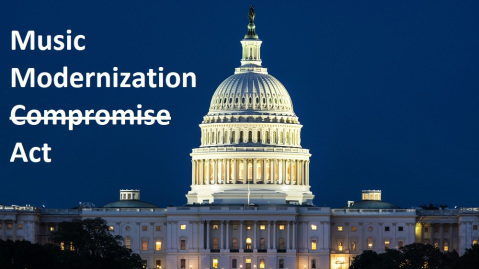
I am a very vocal music creators’ rights advocate and copyright purist. Often, I have the opportunity to share my *opinions* on topics within and circling the music industry that impact the ways in which music creators — especially DIY musicians — navigate and thrive in the United States.
Over the last ten months I have been especially vocal about the Music Modernization Act. I’ve been quoted in Billboard, Rolling Stone, Pitchfork and Digital Media News. I’ve been invited to panel discussions at music industry conferences and keynotes at universities. And I have written several think pieces (and rants) on the bill, which is now law, and related issues.
Still, I am asked what my thoughts are on the MMA.
I’ll summarize my thoughts by saying that I believe the intent of the MMA is good and admirable on its surface — that is, to improve the way rightsholders are accounted to and paid for the use of their music. I believe there is some good stuff in the MMA; particularly, the entirety of Title 2 (The CLASSICS Act) and Title 3 (The AMP Act). However, I feel that there is still work to be done. I also feel that some compromises, at the expense of DIY music creators, were made too easily (this is partially based on private discussions that I’ve had with individuals with privileged knowledge of the negotiations and dealings that took place during the drafting and subsequent amending of the MMA). That being said, I also believe that the soon to be formed Mechanical Licensing Collective has the opportunity to prove to songwriters that this law was truly about them.
Only time will tell.
Here’s a 2018 curated list of my “thoughts” on the Music Modernization Act (and related topics):
- (Oct 16, 2018) Here Are 10 Ways That The Music Licensing Collective (MLC) Can Set The Bar As A Collective Licensing Organization In The 21st Century – https://bit.ly/2RW9kW2
- (Sep 14th, 2018 in Pitchfork) Why So Many Hip-Hop Producers Are Putting Business Before Beats – https://bit.ly/2PEsi1x
- (Aug 19th, 2018) Another Music Modernization Act Opinion Piece – https://bit.ly/2NLp9LC
- (Aug 15th, 2018 in Rolling Stone) Why More Pop Songwriters Are Stepping Into the Spotlight – https://bit.ly/2ClAuAc
- (Jul 24th, 2018) Songwriters Are Owed Nearly $2B In Unclaimed Royalties!!! — Maybe More — I’ve Been Saying This For Some Time Now (Against Pushback), But Finally The Press Has Confirmed It – https://bit.ly/2CMR6Sp
- (May 15th, 2018 in Billboard) Black Box Royalties Myths, Common Misconceptions Debunked at Music Biz 2018 – https://bit.ly/2q4dhLD
- (May 7th, 2018 in Digital Music News) Is the Music Modernization Act Enabling ‘Legal Theft’ Against Smaller Artists? – https://bit.ly/2IugrCS
- (Apr 25th, 2018) 5 Ways The Music Modernization Act Could Be Fairer To ALL Music Creators – https://bit.ly/2Jzn1tb
- (Apr 20th, 2018) I Was Interviewed By The Congressional Budget Office Regarding The Music Modernization Act, And Now I’m Even More Concerned For DIY Musicians – https://bit.ly/2AdwpN0
- (Jan 17th, 2018) – My Thoughts On The MMA In Light Of The CRB Mechanical License Rate Decision – https://bit.ly/2P6bT98
Where do you stand on the MMA?
Here Are 10 Ways That The Mechanical Licensing Collective (The MLC) Can Set The Bar As A Collective Management Organization In The 21st Century

Title 1 of the MMA, also called Music Modernization Act, sets out provisions and guidance for the formation of a collective mechanical licensing body to be called the Mechanical Licensing Collective (The MLC). The MLC will administer a safe harbor blanket license for the streaming of musical works, collect licensee fees from licensees, prepare and remit statements of earnings to songwriters and music publishers, and make royalty payments to the same.
The MLC will join the ranks of SoundExchange, ASCAP, BMI, and SESAC in the sense that it will become a powerful representative of the collective rights of thousands of music creators and rights-holders in the United States. However, unlike its counterparts, The MLC will be born in the 21st century. And as a 21st century collective licensing organization, The MLC has the unique opportunity to implement, at inception, 21st century business practices utilizing 21st century best practices and technologies.
Another Music Modernization Act Opinion Piece

Some music industry executives believe that my position on many issues affecting music creators is too bullish. They dismiss my analyses as sensationalism. They believe, or are at least silent on the notion, that demanding the fair and equitable treatment of middle-class songwriters and recording artists should come with exceptions that disproportionately benefit corporations: major publishers and digital service providers.
But I am a copyright purist.
I believe that the authors of copyrighted musical works — songwriters — should have more say in the way in which their creations are valued and monetized in the marketplace. I do not believe in trickle-down economics or its promise that what’s best for the few at the top will benefit the majority at the bottom.
Greed disproves this all of the time.
Greed is asking songwriters to forgo the potential financial upside of bringing forward legitimate claims of past copyright infringement while simultaneously telling the songwriter community that monies that may become due to them could be redirected, by market share, to the few at the top who negotiated the preemptive dismissal of claims in the first place. Greed is telling artists to campaign for a piece of legislation that will reduce the number of entrants into the on-demand streaming market while simultaneously controlling/dominating the editorial opportunities of the DSP incumbents, greatly reducing opportunities that would otherwise be made available to emerging artists by startups that wish to partner with and elevate emerging artists.
I do believe that the Music Modernization Act will pass. I just hope that the decision-makers give some real thought to the millions of up-and-coming music creators who are not represented by the individuals who wrote the legislation that’ll change the way their copyrights will be exploited in the U.S.
Is the Music Modernization Act Enabling ‘Legal Theft’ Against Smaller Artists?

Read the article here:
https://www.digitalmusicnews.com/2018/05/07/music-modernization-act-mma-legal-theft/Songwriters Are Owed Nearly $2B In Unclaimed Royalties!!! — Maybe More — I’ve Been Saying This For Some Time Now (Against Pushback), But Finally The Press Has Confirmed It

Over the last few years, I’ve been researching and sounding the alarm on the growing problem of unclaimed music royalties or so-called “black box” royalties.
I’ve estimated the value of the collective black box to be nearly or above $2B. I’ve presented research, have written extensively and have spoken publicly about this problem, which disproportionately affect independent and legacy songwriters.
Despite my fanfare, industry insiders and stakeholders have shrugged or have blatantly called my estimates a gross overstatement and have held that unclaimed royalties are at best a few hundreds of thousands of dollars and mostly owed to “long-tail artists” who do not quite understand how the music industry works. This is a very myopic, company-focused view. These talking heads tend to speak from their position of administering one right for some music licensees. My estimates are looking at multiple rights administered by multiple entities, which would make the collective black box exponentially greater than the escrow account of a single entity.
Also Read: State of Unclaimed U.S. Music Royalties and Licenses
Yesterday, Variety published an article on the Music Modernization Act where a very important fact was tucked away on a single sentence in a paragraph near the end of the piece:
The DSPs are holding some $1.5 billion in unmatched mechanical royalties. If the MMA passes, that money would be passed through to the MLC which would match it to the songwriters and publishers. [bold and underline added for emphasis]
via Variety
$1.5B of royalties (I still believe this number is higher) is sitting in, probably, interest-bearing escrow accounts while songwriters and small-to-medium sized music rights holders struggle to understand how and why.
Last year I founded RoyaltyClaim, the world’s first search engine of unclaimed music royalties and licenses, which has recently been acquired by Made In Memphis Entertainment. We’ve helped DIY musicians and rights-holders identify thousands of unclaimed entitlements in just a few months, with one paricular music producer uncovering nearly $150k in unclaimed royalties due to him.
The problem is huge. The system is not transparent. And the people in charge could do a better job communicating these things to rights-holders.
Also Read: I’m Working On A Side Project Addressing ‘Black Box’ Royalties
I’ve been on many panels at music industry conferences where I’ve maintained my position that DIY musicians and small-to-medium sized rights-holders are owed hundreds of millions of dollars, if not several billion, and often my co-panelists have taken a position that my claims are sensational and overstated.
I disagree.
When those on the panel talk about black box we are talking about the aggregate of unclaimed royalties that occur because of any number of factors,’ and not just limited to one service or one collection society, explained moderator Dae Bogan, CEO of TuneRegistry.”
via Billboard
Source: https://www.billboard.com/articles/business/8456271/black-box-royalties-myths-panel-music-biz-2018
Read the Variety article here.
Check out my commentary on black box royalties here.
Introducing, The American Society for Collective Rights Licensing (ASCRL) — The Organization That Wants To Help Visual Artists Collect Their Unclaimed ‘Black Box” Royalties
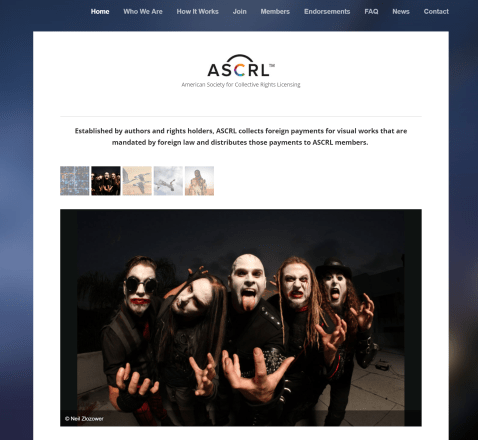
ASCRL homepage. Featured photo © Neil Zlozower
As many of you know, I’ve researched and have written extensively about unclaimed music royalties held in escrow or so-called “black boxes,” which are monies owed to music creators and rights-holders (and founded RoyaltyClaim to address this issue). Today, I want to draw your attention to a similar matter in the world of visual art (e.g. photography, illustration, stills, text design).
 This morning I had the pleasure of speaking with Eugene Mopsik, the CEO of the American Society of Collective Rights Licensing (ASCRL). A successful corporate /industrial photographer with over 32 years of experience, Eugene was previously the Executive Director of the American Society of Media Photographers (ASMP).
Eugene and I talked about issues related to the representation and rights of visual artists and the monetization of their works outside of the United States. He and his co-founders of ASCRL are working to help visual artists claim their fair share of royalties that have long gone to the publishers of visual works.
Similar to musical works (aka compositions or songs) that earn mechanical royalties when the work is reproduced, visual works, in many cases, earn reprographic royalties. Whereas mechanical royalties outside of the U.S. are collected by mechanical rights organizations (MROs) in territories under the MRO’s jurisdiction, reprographic royalties are collected by reprographic rights organizations (RROs) in territories under the RRO’s jurisdication. And, much like the complex web of legal and regulatory issues that makes it challenging for songwriters to collect their ex-U.S. mechanical royalties, similar limitations make it challenging for visual artists to collect their ex-U.S. reprographic royalties.
Antitrust laws has made it difficult to form a collective licensing body. Consequently, the U.S. does not have a local RRO to enter into reciprocal agreements with foreign RROs for the purpose of passing through ex-U.S. reprographic royalties to be paid to U.S. visual artists. Once again, this is similar to the absence of a U.S. MRO for songwriters. Notably, however, the U.S. has made an exception for the collective licensing of performance rights in musical works.
Since 1914, songwriters and composers have been able to join a performance rights organization (PRO) for the collective licensing of performance rights and payment of performance royalties. In the United States, the American Society of Composers, Authors and Publishers (ASCAP), Broadcast Music Inc. (BMI), SESAC, and Global Music Rights (GMR) are PROs that represent the performance rights of songwriters and publishers.
Currently, when reprographic royalties are earned outside of the United States, they are collected by RROs. RROs then distributes royalties to the publishers of visual works and authors of visual works (visual artists) who’ve joined the RRO. The RRO passes reprographic royalties for works due to members of foreign RROs to the RRO in the respective territory. In cases where the publishers or authors of works are unknown or if the author is an unrepresented U.S. visual artist, royalties are held in escrow and eventually distributed by market share to publishers. In the latter, royalties that are fairly owed to U.S. visual artists are being distributed to publishers. This is what the American Society of Collective Rights Licensing aims to address.
Joining ASCRL is free. Members can submit their works and use the ASCRL claiming portal to claim their entitlements and unlock unclaimed royalties. To learn more about ASCRL or to begin the process of joining, visit http://www.ascrl.org.
Spotify Is Launching A New Streamlined Playlist Submission Tool

An email from ADA announcing Spotify’s new playlist submission tool has gone viral on social media, passed between music industry insiders.
Here’s the full version of the email:
Starting tomorrow July 19th, Spotify is rolling out a beta feature designed to help your teams share unreleased music for playlist consideration. As part of this beta period, both the existing processes and this new, streamlined process will co-exist.
Our beta feature will give you a streamlined way to share unreleased music with our global editorial team. This feature will be available to you in Spotify Analytics and for artists in Spotify for Artists. If you don’t have access to Spotify Analytics, you can reach out to your central team to get access.
“Beta” means this is the first step in making our playlist process better for our partners and for artists. This is a big focus for us, and we’re going to continue to work to make the process better. We definitely encourage you to try out this feature and share any feedback you have with me, so we can continue to improve the product.
Click here to download a pdf overview Spotify has provided. https://adamusic.app.box.com/s/a6bg9iz4u100j9we14ua4014px3m9bc1
Current open questions communicated to Spotify:
– Visibility into which editors have listened to the track
– Ability for editors to insert feedback
– Functionality to get unfinished music to editors
– Functionality to pitch released music – Label filterHere are guidelines/FAQs we have complied to assist you with this new process:
– How is music pitched?
Music can be pitched from within Spotify Analytics or Spotify for Artists. The track has to be delivered via our standard feed, with an upcoming release date. All pitch-able content is contained in a new ‘upcoming’ tab in the Catalog view within Spotify Analytics.– Who can pitch music?
Anyone with Spotify Analytics and/or Spotify for Artists access can pitch music.– What happens if the wrong track is pitched, or if we decide to change the focus track?
Pitches can be overwritten. Spotify will consider the most recent pitch. Submissions show the name of the person who submitted a track, and when the submission was made.– How long does it take from delivery to ingestion in Analytics?
Product should be visible in Analytics shortly after Spotify has received delivery from the ADA feed.– I have music that’s not finished but want to share with Spotify. Can this be done?
At the moment, this tool is designed only for music that has been delivered via the feed. Spotify has suggested that we submit music for ingestion via the feed as early as possible. However, music/release planning meetings for long-lead projects should continue to be utilized as a forum to play music for editors in advance.– What about music that has already been released?
We cannot pitch music through this tool that is already released. Continue to use forms in the short term (although these will be phased out eventually) and communicate priorities directly with the Artist & Label Marketing Team, as well as editors, when relevant.– What information needs to be provided for a submission?
The follow criteria has been outlined:
Genre
Music culture
Mood
Language
Recording Type
Instrumentation
Artist Origin
Song Description
Marketing Details– What editors will receive my music?
All submissions are global, meaning all relevant editors based on the criteria submitted will receive the pitch. We have been advised that updates and advance music links should be sent to Artist & Label Marketing team as well as appropriate editors when applicable, but the new process should also be followed.– If submissions are global, what if local markets want to pitch different tracks?
We will not be able to submit different tracks in different markets. The repertoire owner will be responsible for which track is pitched, but please follow up with local editors to reiterate these track priorities.– How much music can be pitched each week?
There is no cap on how much music you can pitch weekly. However, you can only pitch one track per product.– What if you decide to pitch a track from an album?
A pitched track from an album will be highlighted as a priority to editorial, as well as for Release Radar. However, the full album will be available to editorial for programming.– Release Radar Impact
Pitched tracks will be prioritized within the algorithm for Release Radar playlists. Tracks must be submitted 5 business days prior to release for Release Radar consideration.– What will happen to the Google Forms we’ve been using?
The current Google forms will continue to run for a period as we transition to the new system. Phase-out has been tentatively scheduled for October 1, 2018.
I wonder how this will affect the numerous Spotify playlist submission services out there.
Free DIY eBook
CONNECT WITH ME


 Dae Bogan Music