
The MLC presents RegFest

The MLC Presents: RegFest
Songwriters, artists, producers, and rightsholders — don’t miss this free online webinar to maximize your streaming royalties and protect your rights! Join award-winning songwriter and artist Cassandra Kubinski and The MLC’s Dae Bogan as they cover how to register your works and claim all your income streams.
🗓️ Monday, November 10th
⏰ 12pm PT • 2pm CT • 3pm ET
Register at https://themlc.zoom.us/webinar/register/WN_5WmDEPi0ThaFRZQFiDLC3A
On AI in the Music Industry
I have been writing and talking about the use of AI in the music industry since I developed and taught the course “Music Tech Innovation: Launching New Ventures” at UCLA Herb Alpert School of Music in 2016 when I was an Innovation Fellow at the UCLA Center for Music Innovation.
At the time, there were dozens of startups in accelerators and incubators across the US and around the world building AI tools and ML projects to address various aspects of music creation and data analytics.
I had been running my consultancy agency, Rights Department, where I helped founders navigate the intellectual property implications of their startups as well as develop go-to-market strategies. I was also a mentor to startups through a few accelerator programs and an advisor to a roster of music tech and digital media startups through my ENT Ventures, LLC advisory brand. Later, I would feature some of these companies, including those involved in cryptocurrency, augmented reality, NFTs, and blockchain in my lecture that I gave at universities and the Music Biz Conference titled “Music 2020: The Next Era of Innovation in the Music Industry” (https://daeboganmusic.com/2018/10/12/music-2020-the-next-era-of-innovation-in-the-music-industry/)
In early 2019, I wrote a note titled “Are Founders Of AI Music Services Being Disingenuous When They Tell Human Music Creators Not To Worry Or Are They Just Clueless?” where I asked:
“Recently, we’ve seen AVIA become the first AI to be recognized as a composer represented by the French performing rights society SACEM (I have bigger concern over the implication of recognizing AI as a composer and what that could mean to the legal definition of an author under copyright law) and Endel recently became the first AI to land a major label record deal with Warner Music Group.
If AVIA is a composer and Endel is a recording artist, and they can produce massive volumes of content (WMG is releasing 20 albums by Endel this year alone), what does this mean for the quality and pace of human-created music?” (https://daeboganmusic.com/2019/03/22/are-founders-of-ai-music-services-being-disingenuous-when-they-tell-human-music-creators-not-to-worry-or-are-they-just-clueless/)
This past week, ASCAP, BMI, and SOCAN — the largest public performance organizations in North America that represent millions of music creators — put out a joint statement announcing the acceptance of registrations of partially AI-generated songs and thus clarifying that partially AI-generated songs are eligible to receive public performance royalty payments. (https://www.musicbusinessworldwide.com/ascap-bmi-and-socan-will-now-accept-registrations-of-partially-ai-generated-musical-works/)
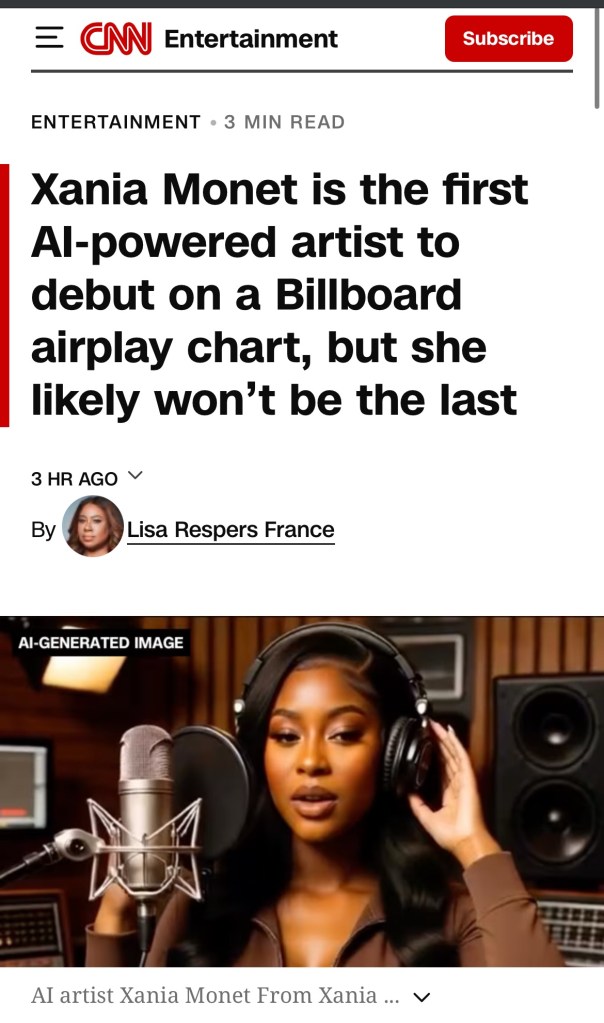
So, the news that AI singer Xania Monet being charted for radio airplay on Billboard means that the songwriter will be able to receive public performance royalties for those plays, in addition to the royalties for the streams on digital music services. (https://www.cnn.com/2025/11/01/entertainment/xania-monet-billboard-ai)
So, that brings me back to the question I asked in 2018: “Are Founders Of AI Music Services Being Disingenuous When They Tell Human Music Creators Not To Worry Or Are They Just Clueless?”
In September this year, I spoke on a panel about AI in the music industry at the Bogotá Music Market in Bogotá, Colombia. I argued that music creators and consumers will have to reconcile our tolerance for creativity and authenticity in the AI-music era and promoted the responsible use of AI as a tool, an innovation in the evolution of the arts no different, fundamentally, from innovations of decades past (enter the printing press, the electronic guitar and synthesizers). (https://www.instagram.com/p/DOgkjVUDT1A)
Some artists will leverage AI as a tool (there are many use cases other than generative AI vocals). Some will resist and possibly fall short. But what is clear to me is that the evolution, which begun as scrappy projects by founders and small teams in the 2010s is now being accelerated by multi-billion dollar investments, regulatory overhauls, and innovative creators who enjoy and do not fear new tools.
And what about consumers? How do consumers feel?
[Podcast] Host Harkos Interviews Dae Bogan on the ‘Music Makin Cents’ Podcast

I sat down with host Harkos of the “Music Makin Cents Podcast” to talk about different ways to make money from your music. Watch the episode here or below.
10 Years Ago Dubset (And I) Wanted Rights-holders To Be Friendlier To DJs…10 Years Later Apple Music Is Making It Possible

Ten years ago, I wrote a piece for Hypebot (posted at the end) announcing the Mix Transparency Report by Dubset (acquired by Pex).
At the time, Dubset, a new startup, wanted to help DJs legally release, distribute, and monetize mixed music (i.e. remixes, mashups, mixes, etc.), and get artists, songwriters, and rights-holders paid. However, there was a ton of resistance amongst rights-holders to what I thought was a great idea. I was biased since I had once managed a roster of DJs who specialized in mash-ups.
The Mix Transparency Report set out a new standard for charting the consumption of mixed music while shinning a light on the commercial opportunities that existed for rights-holders and content creators of derivative works (e.g. DJs, producers, remixers).
(Side Note: Last year, I created the “Beats & Money: A Music Rights & Royalties Crash Course for Beatmakers” webinar for The Mechanical Licensing Collective with support by Chris McMurtry of Pex/RME which you can watch on YouTube https://youtu.be/8ZoPRmJFt-Q.)
Dubset wanted to locate the most popular mixed music in the world, thoroughly analyze it, and share its findings every month. The report would offer full transparency with regards to the “who” and “what” was being listened to (often royalty-free) by millions of music fans a day. Initially, the Dubset report included four charts: Dubset’s 25 Most Sampled Labels, Dubset’s 25 Most Streamed Mixes, Dubset’s 25 Most Sampled Artists, and Dubset’s 25 Most Sampled Tracks.
Recently, Apple announced it is opening its catalog to let users build mix sets by integrating the platform with a number of tools. These tools include Algoriddim’s djay Pro software, hardware platforms AlphaTheta, Serato, inMusic’s Engine DJ, Denon DJ, Numark, and RANE DJ.
(Fun Fact: I was once an advisor to a startup that built a software and hardware for DJs that would be installed between the controller and the sound system. If the controller experienced an outage during a live set, the device would kick in and algorithmically continue the DJ set until the controller was back up and running and the DJ could do his or her thing. Having been both a club promoter and DJ manager in Los Angeles in my early 20’s, I knew it was solution was to a real problem that I’ve witnessed many times, but of course they were “too early.”)
TechCrunch believes the integrations will possibly attract DJs to explore Apple Music’s catalog of over 100 million songs and also give aspiring DJs an opportunity to play around with some of these tools. It’s great to see DSPs engage more meaningfully with DJs. This has been a long time coming, only slowed by rights-holders inability to work with companies like Dubset to figure out the licensing splits.
That Hypebot piece: https://daeboganmusic.com/2015/11/11/hypebot-dubset-releases-inaugural-mix-transparency-report-atlantic-records-david-guetta-most-sampled/
The Socioeconomics of Globalization vs. Glocalization and Why Indie Artists in the Global South Have It Harder
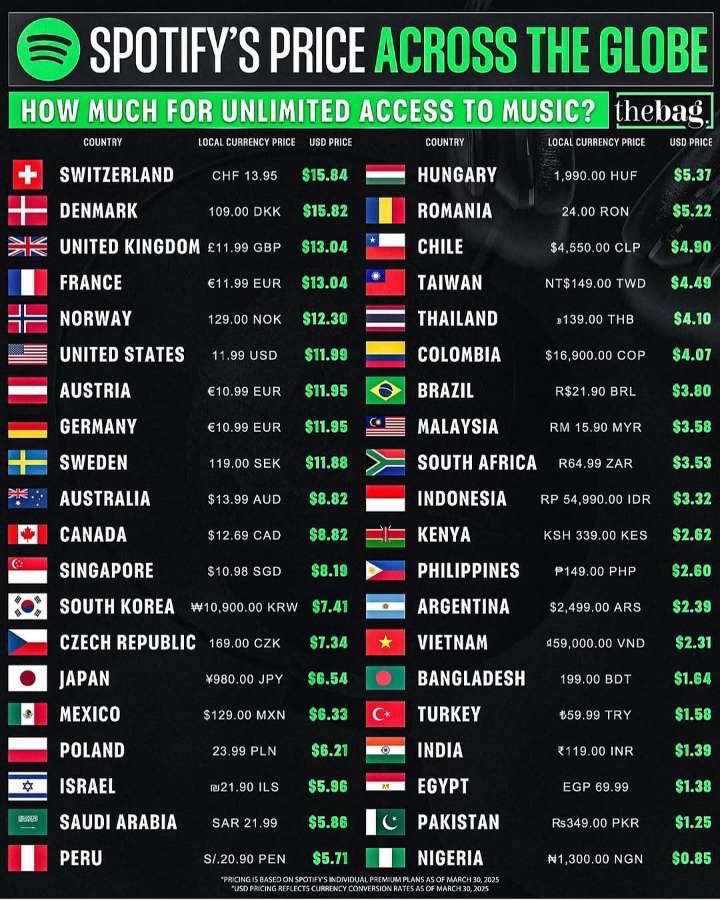
I have been having this very candid conversation about the digital music ecosystem and the socioeconomics (and sociocultural) factors at play in “globalization vs. glocalization” for years now.
Ever since I began exploring the “global south” in 2021, from South America to Southeast Asia to South Africa, and then subsequently moved to Latin America, I’ve observed challenges for local music creators and opportunities for Western music creators.
Artist earnings, in the digital space, are a factor of the socioeconomic health of the region in which artists receive most of their consumption. Two artists from two different countries with the same number of monthly listeners within their own country (glocalization) may not earn the same income due to the differences in the socioeconomic health of their respective countries.
The issue of socioeconomic health is exacerbated by poor copyright compliance and broken or insufficient licensing and royalty collection infrastructure.
Independent artists in lower socioeconomic markets could attempt to look for international collaborations with artists that can introduce them to listeners in more developed markets and they could leverage opportunities to exploit their music in ways that create discovery in new markets (e.g. synch, playlists, etc.). This will aid in exposing the music and eventually earning consumption in other foreign markets (globalization), possibly with better socioeconomic health (or at least higher royalty rates).
Additionally, indie artists should leverage communities like Vampr and BandLab Technologies and other such companies to connect and collaborate with artists, songwriters, and music producers to strive for cross-border appeal and opportunity.
Radar – Data-driven Grassroots Outreach In Latin America

I am thrilled to announce that after nearly 3 years of building relationships across Latin America, collaborating with local creator rights’ advocates, learning about some of the challenges affecting the flow of royalties in various regions, and educating songwriters, I am launching a dedicated team to support The Mechanical Licensing Collective’s mission to ensure songwriters, composers, lyricists, and music publishers in Latin America receive their mechanical royalties from streaming and download services in the U.S. accurately and on time.
RADAR is a data analytics and research platform that has already helped us identify songwriters who are self-published and potentially unaffiliated with their local CMO. Through culturally-relevant resources we are educating songwriters who may have royalties on hold at The MLC about their rights and their options for collecting their money such as joining their local CMO (an MLC member), hiring a publishing administrator (an MLC member), or, if it makes sense for their careers, to pursue direct membership. It is the songwriter’s choice within the framework of their local laws.
After a successful pilot in Colombia last year we are expanding across LATAM with team members in Argentina, Brazil, and Mexico.
Welcome Daniela Arévalo Fernández (Mexico), Maria Ramirez (Colombia), Matías Bagato (Argentina), Renato Martini Martins (Brazil), and continued support by Stephanie Santiago-Rolón (Florida/Puerto Rico, USA) who has been a great collaborator in US-based Latin music since 2021.
Latin America, which has seen Mexico and Brazil named to IFPI’s Top 10 music markets in the world in 2024, is a priority due to the explosion of consumption of Latin music in the US, primarily in the form of digital streaming. The RIAA reported that Latin recorded music earned $1.4B in 2024 (98% of is from streaming), a steady increase over the previous two years, which also boasted over $1B. More US music consumers are listening to Spanish-language music every year; and when they do, it is our mission, in accordance with the Music Modernization Act to identify and locate the copyright owners to whom these digital audio mechanical royalties are due.
The MLC already has an incredible array of solutions, initiatives and technologies enabling us to match and pay out 90% of royalties received, but engaging small, new, and emerging independent artists is a challenge that all collection societies face and ought to solve.
With RADAR, whether it is a salsa band in Cali, a raggaeton artist in Medellin, a funk rapper in São Paulo, a samba singer in Salvador, a Latin rock duo in Buenos Aires, or an urbano group in Guadalajara, The MLC aims to take all reasonable efforts, from engaging CMOs and publishers, to tapping disconnected networks of independent self-published songwriters and composers to pay out every US digital mechanical dollar!
Introducing RADAR “Putting the hardest to find songwriters on The MLC’s radar.”
Encuentro Especial de Compositores Latinoamericanos (Special Meeting of Latin American Songwriters)
[Podcast] SXSW 2025 – Scrubbing the System: Music Data Management Today
I enjoyed returning to SXSW earlier this month and the opportunity to join Jay Gilbert, Molly Neuman, and Rell Lafargue in discussing how companies are tackling and innovating on the challenge of music metadata.
Check out this podcast of our panel “Scrubbing the System: Music Data Management Today.”
[Podcast] SXSW 2025 – Crafting a Transparent Future for Music Rightsholders

Earlier this month, I had the pleasure of moderating the panel “Crafting a Transparent Future for Music Rightsholders” at SXSW. Joining me on stage were Chantal Epp (ClicknClear), Diego Maldonado (ONErpm), and Josh Simons (Vinyl Group). These companies are among the over 500 entities around the world that access The Mechanical Licensing Collective’s data through one or more of our data programs.
Click here to listen to the SXSW panel podcast to hear what we had to say about the future of transparency in music rights and data management on this podcast recording of our session.
View the PDF of the slides that were presented during the panel discussion. You can follow along with how the slides were presented by starting the podcast at audio mark 23:55.
Bonus: Below is a recording of a related webinar that I hosted last year during which each of these companies demonstrated how they leverage The MLC’s data in their businesses. Watch “Exploring The Use of The MLC’s Data: A Showcase of Three Companies”.
In accordance with the Music Modernization Act of 2018, The MLC develops and maintains a variety of data programs that are accessible to a diversity of companies around the world. The MLC’s database boasts over 30 Million musical works, with associated ownership information and matched sound recordings, and is enriched by our members and partners. As mandated by the MMA, The MLC makes the data available in bulk machine-readable formats and via an API.
Join The MLC’s Head of Third-Party Partnerships, Dae Bogan, in this 60-minute webinar showcasing real-world examples of The MLC’s data programs in use by differentiated technology companies around the world. Each of the selected showcase companies — ClickNClear (UK), Jaxsta (Australia), and ONErpm (Colombia) — will explain and demonstrate how it leverages The MLC’s data programs in the solutions that it offers to the music industry or in its backend operations.
Speakers:
· Jaxsta Showcase (Bulk Data Access Subscription) by Ben Orme, Jaxsta Product Lead / Business Development
· ClickNClear Showcase (Public Search API) by Chantal Epp, Founder & CEO
· ONErpm Showcase (DURP) by Diego Maldonado, Global Head of Publishing & Rights Management
DISCLAIMER: This video was uploaded to the MLC’s YouTube channel on 06/06/2024. Some content may no longer be accurate or up-to-date. For the latest information, please visit THEMLC.COM or reach out to our support team with any questions.
100+ INDIE DISTRIBUTORS IN 20 COUNTRIES HAVE NOW SIGNED UP FOR THE MLC’S DATA PORTAL FOR UNMATCHED ROYALTIES

Thank you Music Business Worldwide for covering the story of this important milestone in my work at The Mechanical Licensing Collective and the independent music industry.
Free DIY eBook
CONNECT WITH ME


